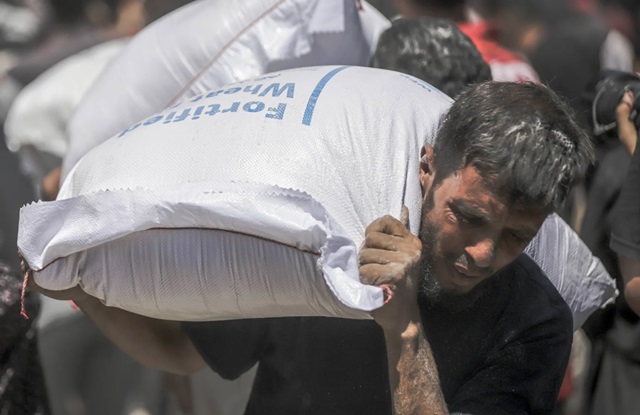
At least 410 Palestinians have been killed by Israeli forces while attempting to access food at Israeli-run humanitarian aid sites in Gaza over the past month, according to reporting by The Intercept. The United Nations Office of the High Commissioner for Human Rights has condemned the attacks, calling them “a likely war crime” and a flagrant violation of international law.
“Desperate, hungry people in Gaza continue to face the inhumane choice of either starving to death or risk being killed while trying to get food,” the U.N. stated.
Reports compiled by The Intercept and other outlets reveal a grim pattern: aid seekers being killed with bullets, tank shells, and drone-mounted weapons. Just this past Tuesday, Palestinian health authorities reported that 44 civilians were killed in separate incidents while waiting for food in southern and central Gaza.
In a rare admission, an internal investigation by Israeli newspaper Haaretz found that Israeli officers and soldiers had received explicit orders to fire on unarmed civilians gathering at these aid sites. The Israeli military prosecution has now called for a formal review to determine whether war crimes were committed.
When contacted by The Intercept, an Israeli military spokesperson acknowledged that the incidents were “under review” and that new field instructions had been issued in light of “lessons learned.”
Militarized Aid and Private Hands
These deadly aid sites are operated by the Gaza Humanitarian Foundation (GHF) — a controversial nonprofit created this year to distribute humanitarian supplies. GHF works in coordination with the Israeli government and American private military contractors, under a plan jointly designed by the U.S. and Israeli governments.
Critics, including over a dozen human rights groups such as the Center for Constitutional Rights and the International Commission of Jurists, say this setup undermines humanitarian principles. In an open letter, they urged governments and donors to stop supporting a system that “outsources life-saving aid to private, politically-affiliated actors.”
Humanitarian professionals warn the GHF model jeopardizes the neutrality, independence, and safety that legitimate aid work depends on. “Militaries can’t be impartial and neutral when they are party to the conflict,” said Maryam Z. Deloffre, an expert on aid systems from George Washington University.
Even GHF’s own former leadership has walked away. Its founding head, Jake Wood, resigned in May, stating the plan could not be executed without violating humanitarian norms. Boston Consulting Group, initially involved in logistics, has also pulled out.
Despite the backlash, the Trump administration has doubled down, approving a $30 million grant to GHF last week, according to Reuters.
Firsthand Accounts of Horror
Palestinian-American Rolla Alaydi provided The Intercept with a voice recording from her cousin, Maher Ahmed, who narrowly survived a massacre at a food site on June 1.
Maher, desperate after three days without flour, joined hundreds at the Dewar Al’aalam distribution center. “Take only one box and go home,” Americans at the site shouted over a microphone. But minutes later, gunfire erupted. His friend Mohammed was shot in the head and chest and died instantly.
“I survived by a miracle,” Maher said. “Mohammed was only dreaming of getting a bag of flour for his mother and family.”
A System Designed for Control, Not Relief
Satellite data analyzed by environmental researcher Yaakov Garb of Ben-Gurion University paints a disturbing picture. Aid compounds are often located in dangerous or restricted zones, inaccessible to most civilians without extreme risk.
Garb’s findings, shared with The Intercept, reveal that these sites are surrounded by fencing and chokepoints, offering no protection or facilities for aid-seekers. He argues that the layout prioritizes surveillance and crowd control over safety and dignity.
“They are part and parcel of the same callousness,” Garb says. “If you can’t do it properly, then get out of the way and let the people who can do it get to work.”
The sites also lie dangerously close to fortified Israeli military positions, increasing the risk of violence. Four out of five known compounds are positioned south of the Morag corridor — an area Israeli officials have indicated could be used to concentrate displaced Palestinians ahead of intensified military action.
A Death Toll Far Beyond the Battlefield
The Gaza Health Ministry reports over 55,000 confirmed deaths since the start of the war. But Lancet medical journal estimates suggest the true toll — including starvation, disease, and untreated injuries — could exceed 180,000.
“The tragedy we’re witnessing is not just a consequence of war, but a direct result of policy choices,” said Deloffre. “This is not aid. This is control masquerading as compassion.”
As international scrutiny mounts, many are calling for an urgent return to rights-based, independent humanitarian access — free from political or military manipulation.
For now, Palestinians like Maher continue to risk death for a bag of flour — while the world watches from afar.