by Eric
The appointment of a new Inspector General of Police (IGP) has arrived in Sri Lanka with the kind of fanfare reserved for political theatre rather than institutional renewal. His recent address at Colombo University—a stage upon which one might have expected a vision for reform—landed with the dull thud of banality. Instead of articulating a roadmap for reinvigorating an institution that is both indispensable and deeply corroded, he offered little more than hollow platitudes. One cannot help but ask: is this appointment merely another performance in Sri Lanka’s never-ending drama of institutional decay? Or can the new IGP genuinely reimagine the police force as a credible guardian of justice rather than a political appendage?
The metaphors often used to describe the police are telling. They are likened to the veins of the state, carrying the lifeblood of law and order across the body politic. Yet in Sri Lanka, these veins are blocked with the cholesterol of corruption, politicization, and mediocrity. The very lifeline of justice has become clogged, forcing the body of the nation into perpetual convulsions. Into this diseased system walks a new IGP—a man touted for his experience in procurement, a bureaucratic familiarity with the machinery of policing, and a self-professed disdain for politicization. The question, however, is whether he possesses the courage to cleanse an institution so deeply infected with political servility and public distrust.
His first gesture in office was almost comic in its symbolism. He announced a WhatsApp hotline through which the public could report incidents directly to him. Superficially innovative, this performative populism revealed a misunderstanding of leadership. The role of an IGP is not to personally manage complaints like a customer service clerk. His responsibility is to ensure that the institutional architecture functions systematically, hierarchically, and professionally. What Sri Lanka needs is not a WhatsApp-savvy helmsman but a leader willing to excise the parasites that feast on the decaying flesh of the police service, to cultivate merit over sycophancy, and to establish professional standards immune to the corrosive touch of politics.
History, however, casts a long shadow over this ambition. The Sri Lankan police is both a repository of valor and a ledger of shame. It has produced heroes who sacrificed their lives for public safety—such as Constable Tuan Saban, the first officer to die in defense of the people. It has also fostered officers of remarkable talent who excelled in athletics and earned international recognition. Yet alongside these noble legacies lie ignominious stains: the burning of the Jaffna Public Library in 1981, the violent suppression of the Tamil Conference in 1974, and the massacre of surrendered officers by the LTTE in 1990. These are not mere historical anecdotes but reminders of how the police have been weaponized by political and ethnic vendettas. The institution’s history is not neutral; it is deeply entangled with the country’s most shameful ruptures.
In its contemporary iteration, the police are plagued not only by historical wounds but also by structural disintegration. Low salaries, inadequate housing, and deplorable facilities for lower-ranking officers have created a climate of frustration and humiliation. Harassment and discrimination within the force cultivate what many have termed a “slave mentality,” in which obedience trumps judgment and subservience is rewarded more than integrity. Worse, the system of promotions has been hijacked by political loyalty. Officers who serve the ruling party’s interests ascend rapidly, while those who adhere to the law are sidelined, demoted, or discarded. This grotesque inversion of meritocracy has created a culture in which professionalism is not just neglected but actively punished.
Against this backdrop, the new IGP faces challenges not simply of administration but of moral resurrection. What the institution requires is structural reform, not superficial gimmicks. Lower-ranking officers must be liberated from systemic exploitation through fair remuneration, dignified working conditions, and professional development. Training must evolve beyond rote obedience to cultivate critical thinking, ethical awareness, and community-oriented policing. The police must learn to serve rather than to command, to protect rather than to intimidate.
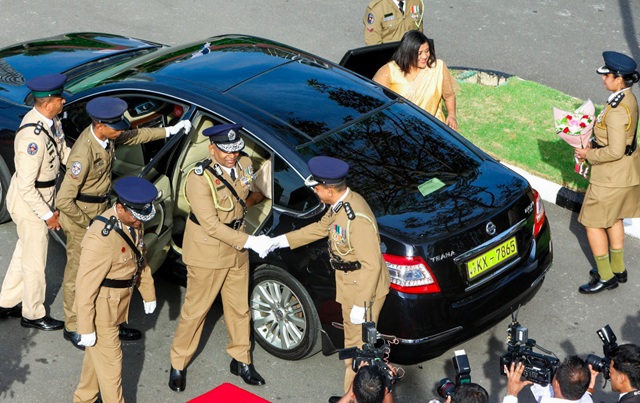
The problem is not only internal but also external. Sri Lanka is convulsing under economic stagnation, political polarization, and technological transformation. Crime itself is mutating. Cybercrime, AI-enabled fraud, and cryptocurrency scams are no longer futuristic hypotheticals but daily realities. Yet the police remain trapped in archaic methods—obsessed with petty traffic violations while oblivious to sophisticated financial crimes. Officers change traffic patterns to accommodate a superior’s motorcade, creating chaos on the streets, but remain ill-equipped to combat transnational cybercriminals. If the IGP fails to redirect attention from theatrical visibility toward technological competence, the institution will remain a caricature of policing in the twenty-first century.
Depoliticization is perhaps the most urgent reform. Political interference has transformed the police into a partisan militia rather than a neutral arbiter of justice. Officers who defy political orders are punished, while those who enforce them are rewarded. This has annihilated public trust. Without trust, law enforcement is impossible. Citizens will not cooperate with an institution they perceive as corrupt, abusive, or beholden to politicians. The new IGP must therefore sever the umbilical cord between politics and policing, insisting on merit-based promotions and accountability mechanisms that punish misconduct regardless of rank or affiliation. Whether he possesses the fortitude to undertake this Herculean task remains doubtful.
One must not underestimate the symbolic power of reform. The Sri Lankan police can reclaim legitimacy only by embodying values of justice, transparency, and accountability. Community policing, public education, and multilingual training—particularly as tourism grows—are not luxuries but necessities. Officers must evolve into analysts, problem-solvers, and cultural intermediaries, not mere uniformed enforcers of arbitrary quotas. The institution must learn from its own moments of excellence, where officers respected human rights and engaged communities with integrity. This is the heritage worth reviving, not the farce of uniformed theatrics that dominate the present.
Yet let us be brutally honest: reform will not materialize from within unless forced by leadership of uncommon courage. The ghosts of history haunt every attempt at change. Politicians will resist depoliticization, for a neutral police force undermines their capacity to manipulate justice. Corrupt officers will resist professionalization, for it threatens their illicit profits. And society itself, long habituated to a police force that inspires fear rather than trust, may struggle to accept a reimagined institution. Reform, therefore, requires not only policy adjustments but a reconstitution of the very soul of policing in Sri Lanka.
The stakes could not be higher. Failure to reform will accelerate the erosion of public trust, exacerbate social unrest, and undermine the fragile rule of law. Success, on the other hand, could ignite a social renaissance: a police force that protects rather than preys, that serves the people rather than politicians, that embodies justice rather than expediency. The choice before the new IGP is stark. He can perpetuate the grotesque theatre of uniformed actors performing for political masters, or he can cultivate a force of professionals who anchor the rule of law. One path leads to further disintegration; the other to the possibility, however fragile, of renewal.
This is not simply about the police. It is about the future of Sri Lanka itself. A state cannot thrive when its veins are clogged, when its guardians of order are themselves agents of disorder. The question is whether the new IGP is willing to confront uncomfortable truths, dismantle entrenched interests, and reconstruct an institution capable of withstanding the pressures of modernity. If he chooses the path of courage, he may yet redeem the Sri Lankan police from its long descent into farce. If not, his tenure will be remembered as yet another tragicomic interlude in the theatre of national decline.
The police must decide whether they will remain a germ of fear, deceit, and obedience—or rise as the guardians of justice and service that the nation desperately needs. That is the real challenge before the new IGP. And in that choice lies not just the fate of an institution, but the destiny of a country.