On a crisp April morning in Beijing, what should have been a ceremonial display of unity within China’s armed forces turned into a glaring signal of turmoil at the top of the People’s Liberation Army. At the annual tree-planting ritual attended by China’s military elite, one face was conspicuously absent: General He Weidong, the country’s second-highest ranking officer and a man handpicked by Xi Jinping less than three years ago to serve as vice chairman of the Central Military Commission (CMC). His disappearance, noted immediately by sharp-eyed China watchers, marked the downfall of the most senior general to vanish under Xi’s rule — and the clearest sign yet of a purge that has swept through the military with an intensity unseen since the Mao era.
According to a Bloomberg News analysis of television broadcasts, parliamentary records, and other public documents, Xi has already removed or investigated nearly one-fifth of the generals he himself elevated, a break with precedent that no Chinese leader since Mao Zedong has dared to attempt. The scale of the purge has left the CMC — the body that commands the world’s largest standing army — at just four members, down from seven when Xi began his third term in late 2022. That is the lowest number in the post-Mao era, highlighting both Xi’s dominance over the armed forces and the fragility created by repeated shake-ups at the top.
The mystery surrounding He’s fate follows a string of unexplained disappearances and abrupt removals of senior military figures, including two defense ministers and several top commanders of the Rocket Force, the branch responsible for China’s nuclear arsenal. In a system as opaque as China’s, absence from public events has become the primary indicator of downfall. While the government rarely confirms such dismissals, parliamentary filings and occasional notices on official platforms have revealed a steady purge of Xi’s inner circle of appointees, raising questions about how much control the Chinese leader truly exercises over the generals who are supposed to carry out his strategic ambitions.
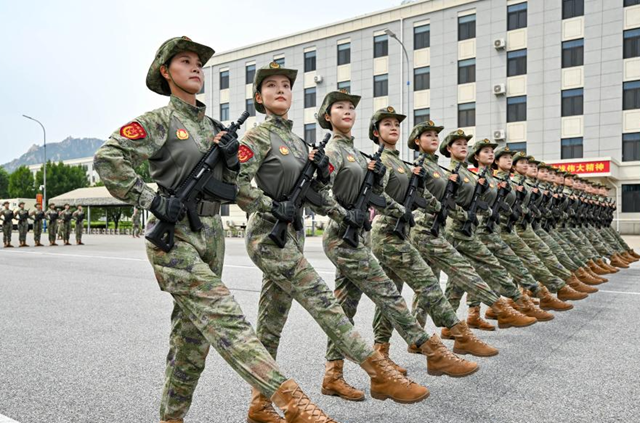
The implications stretch well beyond Beijing’s elite politics. Xi is preparing to oversee China’s first major military parade since 2019, a show of force meant to demonstrate growing capabilities against Taiwan and the United States. Yet analysts suggest foreign observers will be scrutinizing more than just tanks and missiles. They will be asking whether Xi trusts his commanders enough to fight, or whether constant purges have eroded the readiness of an already untested military. As James Char, a Singapore-based scholar at Nanyang Technological University, put it, “There’s a lot of turbulence in the upper echelons right now. It’s bad optics for sure.”
Xi came to power in 2012 warning that corruption in the PLA was a mortal threat to the Communist Party. Bribery, influence-buying, and patronage networks were rife, with officers openly paying for promotions and lucrative postings. His sweeping anti-graft campaign initially targeted rivals and retired figures, but in recent years it has consumed even his closest loyalists. The Equipment Development Department, which oversees procurement, admitted in 2023 to investigating leaks and secret cliques going back several years — a revelation that preceded the ouster of Rocket Force chiefs and now appears linked to He’s disappearance.
Bloomberg’s analysis underscores the magnitude of the shift: neither Hu Jintao nor Jiang Zemin probed a single general they had appointed during their time in power, while Xi has dismissed or investigated fourteen out of seventy-nine. This break with tradition has fueled speculation that he may be grappling with hidden crises in procurement, loyalty, or both. For the first time since Mao, a sitting vice chairman of the CMC may have been brought down, a move that would signal just how deeply Xi is willing to cut into the ranks he once fast-tracked to the top.
The irony is striking. Xi had propelled He Weidong from provincial commands along the Taiwan Strait to the highest levels of the CMC, in what many analysts interpreted as a sign of Beijing’s intensifying focus on the island. Now, He’s absence illustrates the uncertainty surrounding China’s warfighting capacity at the very moment Xi seeks to project confidence abroad. For younger officers, the purges may look like long-overdue housecleaning. But for senior commanders, they may encourage concealment of flaws in equipment and readiness, creating the possibility of costly surprises in combat.
Behind the veil of secrecy, the world is left to guess whether Xi’s purge is a display of unassailable strength — proof he can topple anyone, even his own protégés — or an admission of weakness, revealing just how little trust he places in the men who hold the guns. As Xi eyes a potential fourth term in 2027, the fate of China’s generals will serve as a barometer not just of his power, but of the stability of the military machine on which his rule, and China’s global ambitions, ultimately rest.