by Nil
Julian Richards’ Pakistan’s ISI: A Concise History of the Inter-Services Intelligence Directorate stands as an incisive, unflinching inquiry into one of the world’s most enigmatic and polarising intelligence services. Written with the scholarly poise of a Cambridge historian and the methodological acumen of a career intelligence officer, the book achieves what few have dared — a sober excavation of the Inter-Services Intelligence (ISI) Directorate’s labyrinthine evolution, unmasking both its institutional brilliance and its enduring moral dissonance. Richards positions the ISI not merely as a security agency but as a “parallel state,” one that has “cloaked itself in an almost mythical status of brutal effectiveness,” a description that encapsulates its Janus-faced character — mythic, Machiavellian, and indispensable to the Pakistani polity.
Richards’ narrative begins in the tumult of Partition, where he notes that “the agency’s formation was as much reactive as proactive,” emerging “in an extraordinary environment of new state-building” after Pakistan’s baptism by fire in 1947. This framing is not incidental: it situates the ISI as a product of existential insecurity — born of territorial angst and ideological fracture — a bureaucracy forged, as Richards phrases it, “in the white heat of military confrontation with India.” The early interplay between “poor coordination of intelligence feeds” and the military’s embryonic institutional ambitions created the crucible in which the ISI’s identity as both sentinel and manipulator was formed.
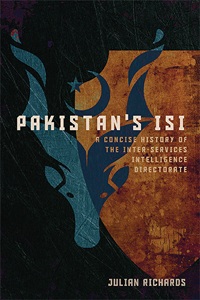
The author traces this genealogy through the decades with almost forensic patience, delineating the transition from a reactive intelligence outfit into a sprawling, quasi-autonomous complex that became, in his words, “the chief lieutenant of the army in ensuring a military-dominated status quo.” Richards’ argument that the ISI’s power was cemented during the Afghan jihad is meticulously substantiated: he calls that era “the agency’s coming of age,” when its “strategy of standing up and coordinating the Mujahideen organisation” elevated it from regional actor to global interlocutor. Yet, this apotheosis, he insists, came at a moral cost. “In cloaking itself in operational omnipotence,” he writes, “the ISI became less accountable, less visible, and less tethered to constitutional governance.”
Where the book is most arresting is in its treatment of what Richards calls the ISI’s “praetorian guardianship myth.” Drawing on a range of historical analogues and intelligence theory, he argues that Pakistan’s military elite — “its single most capable institution at the state’s birth” — adopted the ISI as both shield and sceptre. The agency, he asserts, has long regarded civilian rule with “a suspicion bordering on contempt,” seeing itself as the custodian of national identity and Islamic rectitude. Its operational culture, Richards suggests, was “shaped by a mixture of paranoia and paternalism,” compounded by a geopolitical environment “characterised by violent tumult for generations.” He invokes the recurring pattern of coups and political manipulations — from Ayub Khan’s martial law to Hamid Gul’s orchestration of electoral alliances — to illustrate the ISI’s entrenchment within Pakistan’s political bloodstream.
Perhaps the book’s most compelling passages are those that juxtapose the ISI’s technical sophistication with its ideological rigidity. Richards writes of an institution that “has mastered the craft of irregular warfare, using proxies as instruments of statecraft,” while simultaneously becoming ensnared by its own creations. His analysis of the Taliban and Lashkar-e-Taiba underscores this paradox: “The ISI’s brilliance in covert coordination,” he observes, “has too often bled into complicity, blurring the lines between strategic pragmatism and sponsorship of terror.” This duality — pragmatic intelligence versus ideological entanglement — lies at the heart of Richards’ critique.
The closing sections of the book, particularly the chapter on “Legacy, Impact, and Future,” are suffused with a stern yet measured censure. Richards concludes that unless Pakistan “places all its intelligence services on a clearer and more robust statutory footing,” the ISI will remain “a law unto itself.” He urges the establishment of “a realistic and workable process of oversight and accountability,” contending that such reform is indispensable if the state is to “flourish rather than merely endure.” Yet he does not lapse into moralistic absolutism; he concedes that “the armed forces of Pakistan, and the intelligence service that has become central to their operations, have been valiantly fighting against the most severe and difficult set of threats faced by almost any country in the world.” This balance — empathy without exoneration — gives the book its intellectual credibility.
Richards’ prose is notably unadorned yet sophisticated, his lexicon steeped in academic gravity and journalistic restraint. The text is dense with evidence — “memoirs, media reports, and the very occasional government inquiries,” as he puts it — and never succumbs to conspiracy or sensationalism, a rare achievement in writing on South Asian intelligence. His comparative analyses — with MI6, the CIA, and regional counterparts — lend the work both breadth and depth, while his reflections on the ISI’s self-mythologising tendencies recall Hannah Arendt’s warnings about bureaucracies that “cease to distinguish between secrecy and sovereignty.”
Pakistan’s ISI is not simply an institutional history; it is an anatomy of power in a postcolonial state haunted by its own genesis. Richards dissects the ISI as a mirror of Pakistan’s unresolved contradictions — its oscillation between faith and modernity, militarism and democracy, paranoia and pragmatism. In one of the book’s most haunting sentences, he writes that “the story of the ISI is, in many ways, the story of Pakistan.” To read this study is to confront not just the evolution of a spy agency, but the psychology of a nation that has never ceased to negotiate with its own shadow.