For the first time, mosquitoes have been confirmed in Iceland — a country long believed to be free of the buzzing insects.
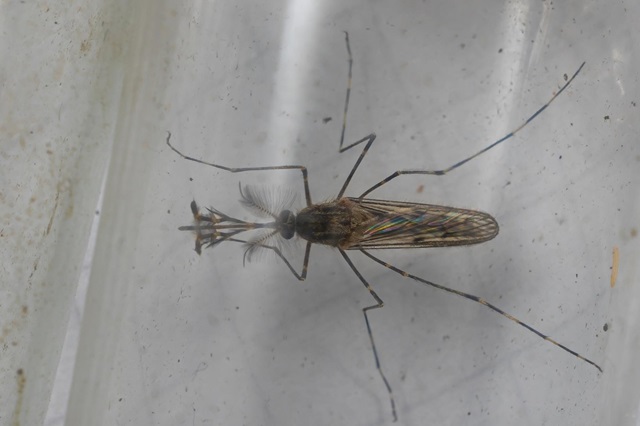
Three specimens of the mosquito species Culiseta annulata were found last week in the garden of Björn Hjaltason, who lives in Kiðafell in Kjós, near Reykjavík. Hjaltason first noticed an unfamiliar insect on October 16 and shared photos of it on the Facebook page Skordýr á Íslandi (“Insects in Iceland”).
“I could tell right away that this was something I had never seen before,” Hjaltason told mbl.is. The first specimen he caught was a female. The following evening, he spotted and captured a male, recognizable by its feathery antennae and larger mouthparts. On October 18, for the third night in a row, another female appeared — and Hjaltason caught that one too.
Curious about his discovery, Hjaltason sent all three insects to Matthías Alfreðsson, an entomologist at the Icelandic Institute of Natural History. Alfreðsson confirmed that the mosquitoes were indeed Culiseta annulata, a species native to northern Europe and known for its ability to withstand cooler climates.
“It’s always fun to discover something new,” Hjaltason said. In a Facebook post announcing the find, he jokingly declared that “the last fortress has fallen,” referring to Iceland’s longstanding status as a mosquito-free country. Until now, Iceland was one of the few nations thought to be naturally inhospitable to mosquitoes due to its cold climate and rapid weather changes.
Whether these mosquitoes will be able to establish a population in Iceland remains uncertain. “It still remains to be seen whether the insects will establish themselves here and survive the winter,” Hjaltason noted.
As for how they arrived, Hjaltason has a theory. “One always suspects Grundartangi — it’s only about six kilometers from me, and things often arrive with ships and containers, so it’s possible something came in that way,” he said. Still, he added that the presence of three in his garden suggests there may be more nearby.
If the Culiseta annulata mosquitoes manage to survive Iceland’s harsh winter, the discovery could mark the beginning of a significant ecological shift — and the end of one of the world’s few mosquito-free zones.