The global economy awoke to a jolt of uncertainty this Easter morning after Donald Trump issued a fiery and expletive-laden warning to Iran, demanding the immediate reopening of the Strait of Hormuz. The message, posted on Truth Social, underscored a growing crisis that now threatens not only regional stability but the foundations of global trade itself. What began as a military confrontation has evolved into a far more complex challenge—one that even the formidable power of the United States Navy may struggle to resolve.
The crisis intensified following a daring raid deep inside Iranian territory, reportedly involving U.S. forces and allied special units. The operation successfully rescued two downed American pilots but came at a steep cost, with hundreds of millions of dollars in equipment destroyed amid fierce fighting. While such missions highlight U.S. military reach and capability, analysts argue they are not the central issue. According to reporting and analysis originally published by 19FortyFive, the real strategic danger lies in Iran’s effective closure of the Strait of Hormuz.
This narrow waterway, bordered by Iran to the north and Gulf states to the south, is one of the most vital arteries of global commerce. Nearly one-fifth of the world’s oil and natural gas supply passes through it. Its disruption has already sent shockwaves through energy markets, pushing prices upward and straining economies far beyond the Middle East. Yet the consequences extend even further. Fertilizers essential to global agriculture, as well as helium critical for semiconductor production, have been caught in the bottleneck, threatening supply chains that underpin both food security and the rapidly expanding artificial intelligence sector.
Despite earlier claims from Washington that the issue was primarily international, President Trump’s escalating rhetoric suggests a growing recognition of its direct impact on American economic and strategic interests. The closure of the strait is no longer a distant geopolitical concern; it is a tangible threat to global financial stability and U.S. influence.
Behind the scenes, a quieter but equally consequential shift may already be underway. Reports indicate that some nations are effectively paying Iran to allow safe passage for their vessels, often using alternative currencies such as the Chinese yuan. If sustained, this practice could erode the dominance of the U.S. dollar in global trade and accelerate a broader realignment of economic power. For Washington, the stakes are no longer limited to reopening a shipping lane—they now include preserving the architecture of the postwar global order.
Faced with this reality, the United States appears to be approaching a critical decision point. Accepting Iran’s de facto control over the strait would signal a dramatic shift in regional power dynamics. Escalating militarily, however, carries profound risks. While it is technically feasible for U.S. forces to push ships through the waterway, doing so is only the beginning of a much more complicated challenge.
The fundamental issue is not whether naval power can clear a path, but whether it can sustain a level of security that convinces commercial shippers, insurers, and energy markets that the route is truly safe. Without that confidence, global trade will not return, regardless of military presence. Markets operate on perception as much as reality, and even isolated incidents—such as a single mine strike or drone attack—could deter traffic and keep prices elevated.
Geography heavily favors Iran in this confrontation. The Strait of Hormuz is narrow, and Iran’s northern coastline is fortified with an array of missiles, drones, naval mines, and fast attack craft. These assets allow Tehran to threaten shipping lanes quickly and unpredictably. Even a limited residual capability could pose enough danger to keep insurers wary and shipping companies hesitant.
Naval mines, in particular, represent a formidable obstacle. Modern variants are sophisticated, difficult to detect, and capable of inflicting significant damage. The mere suspicion of mines in the water can be enough to halt traffic. Clearing them requires specialized vessels and prolonged operations—resources the U.S. Navy currently lacks in sufficient numbers. Any effort would likely depend on allied support, yet many of those allies appear reluctant to commit.
For countries in Europe and Asia, the calculus is stark. Risking valuable naval assets in a high-threat environment may seem far less appealing than quietly paying Iran for safe passage. This reluctance undermines the possibility of a coordinated international response, leaving the United States to shoulder much of the burden alone.
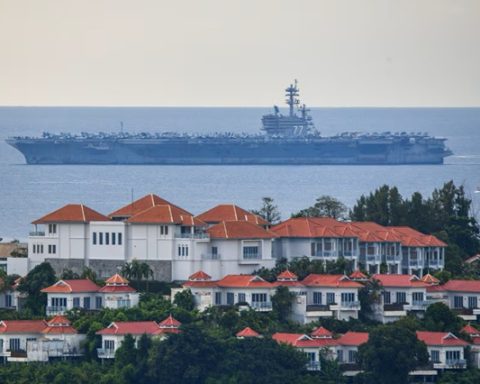
Even if escort operations were established, they would not guarantee success. Protecting commercial vessels would expose U.S. warships to sustained threats from drones, missiles, and potential swarm attacks. Over time, such operations could escalate, requiring strikes against Iranian launch sites and potentially drawing the United States into a broader and more direct conflict.
What begins as a mission to secure shipping lanes could rapidly evolve into a full-scale war. Iran has demonstrated resilience under sustained military pressure, and its ability to continue disrupting maritime traffic—even while under attack—raises serious questions about the long-term viability of any U.S.-led effort.
Ultimately, the challenge is as much economic and psychological as it is military. Reopening the Strait of Hormuz in a meaningful way requires more than clearing obstacles; it demands restoring trust. Without that trust, tankers will not sail, insurers will not underwrite risk, and markets will not stabilize.
The implications of failure are profound. Prolonged disruption could reshape global trade patterns, weaken Western economic influence, and accelerate shifts toward alternative financial systems. Domestically, the financial and political costs of an extended conflict could reverberate in Washington, influencing public opinion and electoral outcomes.
For President Trump, the crisis represents a defining test of leadership. The options available are fraught with risk, and none offer a clear or immediate solution. As tensions continue to mount, one conclusion is becoming increasingly difficult to ignore: reopening the Strait of Hormuz is not simply a matter of force—it is a challenge that may exceed the limits of military power itself.
Unless the conflict de-escalates, the world may be entering an era in which one of its most vital trade routes remains effectively closed, not by force alone, but by fear.