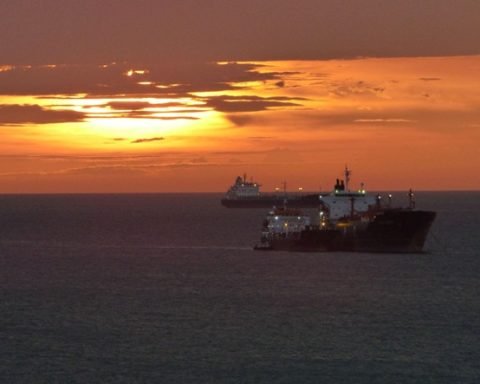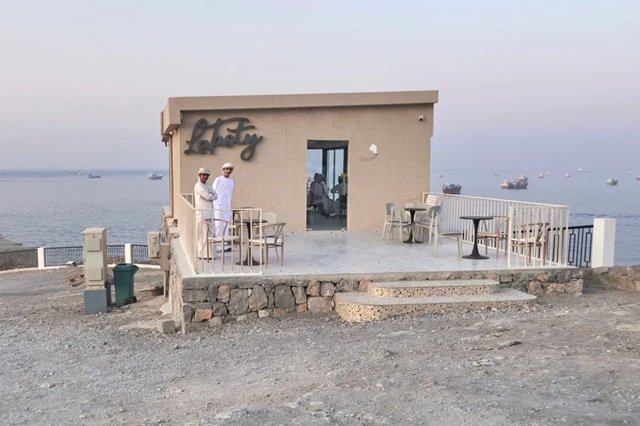
La Tasty, a small café on the waterfront road in Al-Khasab, has become an unlikely destination for visitors seeking a view of one of the world’s most dangerous maritime routes. Its customers order Japanese V60 pour-over coffee, Chemex brews, espresso and cold brew with blackcurrant while watching tankers and other vessels move through the Strait of Hormuz, even as the surrounding waters remain affected by the war. The café’s sudden popularity has been documented by German weekly Die Zeit, whose report describes a business transformed by social media and the extraordinary circumstances around it.
The minimalist concrete-and-glass café has stood on the coastal road for about two years and has two other branches with less dramatic views. Its popularity changed in mid-September, when Instagram and TikTok clips began circulating across the Arab world. The videos showed coffee, San Sebastián cheesecake and the ships gathering behind them in the strait. Jordan’s Roya News reported on the café where customers could see oil tankers, while Arabian Daily described the view as unique. Dubai-based business publication AGBI called it “one of the better business ideas the Iran war has produced”.
Among those arriving after seeing the café online was Nora Al-Dschassasi, a 39-year-old rally driver from Dubai, who travelled by motorcycle for the weekend with her Ukrainian friend Kateryna Tsiselska. “This is simply an incredible place,” Al-Dschassasi told Die Zeit. “We call such places feel-good places. Good-mood makers in these difficult times.” The two women stood out among the predominantly Gulf clientele, many of whom had travelled from Sharjah, Abu Dhabi, Ras al-Khaimah or Dubai. Men wore white robes known in the Emirates as kanduras, while women generally wore full-length black outer garments. Phones were repeatedly produced to photograph passing jetskis and the ships beyond them.
The setting is far removed from an ordinary weekend café. During the same period, reports said Iran’s Revolutionary Guards had again fired on tankers attempting to pass through the strait on the Omani side. Residents of Al-Khasab had heard explosions carried across the water, while in earlier weeks they had seen burning ships. According to the International Maritime Organization, at least 24 seafarers have died in the area since the war began at the end of February. On 12 March, Omani air defences shot down a drone over Al-Khasab. On 3 April, an American A-10 fighter aircraft was reportedly shot down by Iran off the coast of neighbouring Bucha, and a projectile struck a house there in May.
Al-Khasab itself has been heavily affected. The town lies within a 50,000-person Omani exclave separated from the rest of Oman by Emirati territory. Travellers approaching by land pass through the Emirati and Omani checkpoints at Al-Dara before following a coastal road that winds through steep limestone and dolomite formations towards the port town. Barbed wire currently blocks some paths, while the coastguard building and port are sealed off. Authorities have asked residents to report drones through WhatsApp. Attractions that normally bring day-trippers from Dubai, including dolphin watching, wooden-boat excursions into the fjords and a zipline, have lost customers. Hotels and guesthouses are nearly empty.
Before the war, cruise ships regularly stopped at Al-Khasab, including TUI Cruises’ German Mein Schiff vessels. Two were stranded in the Gulf for weeks after the conflict began before making their way through the strait in mid-April after passengers had been flown out. “They don’t come any more,” said a port-area security guard identified by Die Zeit as Salim, a pseudonym used because his real name was not to be published. He said the change was “because of the situation”.
Yet the waterway has not become completely inactive. Salim told Die Zeit that before the war, small vessels carried vegetables and fruit from the Emirates to the Iranian side, while electronics, spare parts and household goods travelled in the opposite direction. Iran supplied goats, sheep, milk and Zamzam-Cola, which he said local people preferred to Pepsi. Much of that trade now moves by lorry along the coastal road, making goods scarcer, more expensive and less fresh.
Some maritime trade, however, continues at night. Salim said small boats still cross under cover of darkness, carrying goods one way and returning with other cargo. Several people in Al-Khasab independently described boats transferring loads between vessels midway across the water. The low sound of engines can be heard at night, while small points of light appear and disappear offshore.
The scale of the wider disruption is reflected in oil flows. Die Zeit cited TankerTrackers data showing that 16.6 million barrels of crude oil a day passed through the Strait of Hormuz before the war. After ships began coming under attack at the end of February, the figure fell to 3.45 million barrels a day, and during the first US naval blockade in mid-April it dropped to 2.7 million. A temporary agreement between Washington and Tehran in June allowed flows to recover to about 10 million barrels a day for almost four weeks. Since 14 July, the US Navy has again blocked Iranian oil exports while protecting exports from other countries, sometimes using militarily secured convoys.
By the time of the Die Zeit report, roughly 10 million barrels a day were again passing through the strait, about two-thirds of the pre-war level. Tankers from Saudi Arabia, Iraq and the Emirates passed the café, sometimes in close succession during daylight and sometimes at night with their tracking systems switched off. Meanwhile, Iranian attacks involving drones, missiles and speedboats were continuing. At La Tasty, the war remains visible from the window, while the café’s young baristas continue sending several social-media posts an hour, turning coffee, ships and the Strait of Hormuz into the unlikely ingredients of a viral business.