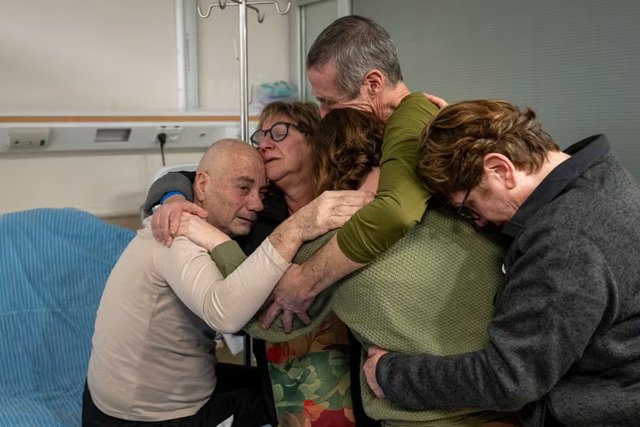
Luis Har, the Argentine-Israeli man rescued from Gaza after 129 days in captivity, says he believes the Israeli government could have secured the release of hostages much earlier, as Israel approaches the third anniversary of Hamas’s 7 October 2023 attack. In an interview with El País, Har said he felt “resentment” over the delay in reaching the ceasefire that eventually brought home the remaining hostages, while calling for a commission of inquiry into the security failures that allowed the attack and mass kidnappings to occur.
Har, 73, was taken hostage alongside his partner, Clara Marman, and three of her relatives, all of whom held Argentine and Israeli nationality. They were seized from Nir Itsjak, a kibbutz near Gaza, during Hamas’s surprise attack on 7 October 2023. Four months before Har’s rescue, the three women were released in an initial exchange with Israel. Har and Fernando Marman, Clara’s brother, remained captive in an apartment in Rafah.
Their captivity ended on 12 February 2025, when Israeli elite soldiers reached the apartment during an operation accompanied by intense aerial bombardment. The bombardment was used as a diversion and killed dozens of Palestinians, most of them civilians, according to the El País account. When the soldiers reached the room, they told the two men, “We’re here to take you home”, before reporting to the command centre: “We have the diamonds.” Har’s rescue was one of only a very small number of successful military rescues among the more than 250 people seized by Palestinian militias on 7 October. Most of the hostages who returned alive were released through negotiated exchanges during successive ceasefires, while dozens died in captivity, either from Israeli fire or at the hands of their captors.
Har said the eventual return of all the hostages remained difficult for him to regard simply as a political success. “If it had been only for our Government, we would still be there,” he told El País. He credited Donald Trump for the final agreement, saying: “That’s why I thank Trump.” Nitzan Alon, one of Israel’s principal negotiators, had said that Prime Minister Benjamin Netanyahu could have signed the final ceasefire “a year earlier”; according to the source, Trump imposed that agreement in October 2025.
The return of the last hostages has not ended Har’s demand for an official investigation. He said he did not want to assign blame but wanted to establish precisely what happened on 7 October and why. “I want there to be a commission of inquiry in which we can know exactly what happened on 7 October and why,” he said. The opposition in Israel has championed such an investigation, while Netanyahu has resisted it for three years. Har also said he was convinced that another attack could happen. “Before we used to say Never again, after the Holocaust. And now I say it can happen anywhere and in any way. And we have to be prepared for that.”
Asked about reports that foreign countries had warned Israel before the attack, Har responded critically to the idea that the prime minister had been unaware of the danger. “Let’s start with this thing that our prime minister was sleeping and nobody woke him up, poor thing,” he said. He added that, although he did not want to discuss politics before the elections, “one feels that everything could have been handled differently.”
His experience in captivity has also altered his attitude towards coexistence. Har said he once believed that Israelis and Palestinians could live together, but that conviction had weakened. “Today we want peace, but we don’t have a partner to make peace with,” he said, arguing that Palestinian attitudes and hatred would have to change. At the same time, he rejected Israel’s political extremes, saying that “the right-wing extremists in our people are terrible, just as the left-wing ones are. Both poles are terrible and I accept neither.”
Despite the continuing effects of captivity, Har has returned to life in southern Israel. He lives in Urim, the kibbutz where he settled after emigrating from Argentina in 1971, while Clara has returned to Nir Itsjak, where they were kidnapped. He said remaining there was important because “we think it is our home and where we have to be”. Yet he acknowledged that hearing Arabic can still trigger an emotional reaction, including when he hears hotel workers speaking the language in Eilat.
Har said he still does not sleep well and has been given medication, which he takes occasionally. He keeps himself constantly occupied, attending conferences throughout Israel, because staying at home can cause memories of captivity to return. His fellow former hostage Fernando Marman has chosen a very different path: he does not give public conferences or allow himself to be photographed, speaking only within the army to express his thanks.
Har, however, said he has come to appreciate his unexpected public role. “I like this life. I feel more comfortable, more important, more appreciated,” he told El País. “It’s a shame that it is because of what happened. But it happened. I was in hell and now we have to get the best out of this.” He said he would not want to become the person he was before the kidnapping.