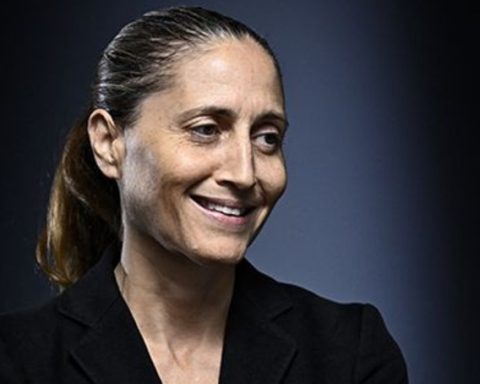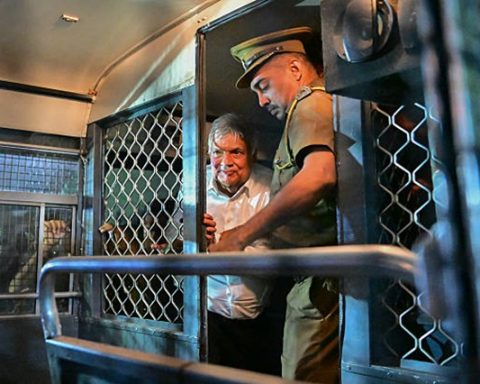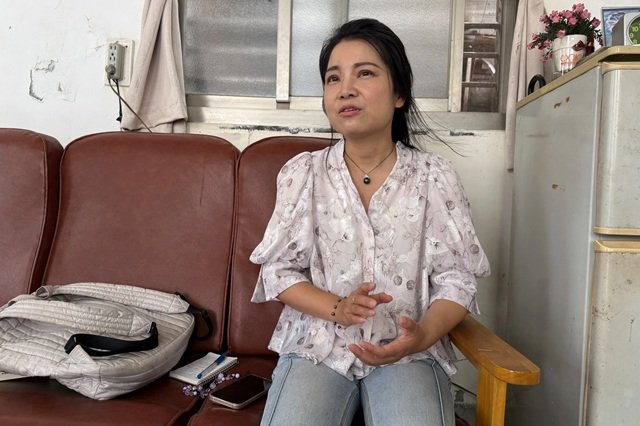
The day after Li Chen-hsiu was sworn in as a member of Taiwan’s Legislature, she faced questions not only about her nationality, but about her identity and ultimately her loyalty to Taiwan.
Li is a “mainland spouse”, a person born in China who became a Taiwanese citizen through marriage. For the two months she served before being forced out of the legislature, she was Taiwan’s only China-born lawmaker to have immigrated to the island through marriage.
“It’s only because of Taiwan which has this free and democratic system, and the Taiwan People’s Party which was willing to give a political newcomer a chance, that I could have this opportunity,” she told The Associated Press in July.
Her case has become part of a much broader debate over the treatment of some 369,000 mainland spouses living in Taiwan. The community includes several generations, ranging from women who married retired Chinese soldiers and moved to Taiwan in search of better economic opportunities to younger, more educated and wealthier people who met after restrictions between the two sides were eased.
The debate has intensified as fears of a Chinese military invasion have grown. China and Taiwan split during a civil war in 1949, after the Nationalist Party fled to the island. The two sides maintained a ban on contact for decades until 1987, when Taiwan’s residents were allowed to visit family members in China for the first time.
Relations have since fluctuated, but tensions have remained high since Tsai Ing-wen, who was independence-leaning, was elected Taiwan’s president in 2016 and China cut off official contact. China now sends military aircraft and navy ships towards Taiwan daily as part of military exercises, while also conducting diplomatic efforts to isolate the island internationally and targeting it with misinformation.
That security environment has increasingly raised questions about who can be trusted. A New Taipei court sentenced Hsu Chun-ying, who headed an organisation dedicated to helping mainland spouses, to seven years in prison on Tuesday for acting on Beijing’s behalf to spy on Taiwan and interfere in its politics.
Historically, many mainland spouses came to Taiwan through marriages with veterans of the Chinese civil war. Mi Zhengrong, 72, was among them. She met her first husband through relatives in China’s Hubei province. He was a veteran who had fled to Taiwan and was later allowed to return to China to visit his hometown. They married and lived in China before moving to Taiwan in 2002 because her husband missed the island.
After he died following 12 years of marriage, Mi married a neighbour in Taiwan. They remained together for nearly a decade, during the final two years of which he was paralysed and required round-the-clock care.
Mi is now fighting to receive her second husband’s pension. She would have qualified after 10 years of marriage, but he died 13 days before that threshold. The military initially awarded her the pension before withdrawing it after determining that the marriage had fallen short. Mi now lives on about 10,000 New Taiwan dollars a month ($330), with around a third going towards rent.
Despite her difficulties, she said she prefers Taiwan. “How many of us want to go back?” she said. “No one wants to go back.”
Taiwan’s government had previously sought to integrate mainland spouses by reducing the time required to obtain citizenship and allowing them to work. It is now tightening aspects of that policy.
Last spring, Taiwan deported three women who had advocated on social media for reunification with China by force. The Mainland Affairs Council said they represented “repeated threats to Taiwan’s national security and social stability”. Immigration authorities also ordered some 12,000 spouses who already held Taiwanese citizenship to provide proof that they had cancelled their household registrations in China or risk losing their Taiwanese citizenship.
Li’s case brought the issue into national focus. She entered the legislature in February with the Taiwan People’s Party but faced immediate opposition. Taiwan’s interior minister said she could not serve because she had not submitted documents showing that she had renounced her Chinese citizenship. The Mainland Affairs Council said she had failed to provide evidence in time that she had maintained only a single nationality for the previous 10 years.
Li disputes that interpretation, saying she has held Taiwanese citizenship since 1999 and cancelled her Chinese household registration that year. With the dispute unresolved in April, her party expelled her, while the government subsequently tightened requirements for Chinese-born legislators.
Some scholars argue that the authorities are applying the law selectively. Bruce Liao, a law professor and immigration law expert at National Chengchi University, said the government had interpreted some laws “wrongly” or “in a distorted way”. Others defend the policy as a legitimate national security measure. Yen-Tu Su, a researcher at Academia Sinica, said the government has a “compelling interest in protecting the safety of the country”.
The legal differences between mainland spouses and other immigrants predate the current tensions. Mainland spouses can apply for Taiwanese citizenship after six years, compared with four years for foreign spouses. They must also hold Taiwanese citizenship for 10 years before applying for government jobs, while foreign spouses can apply for most lower-level government positions after obtaining citizenship.
For many mainland spouses, those distinctions have made questions of loyalty a permanent feature of life in Taiwan. Chinese writer and activist Shangguanluan, who moved to Taiwan in 2021 with her Taiwanese husband, said she is repeatedly questioned over whether she acts on orders from the Chinese Communist Party or could be a spy.
She acknowledges that China actively seeks targets but argues that mainland spouses are unlikely to be the most valuable ones. In her view, people with direct access to Taiwan’s defence, technology and institutions would be far more useful sources of sensitive information.
As tensions across the Taiwan Strait deepen, the debate over mainland spouses is therefore becoming a difficult balance between national security and equal treatment. For people such as Li and Mi, the question is no longer simply where they were born, but whether their origins should determine how fully they are allowed to belong to the society they have chosen to call home.