Four days after a devastating flash flood tore through the Himalayan border region between Nepal and Tibet, Nepal’s disaster authorities have warned of the possibility of another flood wave, raising fresh concerns for communities already confronting widespread destruction and an increasingly uncertain search for survivors.
The warning applies to the Bhotekoshi River, according to Nepal’s disaster management authority, which urged people living near the river in Rasuwa, Nuwakot and Dhading to remain cautious. The alert comes as rescue teams continue working through mud, debris and difficult weather conditions in an effort to locate those still missing.
The scale of the disaster has continued to grow as authorities on both sides of the border release updated figures. China published new figures on Sunday, reporting 16 deaths and 546 people missing in the affected area. Among those listed as missing are three Germans.
When the Chinese figures are combined with those reported by Nepal, the disaster has claimed 691 lives, while almost 3,000 people remain missing.
The figures also raise questions about the number of foreign nationals still unaccounted for. It was initially unclear whether the number of missing Germans in Nepal and Tibet had increased or whether the figures issued by authorities on the two sides included duplications. Nepal had previously reported eight missing Germans in the disaster area. Four of them apparently belonged to a group of foreign pilgrims.
The uncertainty illustrates the difficulties confronting authorities as rescue and identification efforts continue across a disaster zone divided between two countries. With communications, access and conditions complicated by the scale of the flooding and debris, the precise human toll remains subject to revision as more information emerges.
In Tibet, Chinese state broadcaster CCTV reported that 261 of those missing were foreign nationals. The figure included 104 people from Nepal, 49 from India, 33 from Latvia and 18 from the United States. CCTV said Chinese authorities had informed the respective embassies and consulates of the countries concerned.
At the same time, authorities said no foreign tourists were stranded in Gyirong, the district in Tibet affected by the flash flood.
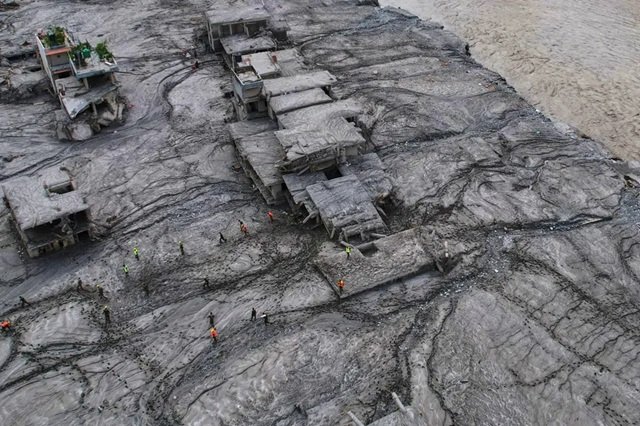
The immediate danger has not ended. Floodwaters have left large quantities of mud and debris across affected areas, while heavy rain continues to complicate rescue operations. International disaster workers are searching through metre-high deposits of mud and enormous piles of wreckage for people who remain unaccounted for.
The continuing rain also presents a further public-health concern. The affected areas face an increasing risk of infectious diseases as floodwaters and debris remain in place. Across Asia, the monsoon season is still under way and normally continues until September, meaning that further rainfall could continue to hamper rescue operations and complicate conditions on the ground.
The disaster has also prompted an international response. The United States has pledged $3.6 million in emergency assistance for the affected region. The US State Department said the United States stood alongside the Nepalese people, with the funding intended, among other purposes, to provide up to three months of food assistance for as many as 10,000 flood-affected households.
Behind the immediate emergency, authorities and experts have also been working to establish how the catastrophic flood began.
According to the findings available so far from the United States Geological Survey, a glacier collapse in the border region between Nepal and China triggered the flash flood on Wednesday. The flood then travelled through the Bhotekoshi, moving from Nepalese territory towards southwestern Tibet before returning to Nepal and causing extensive destruction along its path.
Chinese experts have subsequently supported that explanation. According to the Chinese news agency Xinhua, they concluded that a glacier on the southern flank of Langtang Lirung in Nepal had collapsed, triggering an avalanche of ice and rock.
That account places the disaster within the complex geography of the Himalaya, where rivers and mountain systems cross political boundaries and where an event originating in one part of the region can rapidly affect communities elsewhere. In this case, the path of the flood carried the consequences of the glacier collapse across the Nepal–Tibet border and back into Nepal.
Yet the immediate focus remains firmly on those still missing and the communities facing another potential surge of water. Nepal’s warning over the Bhotekoshi means that residents near the river must remain alert even as rescuers continue their work.
For families waiting for news of missing relatives, the distinction between confirmed deaths, missing persons and potentially duplicated figures remains more than a statistical problem. It is part of the uncertainty surrounding a catastrophe whose full human cost is still being established.
As heavy rain continues and search teams work through vast quantities of mud and wreckage, the Himalayan disaster remains an unfolding emergency. The rising toll, the warnings of another flood wave and the threat of disease have transformed what began as a devastating flash flood into a continuing humanitarian crisis stretching across one of the world’s most difficult and politically complex regions.