by Nil
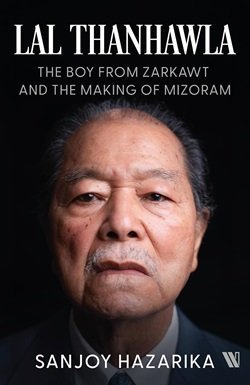
Sanjoy Hazarika’s most recent work, Lal Thanhawla: The Boy from Zarkawt, and the Making of Mizoram is presented as a biography, but its real ambition is considerably larger. “What started as a biography of an individual has grown, through his lens, into a biography of a state” (p. 10), Hazarika writes, announcing the method that governs the book. Lal Thanhawla becomes both subject and interpretive device: a political life through which the author reconstructs insurgency, military repression, forced resettlement, Christianisation, ethnic identity, prohibition, coalition politics, corruption allegations, refugee crises and the long negotiation between Mizoram and the Indian Union. This is an attractive proposition, particularly because Mizoram is too often reduced in the Indian political imagination to a peripheral success story about an insurgency that ended peacefully. Hazarika complicates that comfortable narrative. Yet the book is also at its most vulnerable precisely where it is most confident. Its determination to turn Thanhawla into the indispensable protagonist of Mizoram’s modern history sometimes produces a tension between biography and hagiography, between critical history and the construction of a political legacy.
The most compelling sections are those dealing with the 1966 Mizo National Front uprising and the extraordinary state response that followed. Hazarika immediately rejects the sanitised vocabulary of a mere “law-and-order problem”. He notes that the government’s own account described the rebellion in such terms, which, he argues, “showed the mindset of the Indian State at the time” (pp. 57–58). More importantly, he distinguishes between strategic and tactical intelligence: “If Laldenga’s move is seen as a pre-emptive attack, the strategic intelligence cannot be taken as faulty. However, tactical intelligence was a failure” (p. 58). That distinction is analytically useful because it avoids the lazy assumption that every intelligence failure is evidence of conspiracy or deliberate collusion. The subsequent military response, however, raises a much darker question about the limits of the Indian state’s counter-insurgency imagination. Hazarika records that fighter aircraft were deployed against Aizawl, describing the operation as “the first time that the national government had hurled its air wing against its own people” (p. 8). The book’s most haunting testimony is consequently not an abstract indictment but the remembered soundscape of civilians: “bomb blasts and the crackle of gunfire”, “terrified screams”, helicopters and aircraft “screaming overhead” (p. 4). The distinction between insurgent violence and state violence remains essential, but Hazarika refuses to allow the latter to disappear merely because the former preceded it.
The account of regrouping is even more disturbing because it exposes how counter-insurgency can transform civilian administration into an instrument of coercion. Hazarika calls the settlements “internment camps” (p. 96) and proposes the term “DRHC—displace, relocate, humiliate, control” (p. 96). The phrase is rhetorically powerful, perhaps too powerful, but the evidence he presents gives it considerable force. Villagers were identified by numbers, subjected to roll-calls and compelled to perform labour, while their traditional agricultural economy was disrupted. One military account reproduced by Hazarika describes soldiers forcing villagers from their homes, setting the houses ablaze and marching them fifteen miles through the night. The officer concludes: “I had done the job of an executioner” (pp. 98–99). Even more damning is the subsequent description of villagers being compelled, under the presence of a loaded revolver and sten guns, to sign documents claiming that resettlement and destruction had been voluntary (p. 99). Here the book moves beyond the familiar moral language of “excesses”. It raises a constitutional question: what happens to the legitimacy of a state when its counter-insurgency machinery manufactures documentary consent after coercively destroying the conditions under which consent might have existed?
Yet Hazarika is not content merely to indict the security forces. His treatment of the MNF is equally important, although it is less consistently developed. The rebellion was not an innocent eruption of collective grievance. Laldenga was a formidable political entrepreneur who converted genuine grievances into a nationalist project. Hazarika describes him as a “mesmeric speaker” who exploited “the deep religious roots of the Mizos” and constructed a vision of a promised land free from Indian rule (p. 54). The uncomfortable element here is that Mizo nationalism was simultaneously a movement against domination and a project of exclusion. Hazarika records Laldenga’s racist language towards Indians and his warnings about Hindu demographic expansion (p. 54). The book therefore resists the fashionable temptation to romanticise every insurgency as a straightforward struggle for liberation. But another contradiction remains unresolved: the same Laldenga who resisted the Indian state eventually swore to uphold “the Indian Constitution and the integrity and unity of India” (p. 171). Hazarika rightly treats this as an extraordinary political reversal, but the deeper question is whether it should be understood primarily as hypocrisy, strategic adaptation, exhaustion, or the normal transformation of revolutionary nationalism once it encounters the institutional possibilities of state power.
It is here that Lal Thanhawla becomes the book’s central political argument. Hazarika attributes extraordinary importance to his decision to step down as chief minister in 1986, calling it “this singular decision, on which Mizoram’s future and present has hinged” (p. 9). That is a striking causal claim. The subsequent peace accord certainly validates the importance of political sacrifice and accommodation, but to place the future of an entire state upon one individual decision risks reproducing precisely the kind of leader-centred history that a more structural account might question. Hazarika himself recognises Thanhawla’s talent for political networking, calling him “the original networker at the highest political level” (p. 197) and noting his relationships with six Indian prime ministers, from Indira Gandhi to Narendra Modi (p. 198). The political skill is undeniable. But networking is not necessarily statesmanship. The distinction matters, particularly when the subject is repeatedly praised as “a builder” and “a reconciler” (p. 336). A biography must establish not merely that a leader was influential, but how much of that influence translated into durable institutions rather than personalised access.
The author is at his most interesting when he allows Thanhawla’s contradictions to remain visible. The chief minister was a “devout Christian” who maintained “a fine bar” despite prohibition (p. 9), openly declaring, “I’m not a hypocrite, I drink in moderation and everyone knows that” (p. 238). This episode is more than colourful biography. It captures the tension between personal morality, political pragmatism and the enormous institutional authority of the Church. Hazarika shows how prohibition became a battle over who possessed the right to define public morality in Mizoram. His description of the Church as an organisation capable of mobilising its followers “as if summoning them in the hymn ‘Onward Christian Soldiers, Marching as to War’” (p. 234) is deliberately provocative. Yet the book is strongest when it refuses to reduce the Church to an obstructive pressure group. It also documents its peace-making role during the insurgency, including secret negotiations with the MNF and the creation of joint Presbyterian and Baptist peace initiatives (pp. 159–160). The contradiction is fundamental: the same institution could function as guardian of social discipline, political power and peace-building. That complexity deserves even greater theoretical attention than Hazarika sometimes gives it.
The discussion of identity politics becomes more troubling when the book turns to the Chakmas, Kuki-Chin identity and the politics of borders. Hazarika records both the humanitarian generosity of Mizoram towards refugees from Myanmar and sharply exclusionary statements concerning Chakmas. The juxtaposition is difficult to ignore. On one page, the argument is that “Mizoram cannot remain indifferent” to a humanitarian catastrophe (p. 287); elsewhere, Chakmas are characterised as “illegal infiltrators” (p. 311). The book thereby reveals an uncomfortable truth about ethnic solidarity: humanitarianism can be expansive when directed towards a perceived kin group while becoming restrictive when directed towards another minority. The demand that contiguous Mizo-inhabited territories be brought into a “single administrative unit” (p. 309), meanwhile, raises a profound contradiction between territorial nationalism and the sovereignty of existing states. Hazarika deserves credit for putting these tensions on the record. But the reader is left wanting a more systematic interrogation of whether Mizo nationalism can simultaneously demand recognition of its own transborder identity and deny comparable claims made by others.
There is also an important historical problem in the book’s treatment of pre-Christian Mizo society. Hazarika observes that missionary Christianity attacked institutions such as the zawlbuk and discouraged traditional practices, arguing that such interventions “undermined Mizo self-pride and their historical dignity” (p. 38). Elsewhere, however, the pre-Christian past is described through warfare, raiding, enslavement and head-taking (pp. 18–21). These passages are valuable because they resist both missionary triumphalism and romantic primitivism. Yet they raise a question that the book could pursue more rigorously: what exactly was lost, transformed or reinvented through Christianisation? If the zawlbuk represented an indigenous institution for transmitting leadership, memory and social norms, its destruction was not merely religious conversion but institutional transformation. The making of Mizoram was therefore not simply a story of integration into India. It was also the making of a new society from competing indigenous, missionary, colonial and nationalist inheritances.
The book’s ultimate judgement on Thanhawla is unmistakably generous. “His biggest achievement has been in keeping Mizoram safe, stable and united” (p. 337), Hazarika concludes, adding that Thanhawla was loyal “to his country, to his state, to his party and its first family—and to his own” (p. 337). The latter formulation is intriguing precisely because it contains an ambiguity the book never fully resolves. Loyalty to party, political family and self can be interpreted as virtues of political continuity or as evidence of the personalised networks through which power operates. The final regret—“He could have left on a high note. But that was not to be” (p. 327)—and the haunting admission, “I should have listened to Matthew” (p. 327), give the biography an elegiac quality. But elegy is not history. The danger is that the emotional architecture of the ending encourages the reader to evaluate Thanhawla through the moral grammar of endurance and reconciliation rather than through the harder questions of governance, accountability and institutional legacy.
The great achievement of Lal Thanhawla is therefore not that it settles the history of Mizoram, but that it makes the history considerably harder to settle. Its strongest pages expose the brutality of forced displacement, the ambiguities of insurgent nationalism, the political power of Christianity, the contradictions of ethnic solidarity and the remarkable pragmatism that converted armed rebellion into constitutional politics. Its weakness is the reverse side of its strength: the closer Hazarika gets to Thanhawla, the more the state risks becoming a reflection of one man’s political biography. The book asks us to remember Thanhawla as “a builder” and “a reconciler” (p. 336). That may be justified. But the more provocative conclusion is that Mizoram’s real historical achievement cannot belong to one politician. It belongs to a society that survived rebellion, state violence, displacement, ideological transformation and political rivalry without permanently reproducing the logic of war. Hazarika’s biography is most valuable when it points towards that larger achievement. It is least convincing when it appears to suggest that the achievement was embodied, above all, in the boy from Zarkawt.