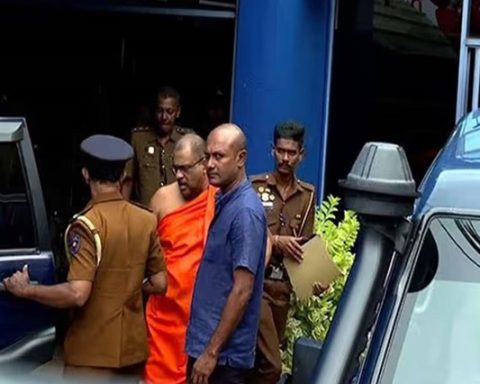
Former minister Champika Ranawaka has sharply criticised Sri Lanka’s handling of Trincomalee port and its growing strategic engagement with India, arguing that Colombo is allowing major powers to shape decisions without a coherent national strategy.
In an interview published by a Colombo-based daily newspaper following his recent visit to China, Ranawaka said Trincomalee port had effectively been given to India in 1987, but that little had been achieved since then. He said the port had long been at the centre of Sri Lanka’s geopolitical disputes and recalled claims during the J.R. Jayewardene administration that it could be given to the United States. “It was not entirely false that there were discussions at that time about giving Trincomalee port to America,” he said. “Now they are going to give it to India and the United Arab Emirates.”
Ranawaka argued that decisions concerning Trincomalee could draw Sri Lanka deeper into competition between major powers. “The people involved in the MECA agreement are watching this,” he said. “Accordingly, the country has been made a party to the power struggle.” He questioned whether handing responsibility for Trincomalee to India and the UAE could genuinely provide Sri Lanka with a route to greater engagement with Asia.
“We do not have a programme. We are working without any strategy,” Ranawaka said. He argued that investment from Dubai should have been pursued through a competitive process, rather than through what he described as decisions made according to the president’s personal discretion. “These things are being done as political bribes,” he said, adding that such an approach would not produce good results for Sri Lanka.
Ranawaka also criticised Colombo’s limited engagement with BRICS, describing the grouping as the institutional expression of the Global South. He said India had the capacity to provide leadership within BRICS but instead maintained closer relations with Western countries. Sri Lanka, he argued, should engage more decisively with the grouping, drawing a comparison with the foreign policy pursued by former prime minister Sirimavo Bandaranaike.
He said Sri Lanka had been a BRICS observer country since 2009 but had avoided participation because of concern about the United States. “We stay away from these things because we are afraid of America,” he said. “We avoid them. That should never be done.” He cited the BRICS New Development Bank and its separate payment arrangements, arguing that participation could provide opportunities to obtain fuel and other goods at lower prices. He added that Sri Lanka had received no special concessions from Washington for staying outside BRICS, while Vietnam and Bangladesh had received greater concessions despite competing with Sri Lanka.
Ranawaka was also critical of the government’s foreign-policy direction, contrasting its absence from BRICS meetings with the participation of government representatives in NATO-related meetings, including meetings in Canada. “No government has betrayed its policies as much as this government,” he said, alleging that Sri Lanka was increasingly acting according to the strategies of other countries.
On the Indian Ocean, Ranawaka warned that intense strategic competition was developing and that Sri Lanka could become trapped between rival power groupings if it failed to establish its own strategy. He also alleged that separatist Tamil Eelam activity had resumed following the change of government and claimed that jihadist activities were emerging in Kalmunai, describing the situation as dangerous.
Addressing defence relations with India, Ranawaka said Sri Lanka should be transparent about security agreements. He alleged that agreements signed with India under President Anura Kumara Dissanayake had been concealed from the public and pointed to what he described as a dramatic change in the political establishment’s approach towards India.
Ranawaka also linked the recent visit of a senior US Pacific security official to what he described as Washington’s increasing attention to Sri Lanka and the wider region. “America is paying considerable attention to this region,” he said.