by Our Correspondent in Colombo
Sri Lankan President Anura Kumara Dissanayake said his government had rejected requests from the United States for multiple military aircraft to land in Sri Lanka and from Iran for a fleet of warships to enter its waters, citing the country’s commitment to a non-aligned foreign policy.
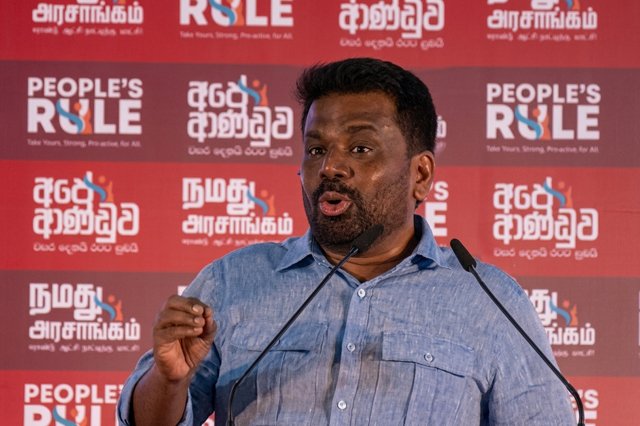
Speaking at a political rally in Nikaweratiya on Sunday under the theme “Two Years Strong. Progress for All”, Dissanayake said the government had applied the same approach to both countries during a conflict in the Middle East, refusing to allow Sri Lanka to become involved in a confrontation between foreign powers.
“When the United States and Iran started a conflict in the Middle East, multiple U.S. military aircraft asked to land in Sri Lanka. We said no. An Iranian warship fleet asked to come to Sri Lanka. We said no,” he said.
“We have gained the capability to pursue an independent foreign policy without bowing down to anyone,” the President added.
The remarks presented the government’s handling of the reported military access requests as an example of its stated commitment to neutrality in international conflicts. Dissanayake said Sri Lanka, as a small country concentrating on strengthening its economic foundations, had neither the military capacity nor the need to participate in global power struggles.
He said the National People’s Power government followed a non-aligned foreign policy that required Sri Lanka to remain neutral when international military conflicts arose, rather than siding with a particular superpower or military bloc.
“We are a small country… When global military conflicts happen, where should we stand? The National People’s Power government operates on a non-aligned foreign policy that remains neutral in those conflicts,” he said.
Dissanayake linked this position to Sri Lanka’s economic interests, arguing that the country’s participation in international markets, technological networks and trade agreements made isolation or exclusive alignment with one group of countries impractical.
“We are interconnected through the global market, global technology, and various trade agreements. In such a world, we cannot live isolated,” he said.
The government’s approach, he added, was to maintain friendly relations with countries across different geopolitical groupings rather than allow international disputes to dictate Sri Lanka’s diplomatic choices.
“We pursue a foreign policy filled with friendly relations with many countries around the world. We cannot side with just one faction; we must maintain a neutral foreign policy. That is the step in building this country,” he said.
The President also addressed Sri Lanka’s relationship with neighbouring India, describing the country as a vital factor in regional affairs and saying Colombo had made clear that its territory and airspace would not be used in ways that threatened Indian security.
“In this region, India is a vital factor. We have made it very clear: we will never allow our land or our airspace to be used in a way that poses a threat to India,” Dissanayake said.
He said Sri Lanka sought to protect its sovereignty through diplomacy and mutual respect, rather than confrontation. Referring to Katchatheevu Island, he said diplomatic clarity had led the Indian central government to formally acknowledge Sri Lanka’s sovereignty over the island.
Dissanayake said the country understood its position and limitations in regional and international affairs and would conduct its foreign relations accordingly.
“We know our own weight, and we know how to conduct ourselves,” he said.