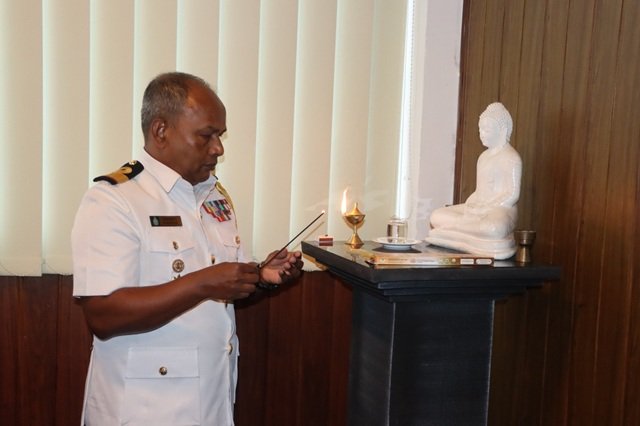
From pioneering Sri Lanka’s sea-drone technology during the conflict against the LTTE to developing affordable drinking-water systems, advancing marine engineering and leading national defence research, Commodore (E) MCP Dissanayake’s professional journey reflects a sustained commitment to innovation, public service and nation building.
A nation’s strength is measured not solely by the power of its armed forces, the size of its economy or the sophistication of its infrastructure. It is also reflected in the ability of its people to transform knowledge into innovation, challenges into opportunities and ideas into practical solutions that improve the lives of future generations.
Commodore (E) MCP Dissanayake of the Sri Lanka Navy represents a notable example of this principle. His professional journey demonstrates how a naval officer, equipped with engineering knowledge, military discipline, scientific curiosity and a commitment to national service, can develop into an inventor, researcher, academic and institutional leader.
From pioneering the development of an unmanned sea-drone platform in 2007 during the conflict against the LTTE to developing affordable drinking-water technology for rural communities, researching renewable energy from the ocean, advancing maritime engineering education and leading Sri Lanka’s Centre for Defence Research and Development (CDRD), his career reflects a consistent effort to translate engineering knowledge into national capability.
His story is not simply that of a distinguished naval engineer. It is that of a professional who has sought to apply the experience and expertise gained through military service to the wider development of Sri Lanka.
Commodore Dissanayake joined the Sri Lanka Navy on 8 November 1992 as an Officer Cadet of the 10th Intake of the General Sir John Kotelawala Defence Academy. He was commissioned in 1994 and subsequently joined the Engineering Branch of the Sri Lanka Navy.
His professional development was built on a strong academic foundation in mechanical and marine engineering. He graduated from the Naval College of Engineering at INS Shivaji, India, affiliated with Jawaharlal Nehru University, with a Bachelor of Technology in Mechanical Engineering. He subsequently obtained a Master of Science in Naval Engineering from the Australian Maritime College, University of Tasmania.
One of the most significant milestones in his career was his role in designing and developing Sri Lanka’s first sea drone in 2007, during the conflict against the LTTE.
At the time, the Sri Lanka Navy faced serious maritime security challenges from the LTTE Sea Tigers, whose operations posed significant threats to naval vessels and personnel. The evolving nature of the maritime threat demanded innovative thinking and engineering solutions, as conventional approaches alone could not address every operational challenge.
Recognising the potential of unmanned maritime technology, Commodore Dissanayake pioneered the development of a remotely controlled, unmanned waterborne vehicle for the Sri Lanka Navy. The initiative represented an important example of indigenous engineering innovation at a time when unmanned maritime systems had yet to become widely established as mainstream naval technologies.
The development was driven by a practical national requirement: applying locally available engineering expertise to address an urgent maritime security challenge while reducing dependence on imported technological solutions.
The significance of this work is also reflected in his academic publication, Developing an Explosive Laden Unmanned Waterborne Vehicle to Eliminate LTTE Suicide Boat Attacks at Sea, presented at the 14th International Research Conference of General Sir John Kotelawala Defence University in 2021. Today, unmanned surface vessels, autonomous maritime platforms and sea drones are increasingly important components of maritime technology and naval capability.
Another significant dimension of Commodore Dissanayake’s professional career emerged when naval engineering expertise was applied to a major civilian challenge: providing safe drinking water to communities affected by Chronic Kidney Disease of unknown aetiology (CKDu).
Following the end of the conflict in May 2009, the Sri Lanka Navy increasingly expanded its contribution to national development through engineering, research and community-support initiatives. By 2015, the growing incidence of CKDu in the North Central Province had brought the need for safe drinking water into sharp national focus.
According to an account published in The Island by a former senior naval officer, the Navy Commander directed the Research and Development Unit to develop an affordable water purification system. The responsibility was assigned to then Commander MCP Dissanayake, an Indian-trained marine engineer with experience in naval research and development.
The challenge was considerable. Imported reverse osmosis plants were expensive, while their capital, maintenance and operational costs made it difficult to provide sustainable drinking-water services to rural communities.
Drawing on the Navy’s longstanding experience with reverse osmosis systems aboard ships, Commodore Dissanayake led the development of a locally manufactured Brackish Water Reverse Osmosis (BWRO) plant. The result was more than an engineering product; it was a technological intervention directed towards an urgent social need.
The initiative demonstrated how technologies developed and maintained for naval requirements could be adapted to address civilian public health challenges.
The scale of this contribution is reflected in the published record. According to a 2023 KDU research publication, approximately 1,000 Navy-established BWRO plants had provided safe drinking water to more than two million people in CKDu-affected communities since December 2015.
The programme subsequently expanded. An account published in The Island reported the opening of the 1,132nd Navy-established reverse osmosis plant at Mahinda Maha Vidyalaya, Kauduluwewa.
This achievement illustrates how engineering innovation can deliver tangible benefits to communities. The contribution was recognised through a Letter of Commendation from the President of Sri Lanka and commendations from the Commander of the Navy. Commodore Dissanayake also received the Japanese–Sri Lanka Technical Award associated with the development of the low-cost reverse osmosis plant.
His research into optimising the recovery ratio of BWRO systems received the Best Research Paper Award at the KDU International Research Conference in 2021.
Although access to safe drinking water represents an important public-health intervention, the wider decline of CKDu must be assessed through independent health research rather than attributed to a single technology. Nevertheless, the provision of affordable water purification infrastructure to affected communities remains a significant example of engineering applied to human needs.
Sri Lanka’s geographical position in the Indian Ocean offers considerable opportunities for developing maritime industries and renewable ocean energy. However, translating these natural resources into practical energy solutions requires indigenous research, engineering expertise and appropriate technological infrastructure.
Commodore Dissanayake has contributed to this emerging field through research on the Oscillating Water Column (OWC) ocean-wave energy conversion system.
His research examined the feasibility of establishing a breakwater-type OWC system at Hambantota Port. The study investigated wave conditions inside Hambantota Harbour and offshore, exploring the potential of using wave-induced air movement to operate a turbine connected to an electrical generator.
The research examined a preliminary average wave-power resource of approximately 12–15 kW per metre in the investigated Sri Lankan context. The work received the Best Research Paper Award at the KDU International Research Conference in 2023.
Another dimension of his research career is his involvement in autonomous underwater technology. His published research includes Design and Development of an Autonomous Underwater Vehicle (AUV): For Rip Current Data Collection and Shallow Water Explorations, presented at the KDU International Research Conference in 2022.
The research demonstrates the potential of locally developed underwater platforms for collecting marine data and supporting scientific investigations in coastal and shallow-water environments. Together with his earlier work on sea-drone technology, it reflects a sustained interest in unmanned maritime systems and the wider engineering possibilities of autonomous platforms.
For Sri Lanka, developing indigenous expertise in these fields is strategically important. An island nation must possess the technical capacity to understand, monitor and sustainably manage its surrounding maritime environment. Local engineering knowledge can reduce technological dependence, create research opportunities for universities and contribute to the development of the country’s marine technology sector.
Technology alone, however, cannot build a nation. It requires skilled people who can design, manufacture, operate, maintain and continuously improve technological systems.
Commodore Dissanayake’s contribution to engineering education at General Sir John Kotelawala Defence University represents another important dimension of his professional career. His academic engagement with the Department of Marine Engineering has involved research, engineering education and the development of practical learning facilities.
The development of academic programmes in Marine Engineering and Naval Architecture and Marine Engineering provides opportunities to produce qualified professionals for the Sri Lanka Navy and the wider maritime industry.
These disciplines are particularly important for an island nation seeking to expand its shipbuilding, ship repair, commercial shipping, offshore engineering and port-related industries.
His contribution to the development of a Hybrid Marine Engine Simulator provides an example of how theoretical education can be connected with practical engineering experience. The simulator offers a controlled learning environment in which marine engineering undergraduates can understand engine-room operations and examine the behaviour of marine engineering systems.
The broader significance of such initiatives lies in their potential to develop practical competencies and strengthen the relationship between university education and professional requirements.
By encouraging graduates to pursue opportunities in commercial shipping and the international maritime industry, Sri Lanka can develop a skilled workforce capable of contributing to national income and foreign-exchange earnings. The objective extends beyond producing graduates; it is about building a professional maritime workforce equipped to compete internationally.
In October 2026, Commodore (E) MCP Dissanayake assumed duties as the 10th Director General of the Centre for Defence Research and Development (CDRD), under the Ministry of Defence. The appointment marks a significant new chapter in his professional journey.
The CDRD plays an important role in strengthening Sri Lanka’s defence-related scientific research, engineering innovation and technological development. Its institutional mandate includes planning, researching, designing and developing technological solutions, strengthening research infrastructure and promoting the development of skilled human resources.
For a country operating in a rapidly changing global technological environment, the importance of such an institution is considerable. Modern national security increasingly involves advanced engineering, artificial intelligence, robotics, autonomous systems, cyber technologies, materials science, communications and other emerging scientific disciplines.
Sri Lanka needs to develop the capacity to identify its technological requirements, encourage indigenous research and build solutions suited to national priorities.
Commodore Dissanayake’s professional background in naval engineering, maritime innovation, research and university education provides a relevant foundation for this responsibility. His leadership also offers an opportunity to strengthen cooperation between the defence establishment, universities, independent researchers, industrial innovators and the private sector.
The professional journey of Commodore MCP Dissanayake provides an example of how the role of a military professional can evolve beyond the traditional boundaries of defence service.
He began his career as a naval engineering officer. During the conflict against the LTTE, he contributed to the development of indigenous unmanned maritime technology. In the post-conflict period, he applied engineering expertise to an important public-health challenge through the development of affordable drinking-water technology.
He subsequently pursued research in ocean energy, underwater exploration, marine engineering and renewable technologies, while contributing to university education and the development of skilled maritime professionals. Today, he leads a national institution responsible for advancing defence research and technological innovation.
These achievements point to a consistent professional approach: identifying a national requirement, applying engineering knowledge, developing practical solutions and creating opportunities for others to build upon those achievements.
Sri Lanka needs more professionals capable of connecting military expertise with civilian development, scientific research with industrial production, and university education with national economic priorities. It also needs institutions that recognise and support such individuals, protect intellectual property, encourage experimentation and create pathways for promising inventions to reach practical application.
Commodore Dissanayake’s career serves as a reminder that nation building is not confined to political leadership or conventional development programmes. It also takes place in engineering laboratories, research institutions, university classrooms, naval establishments and communities that benefit from technological innovation.
His professional evolution, from a naval officer contributing to the country’s maritime security to an engineer developing solutions for its people, an academic strengthening its human capital and an institutional leader advancing its technological capabilities, offers a distinctive example of public service.
The most valuable legacy of such a professional is not simply the number of awards received or positions held. It is the knowledge created, the lives improved, the young professionals inspired and the national capabilities strengthened.
From pioneering sea-drone technology to leading national defence research, Commodore (E) MCP Dissanayake’s journey illustrates how professional expertise, scientific curiosity and a commitment to public service can contribute to nation building.
His story carries an important message for Sri Lanka: securing the nation’s future requires not only defending its borders but also developing the knowledge, technology and human capabilities that will shape generations to come.