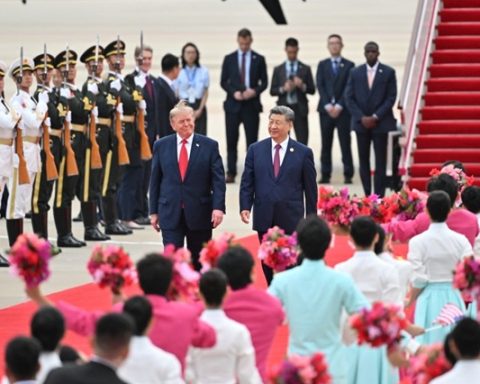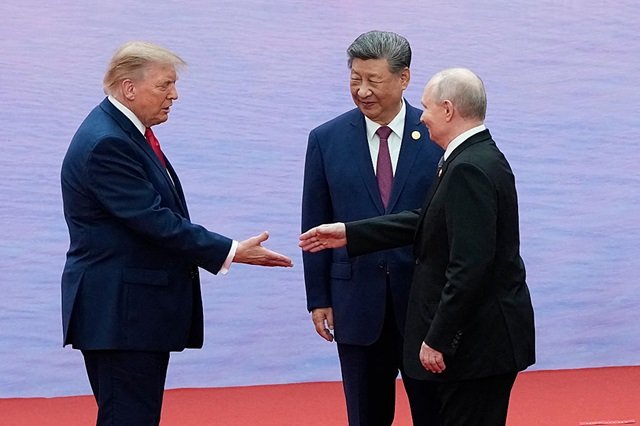
The leaders of the United States, China and Russia are preparing to sit at the same table at a moment when their countries are competing for influence across an increasingly fractured international system. The planned meeting between US President Donald Trump, Chinese President Xi Jinping and Russian President Vladimir Putin, on the sidelines of the Asia-Pacific Economic Cooperation (APEC) summit in Shenzhen, is significant not simply because of the three leaders involved, but because of the contradictions that define their relationships. They are strategic competitors, economic rivals and, on certain questions, indispensable negotiating partners.
The gathering brings together three countries commonly associated with the concept of great-power competition. Yet the immediate challenge is whether competition can be managed through selective cooperation, particularly as conflicts in Iran and Ukraine, the erosion of nuclear arms-control arrangements and economic interdependence complicate their respective strategic calculations. An analysis published by The Soufan Center identifies these overlapping pressures as central to understanding the significance of the meeting.
Nuclear weapons are likely to feature prominently in the discussions. The expiry of the New START treaty between Washington and Moscow in February has removed the last major bilateral restrictions on the nuclear arsenals of the world’s two largest nuclear powers, leaving their strategic weapons outside agreed limits for the first time in half a century. Trump has expressed interest in establishing a modernised nuclear agreement involving China and Russia, arguing for a broader framework to manage strategic competition. However, Beijing has historically resisted participation in such arrangements, maintaining that its nuclear arsenal is considerably smaller than those of the United States and Russia.
The disparity remains substantial. China is believed to possess approximately 600 nuclear warheads, compared with more than 5,000 each in the American and Russian arsenals. Nevertheless, China’s nuclear programme is expanding rapidly and is projected to exceed 1,000 warheads by the end of the decade. This growth presents Washington with a strategic dilemma: whether to pursue an agreement that includes Beijing despite the considerable differences in existing stockpiles, or continue negotiating within a framework that excludes an increasingly consequential nuclear power. White House officials have nevertheless played down expectations of an immediate breakthrough, acknowledging that negotiating and implementing a three-way nuclear agreement could take years.
The war in Iran presents a more immediate diplomatic and military challenge. As the conflict enters its ninth month, Washington and Tehran remain locked in a stalemate, with both sides convinced that they retain sufficient leverage to influence the outcome. The United States has struggled to secure a lasting ceasefire and prevent Iran from exerting control over the Strait of Hormuz, a strategically important waterway whose disruption has affected international trade and energy prices.
The timing of the Shenzhen meeting is particularly significant because Washington is deploying a third aircraft carrier, the USS Theodore Roosevelt, to the area of responsibility of US Central Command in the Middle East. The Trump administration is weighing further military escalation as diplomatic efforts remain inconclusive. According to The Soufan Center’s assessment, Washington may seek to use the trilateral gathering to enlist Chinese and Russian influence in persuading Tehran to accept an agreement. Discussions about nuclear arms control among the three powers could also extend to limiting Iran’s nuclear capabilities.
There is, however, little indication that either Beijing or Moscow would readily accommodate Washington’s objectives. Both countries have strategic reasons to avoid helping the United States resolve a conflict that is consuming American military resources. Consequently, the meeting could expose the limits of trilateral cooperation rather than produce a common approach towards Tehran. If diplomatic pressure fails to change Iran’s negotiating position, the possibility of further American escalation remains significant.
Economic relations will provide another important dimension. The trade confrontation between Washington and Beijing has eased, creating some room for discussions on wider economic cooperation. American purchases of Russian diesel and the suspension of sanctions on certain countries buying Russian gas and oil, including China, have also contributed to the changing commercial environment.
For Putin, however, the economic consequences of the war in Ukraine remain increasingly difficult to contain. Russia’s budget deficit has doubled from 1.6 per cent of gross domestic product in the previous year to 3.2 per cent in 2026, while government expenditure is expected to rise by 13 per cent because of the continuing war, according to figures cited in the analysis. Economic pressure is growing among influential Russian business interests seeking a way out of the conflict. Ukraine’s sustained drone campaign against Russian infrastructure has added another dimension to the costs facing Moscow.
The consequences extend well beyond Russia’s domestic economy. Moscow’s dependence on Beijing has increased substantially since the invasion of Ukraine in early 2022. China now accounts for approximately half of Russian imports, almost twice the proportion recorded before the invasion. This growing dependence strengthens Beijing’s economic position within the relationship and places Russia in an increasingly unequal partnership with its principal strategic ally. Meanwhile, China is seeking to use the APEC summit to revive progress towards establishing a regional free-trade zone.
These developments complicate the position of the United States. The partnership between Moscow and Beijing, described by the two countries as having no limits shortly before Russia invaded Ukraine in February 2022, has given their relationship a strategic foundation that Washington cannot easily reverse. In the proposed trilateral arrangement, the United States is therefore the least naturally aligned participant. Yet their differences do not make cooperation impossible.
Artificial intelligence offers one example. Washington and Beijing held discussions at a September AI summit and established a communication channel on AI safety. The Soufan Center has previously argued that preventing terrorist exploitation of artificial intelligence should become a priority in bilateral discussions. However, tensions remain over issues including Jensen Huang’s relationship with an individual described by some as a Chinese spy, and an agreement signed by the United States and its allies to protect artificial intelligence supply chains from China.
The meeting also carries implications for countries outside the immediate negotiating circle. Although the United States and Russia have encountered significant limitations in their respective approaches to Iran and Ukraine, both Beijing and Moscow continue to regard Washington as the dominant global power. For Ukraine, the prospect of Trump, Xi and Putin discussing international affairs without Ukrainian participation is particularly troubling. European governments, too, face the prospect of major decisions being discussed among three leaders without them having a direct place at the table.
Comparisons with the 1945 Yalta Conference, where Franklin D. Roosevelt, Winston Churchill and Joseph Stalin negotiated the post-war settlement, have inevitably emerged. Some observers have portrayed the forthcoming meeting as a modern version of the Big Three, suggesting that the leaders could seek to determine spheres of influence at the expense of smaller countries. The Soufan Center considers the analogy overstated. Nevertheless, the symbolism is difficult to dismiss.
The significance of the Shenzhen gathering lies less in any expectation that three competing powers will reach a comprehensive settlement than in the opportunity it provides to demonstrate how international influence is being redistributed. For Xi, hosting the meeting offers a platform to present China as a central participant in decisions affecting global security, trade and diplomacy. Whether the discussions produce concrete agreements or merely expose competing priorities, the presence of the three leaders at one table will reflect a central reality of contemporary international politics: the powers most capable of destabilising the international system are also among those whose cooperation is necessary to manage it.