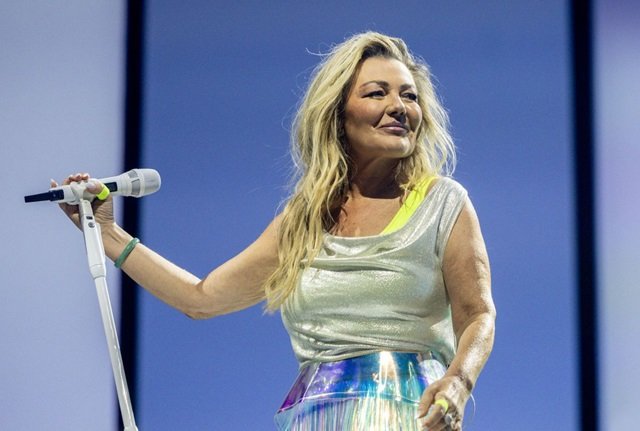
For Amaia Montero, returning to the stage after years away from the music industry was supposed to mark the beginning of a new chapter. Instead, her comeback with Spanish band La Oreja de Van Gogh has become an unusually public confrontation with the darker side of celebrity culture: online harassment, relentless scrutiny of physical appearance, ridicule of professional mistakes and the casual treatment of personal suffering as entertainment.
In the band’s first interview since announcing Montero’s return in October 2025, published by EL PAÍS, the singer and her three current bandmates discuss the controversies surrounding their reunion tour, the pressure of performing under intense public attention and the future of a musical partnership that has attracted renewed interest across Spain. Their conversation offers an account of an artist attempting to rebuild her career while confronting a digital environment in which a few seconds of footage can overshadow an entire concert.
Montero’s explanation of what the return means to her is particularly revealing. Speaking from the band’s rehearsal premises outside San Sebastián, she describes years of severe personal difficulties, including a prolonged period largely confined to bed and hospitalisation in a psychiatric institution. She also discloses that she had twice reached a point at which she no longer wanted to continue living. Her recovery, she says, was itself an extraordinary achievement, with her doctors recognising the strength required to overcome such circumstances.
Against that background, the criticism directed at her performances has acquired a different significance. Montero says she finds it difficult to understand how people can take isolated five-second videos and use them to ridicule someone who has fought to return to professional life. She acknowledges that she is currently overweight and says she will address it when she chooses, rejecting the idea that comments about her appearance should determine her self-worth. What troubles her more, she explains, is the impact of the hostility on her colleagues, family and the wider touring team.
The scale of the undertaking is considerable. Approximately 150 people are involved in the production, and Montero describes an environment in which musicians and crew members are fully committed to each performance. She says the group gives everything at every concert, making the circulation of decontextualised videos and mocking commentary particularly difficult to accept. Her frustration is directed not simply at criticism, but at what she sees as the deliberate transformation of ordinary mistakes into public humiliation.
The distinction between the concert hall and the internet has become central to the reunion. The band’s Tantas cosas que contar tour began in Bilbao on 4 May and is scheduled to conclude in Madrid on 30 December after 35 performances. Inside the venues, audiences have filled concert halls, singing familiar songs and responding emotionally to the band’s return. Online, however, the same performances have generated a parallel spectacle dominated by selected mistakes, jokes and viral clips.
The band members acknowledge that the performances have not been flawless. Keyboardist and composer Xabi San Martín admits that there have been occasions when the group has made mistakes, including one concert in which they lost the correct musical key during Tan guapa. He says the musicians themselves were dissatisfied even when audiences left happy. Yet he questions why the narrative of the reunion so often concentrates on supposed decline rather than the wider experience of the concerts.
Drummer Haritz Garde argues that the five musicians are presenting their work without attempting to conceal imperfections. The group does not want to pretend that every performance is perfect, he says. Montero similarly recalls an incident at a Bob Dylan concert in which the singer approached one of his guitarists to correct something that was not working. For her, such moments demonstrate that imperfection is part of live performance rather than evidence of artistic failure.
The singer is also particularly critical of what she describes as the paternalistic and sexist treatment of her. She rejects suggestions that she is being manipulated or inadequately protected by the people around her, arguing that such assumptions portray her as incapable of making decisions for herself. She also distinguishes sensitivity from weakness, describing mental health as involving both emotional sensitivity and biological factors rather than a simple lack of resilience.
Her relationship with social media remains a concern for her colleagues. San Martín, whom Montero describes as her lifelong best friend, says the other members repeatedly advise her not to read online comments. He regards much of the hostility as coming from a small number of people intent on causing harm. The singer, however, admits that the comments affect her despite her determination to continue.
The reunion has also reopened questions about the band’s internal history. Founding guitarist and composer Pablo Benegas has not joined the current tour, and the remaining members say they miss him but consider the circumstances a private matter. More directly, the interview addresses the departure of Leire Martínez, who replaced Montero after she left the group in 2008 and remained its vocalist until 2024.
Asked whether Martínez’s departure could have been communicated more effectively, San Martín concedes that it could have been handled better. Bassist Álvaro Fuentes attributes the separation to creative differences and the gradual exhaustion of a 17-year professional relationship. He also refers to activities outside the group that, although legitimate, no longer fitted the band’s direction. He maintains that both Martínez and the remaining members are now happy with their respective positions.
Beyond the controversies, the tour has demonstrated the continuing appeal of the band’s catalogue. Audiences in their forties are returning to songs associated with their university years and early adulthood, including La playa, Rosas, Soledad and Puedes contar conmigo. The concerts have become opportunities to revisit an earlier period of life, even for spectators who now have children and must arrange childcare to attend.
The band insists that the reunion is not a temporary exercise. San Martín reveals that approximately half of a new album has already been completed and that recording could begin in January or February 2027. An international tour involving more than 60 performances across Latin America and the United States is also planned for 2027, substantially expanding the group’s touring schedule.
For Montero, the significance of the reunion appears to extend beyond commercial success or renewed popularity. Her return has placed her personal recovery under public examination, exposing the difficulty of rebuilding a career when vulnerability becomes material for online entertainment. The concerts may be about familiar songs and collective nostalgia, but the controversy surrounding them raises a wider question about the treatment of public figures: whether audiences can distinguish genuine artistic criticism from the humiliation of someone whose mistakes and personal struggles have become a digital spectacle.