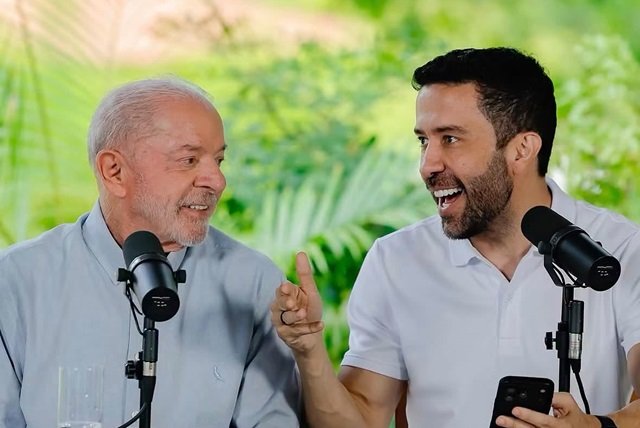
André Janones does not describe himself as a political consultant. He prefers the language of a commander. As the leader of what he calls the digital army of Brazil’s President Luiz Inácio Lula da Silva, the 42-year-old congressman has become one of the most closely watched figures in the country’s political communication machinery. Having helped mobilise millions of internet users during Lula’s unexpected electoral comeback, he now wants to take the lessons of that campaign beyond Brazil — with an ambition that reaches well beyond electoral politics.
“I want to share my knowledge to contribute to the growth of the progressive camp and, consequently, to the end of the far right in the world,” Janones tells EL PAÍS.
His influence has recently extended into presidential diplomacy. Janones accompanied Lula on his first international tour since re-election, visiting Spain, Turkey and the Philippines. He attended bilateral meetings, including the encounter between Lula and Spanish Prime Minister Pedro Sánchez at the Moncloa Palace in Madrid. He says he witnessed the respect other leaders showed the Brazilian president and gained an unusually close view of his negotiating style.
Janones is careful, however, to distinguish his political sympathies from direct intervention in foreign elections. Although he wants Sánchez and the Spanish Socialist Workers’ Party to win the forthcoming election, he insists that he is not working on their campaign. He has shared Brazilian experience, offered recommendations and spoken with the young woman responsible for the party’s digital channel, but says he is not participating directly. Lula, he adds, does not interfere in other countries’ elections. During his conversation with Sánchez, the Brazilian president reportedly stressed that relations between Brazil and Spain would continue regardless of the electoral outcome.
Janones nevertheless believes that between 50 and 60 per cent of Brazil’s digital campaign model could be reproduced in Spain, although street-level mobilisation would carry greater importance there. He considers Argentina an even more promising environment, arguing that the far right dominates the political narrative while the left remains comparatively hesitant on social media.
The strategy that brought him international attention is less complicated than its reputation suggests. A short, unofficial manual describing his methods has reportedly circulated in 27 languages. Its central lesson is counter-intuitive: supporters should not rush to defend their candidate whenever opponents attack. Doing so, Janones argues, generates engagement and encourages platforms to distribute more of the hostile material.
He describes the algorithm as “an extremely high-IQ being, an Albert Einstein, but blind”. It interprets interaction as a signal of interest rather than distinguishing between approval and condemnation. If attacks on a candidate attract large numbers of comments, the platform may promote more of that content. His advice is therefore to engage only with publications favourable to one’s political side.
Speed is the second principle. Janones argues that timing matters more than polished content. Progressive campaigners, he says, can become trapped in the pursuit of carefully edited, immaculate messages, while political communication on social media rewards immediacy and spontaneity. The third ingredient is emotional intensity. His own posts frequently begin with the urgent declaration “pessoal, urgente!” — an appeal designed to mobilise supporters and create a sense of immediate action.
His style is deliberately confrontational. “My methods are violent, but the discourse is peaceful,” he says, presenting aggression in presentation as compatible with a peaceful political objective. The distinction is central to his approach, but it also exposes a tension in the strategy: a movement seeking to defeat extremism may find itself adopting some of the emotionally charged techniques that have helped polarise political debate.
Janones argues that the Brazilian experience cannot be exported wholesale. Lula himself is an irreplaceable political asset: a charismatic figure with a working-class background and a personal history that, in Janones’s view, makes him appear to embody democracy and popular identity. Digital tactics can amplify such a candidate, but they cannot manufacture the same political connection.
Janones’s own trajectory helps explain his identification with Lula. Raised in poverty by a mother who worked as a domestic employee, he worked as a bus conductor to finance his law studies. He became known on social media as a lawyer representing patients seeking treatment through the public health system. After joining the Workers’ Party and participating in Lula’s 2022 campaign, he emerged as a more consequential figure during the recent electoral contest.
His influence also helped persuade Lula, previously resistant to owning a mobile phone, to enter the digital world during the campaign. The president now occasionally checks Instagram and X and, according to Janones, has begun to understand the language of memes. The objective, he says, is not to turn Lula into a social-media personality but to make him recognise the importance of digital communication.
There are signs that the digital mobilisation machine may be difficult to sustain between elections. Janones’s WhatsApp channel has 9.5 million followers, approximately one million fewer than on election night. He describes the decline as the aftermath of victory, with supporters revisiting the campaign and joking about the defeated side. He expects the network to regain momentum when Lula’s fourth term begins on 5 January and the new Congress takes office.
Its next mission will be different. Rather than securing an election victory, the digital army will be expected to help Lula govern, sustain his popularity and build support for his programme. Janones has set his sights on restoring the kind of public approval Lula enjoyed at the end of his first presidential period, when his popularity reached 87 per cent.
The broader significance of his rise lies in what it reveals about political power in the digital age. Campaigns are increasingly fought not only through speeches, policies and conventional media, but through the mechanics of platforms that reward attention, speed and emotional response. Janones believes he has learned how to turn those mechanics into an electoral advantage. Whether his formula can strengthen progressive movements abroad — or further intensify the polarisation it seeks to overcome — remains an open question.