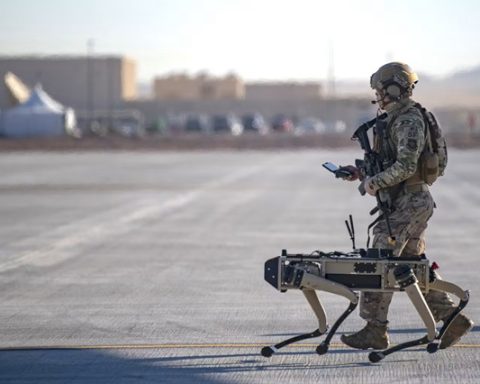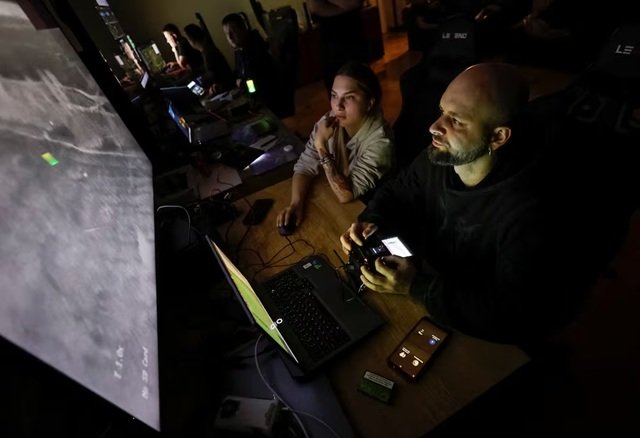
The transformation of warfare is becoming increasingly visible in Ukraine, where small, remotely operated machines are performing tasks once reserved for conventional military forces. On the battlefield, heavy aerial drones are extracting wounded soldiers from positions inaccessible to medical teams and ground vehicles. At sea, explosive unmanned vessels are destroying sophisticated warships without requiring a conventional naval confrontation. Two developments, separated by geography but connected by technology, illustrate how Ukraine’s war against Russia is changing the relationship between military capability, operational reach and the vulnerability of traditional weapons systems.
For 25-year-old Ukrainian soldier Eugen, identified by his military callsign Izum, an experimental evacuation drone became the difference between survival and potentially dying on the battlefield. On 23 October, while digging trenches at a position approximately five kilometres from the Russian border, he unknowingly stood on a landmine concealed beneath fallen leaves. When he attempted to move towards shelter after hearing a suspicious buzzing sound, the explosion destroyed part of his left foot. His colleagues carried him into a shelter, applied a tourniquet and dressed his wounds, following instructions from a combat medicine specialist more than 30 kilometres away.
The immediate medical response was followed by an improvised logistical operation. A Ukrainian Vampire drone delivered painkillers, antibiotics and drinking water to the isolated position. But medical supplies could not solve the central problem: getting the severely wounded soldier out. The surrounding terrain was difficult, and travelling approximately 30 kilometres across exposed ground would have left him vulnerable to Russian first-person-view (FPV) drones. Ground-based evacuation vehicles could not reach his position either.
By the fourth day, Izum’s physical and psychological condition had deteriorated. He had begun losing hope when his commander announced that an aircraft would be sent to retrieve him. The machine was a StarGate, a large aerial drone developed by Ukrainian company SkyFall, capable of carrying up to 150 kilograms in a suspended rectangular cabin.
The aircraft’s development took approximately a year, according to an unnamed SkyFall spokesperson. The company began working on the concept after the commander of Ukraine’s 475th Independent Assault Regiment, known as Cod.92, identified the need for an alternative method of extracting soldiers trapped in positions beyond the reach of conventional evacuation systems. Izum was subsequently transported from the front and taken to hospital in Kyiv, where he has undergone 12 operations.
His experience reflects a wider deterioration in the conditions for battlefield medical evacuation. Medical teams are increasingly exposed to FPV drone attacks, while ground-based robotic vehicles are vulnerable to strikes or simply cannot access certain positions. A doctor from Ukraine’s 24th Brigade in Kramatorsk described the medical consequences of these delays: prolonged evacuation increases the difficulty of treating infections, with some wounded soldiers losing limbs because treatment cannot be provided in time, while others die.
The StarGate system represents an attempt to address this problem through a different form of military aviation. Its introduction followed another highly publicised evacuation involving Ukrainian soldier Kostyantyn Vlasenko, who was reportedly trapped on the front for 491 days and had lost both legs. Images of his extraction by an aerial drone attracted considerable attention in Ukraine. The StarGate subsequently completed its first rescue mission, retrieving 24-year-old Artem Lytvy, who had been wounded for eight days.
Lytvy had lost a foot after an explosion involving an anti-tank mine. His companion suffered severe injuries and later died in his arms. With Russian attacks continuing and infection advancing, Lytvy’s colleagues could provide little more than food and water. When the rescue aircraft arrived during the night, he crawled towards it, climbed inside and was transported away. The mission’s pilot, Andrii, described the operation as the greatest responsibility of his life. He had been unable to sleep for three days before the mission, and the aircraft required three attempts to take off.
The risks extend beyond the aircraft’s mechanical capabilities. Operations require coordination with other Ukrainian battalions, while Russian drones can attack the vehicle or electronic interference can disrupt its systems. Nevertheless, the source reports that eight evacuations have been completed using the StarGate since its introduction.
The same technological shift is producing consequences far beyond the land battlefield. Ukraine’s campaign against Russia’s Black Sea Fleet has demonstrated that conventional naval superiority does not necessarily guarantee protection against smaller, remotely controlled weapons. In almost five years of war, the Russian and Ukrainian navies have never fought a direct ship-to-ship engagement. Yet dozens of Russian Black Sea Fleet vessels, including most of its major warships, have been sunk or seriously damaged.
The latest example is the Russian corvette Merkury, which was destroyed on Sunday by maritime drones while anchored at a naval base in Libya, more than 1,500 kilometres from Ukraine’s coastline. The vessel, belonging to the Project 20380 Steregushchi class, entered service in 2023 and was among Russia’s most modern warships. Measuring 104 metres, displacing 2,200 tonnes and carrying approximately 100 crew members, it was equipped with artillery, missiles and a helicopter. Several unmanned vessels, each only a few metres long, nevertheless overwhelmed it.
The destruction carries particular significance because President Vladimir Putin had publicly celebrated the corvette during Russia’s Navy Day parade in St Petersburg in July 2023. The Russian Defence Ministry had previously highlighted the class’s modern naval missiles and potential for further upgrades. Its destruction has therefore reopened questions within Russia about the adequacy of traditional naval defences.
The vulnerability was already apparent following the sinking of the Black Sea Fleet’s flagship, the missile cruiser Moskva, in April 2022. Ukrainian aerial and maritime drones subsequently forced numerous Russian vessels away from the strategically important base at Sevastopol. In 2024, Ukrainian forces disabled the submarine Rostov-on-Don using aerial drones while it was anchored there. In 2025, underwater drones damaged another Russian submarine at Novorossiysk, an operation Kyiv described as a turning point in naval warfare. In June this year, aerial drones also seriously damaged the Merkury’s sister vessel, the Boiki, at Kronstadt.
The latest attacks have provoked criticism among Russian military commentators and analysts. War correspondent Alexandr Kots warned that naval combat had become a challenge that Russia must confront or face disaster. He argued that drone operators could operate from almost anywhere and that civilian vessels under different flags could potentially serve as launch platforms. Deploying inspection vessels to monitor every section of the world’s oceans, he acknowledged, would be impossible.
Some Russian military commentators have consequently called for retaliation against countries providing Ukraine with bases and surveillance assistance. However, the source also records that Russian attacks have sunk several cargo ships belonging to NATO countries this year, particularly Turkish vessels in waters near Romania and Bulgaria, killing dozens of sailors.
The significance of these developments extends beyond the immediate contest between Moscow and Kyiv. On land, unmanned aircraft are becoming potential lifelines for soldiers whom conventional military logistics cannot reach. At sea, relatively small explosive vessels are demonstrating their capacity to destroy heavily armed warships. Neither development eliminates the importance of conventional forces, but both expose the limitations of relying on established military platforms in an environment increasingly shaped by remote operation, electronic warfare and unmanned technology. Ukraine’s experience is demonstrating that the decisive question in modern warfare may no longer be simply which side possesses the largest weapons, but which can adapt its military capabilities to make traditional advantages increasingly difficult to defend.