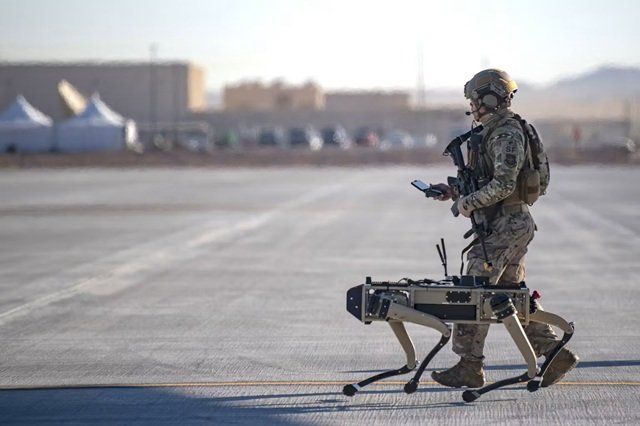
Artificial intelligence is no longer merely a technological prospect for the world’s militaries. It is becoming part of the machinery through which wars are planned, fought and potentially escalated. From intelligence analysis and target identification to logistics, surveillance and command decisions, AI-enabled systems are already changing the conduct of military operations. Yet behind these technologies lies an increasingly powerful network of private companies whose influence extends beyond supplying equipment and software. They are also helping to shape the rules by which military AI will be developed and used.
This is the central concern of Mapping the Military Artificial Intelligence Industry: Actors, Influence and Policymaking, a November 2026 report by Alexander Blanchard and Laura Bruun, published by the Stockholm International Peace Research Institute, known as SIPRI. The report examines an issue that receives less attention than the technology itself: who controls the commercial ecosystem behind military AI, what interests drive its participants, and how much influence should these companies exercise over the policies governing their products?
The report begins by challenging the idea that the military AI industry is a single, clearly identifiable sector. Instead, it describes a layered and constantly evolving ecosystem comprising four broad categories: established defence contractors, newer defence technology companies and start-ups, major technology corporations, and providers of advanced AI models. These groups have different business structures, sources of finance and relationships with governments. Their interests do not necessarily coincide, but their growing dependence on partnerships, acquisitions and shared infrastructure is making the boundaries between them increasingly difficult to distinguish.
The traditional defence contractors, or ‘legacy primes’, remain important suppliers of sophisticated military platforms and integrated systems. Companies such as Lockheed Martin, Northrop Grumman, BAE Systems and Thales have longstanding relationships with governments and experience managing complex defence programmes. Their involvement in technologies that underpin contemporary military AI predates the current excitement surrounding generative AI. Automated sensing, data fusion, surveillance and decision-support systems have been part of military development for decades.
A newer generation of companies is challenging this established model. Firms such as Palantir, Anduril, Shield AI and Germany’s Helsing have developed software-driven products, autonomous systems and data platforms, often with the support of venture capital. Unlike traditional contractors, which frequently develop equipment in response to government specifications, these companies invest in products independently and then seek military customers. Their emphasis on rapid development, commercial software models and shorter procurement cycles has begun to alter how governments acquire military capabilities.
The distinction matters because these companies are not simply selling equipment. Some offer software through subscription arrangements, retaining control over the platforms and intellectual property that militaries depend on. The SIPRI report draws attention to the resulting possibility of ‘vendor lock-in’: once a military organisation integrates a proprietary system into its operations, changing suppliers can become technically difficult and expensive. Dependence on a commercial provider can therefore acquire strategic implications, particularly when the company controls essential software updates, data formats or system functionality.
Big technology companies occupy another critical position. Microsoft, Google, Amazon and Oracle provide cloud computing, data storage and processing infrastructure on which many advanced AI applications depend. Their military involvement is not always immediately visible because the same infrastructure may serve civilian and military customers. However, the report documents the growing integration of commercial technology into defence systems, including major cloud contracts and arrangements supporting military and national security applications.
At the other end of this ecosystem are foundation model providers, whose products supply the underlying capabilities for a wide range of AI applications. OpenAI, Anthropic, xAI, Google DeepMind and France’s Mistral AI are among the companies discussed. Their movement into military markets is particularly significant because some initially maintained restrictions on military applications before changing their positions or expanding their engagement with defence institutions. For these companies, military contracts offer access to substantial government budgets and an additional source of revenue to support the considerable costs of developing and operating advanced models.
The convergence of these four categories is producing a new kind of military-industrial relationship. A defence contractor may integrate a start-up’s software into a weapons platform; a technology giant may provide the cloud infrastructure; and an AI model provider may supply the underlying intelligence capabilities. The public may see the finished military system without knowing which companies designed, developed, financed or control its different components. SIPRI argues that this growing interdependence makes it harder to establish who is responsible for what, while potentially encouraging further consolidation across the industry.
But the report’s most consequential argument concerns the industry’s influence over policymaking. Companies involved in military AI do not approach international discussions as neutral providers of technical expertise. They also have commercial interests, institutional preferences and particular ideas about how military AI should be regulated. Their positions are shaped by their business models, their relationships with governments and the degree to which their activities are exposed to public scrutiny.
Blanchard and Bruun identify three principal routes through which companies can influence policy: access to people and policymaking spaces, narrative-building, and legal or contractual mechanisms. The first includes lobbying, participation in policy forums and the movement of personnel between government and industry. Such exchanges can bring valuable expertise into public institutions, but they can also carry commercial priorities and assumptions into government decision-making.
The second route is less direct but potentially just as influential. Companies construct narratives about technological competition, national security and the future of warfare. Some newer US defence technology firms, for example, frame military AI development as an essential requirement in the strategic competition with China. Arguments that excessive regulation could weaken national security or allow geopolitical rivals to gain an advantage can influence how policymakers understand the choices before them. The report examines how such narratives may narrow the space for debate, particularly when calls for restraint are presented as strategically naïve or harmful to national interests.
The third route involves legal and contractual arrangements. Companies can influence how their technologies are used through terms of service, licensing conditions and restrictions embedded in their products. These arrangements can give private firms a degree of control over the practical boundaries of military applications. The report’s discussion of Microsoft’s decision in September 2025 to disable certain services supplied to an Israeli military unit illustrates how contractual conditions can become consequential in the relationship between technology providers and armed forces.
None of this means that companies should be excluded from discussions about military AI. Governments need access to the technical knowledge of organisations developing and deploying these systems. Industry participation can help policymakers understand technological capabilities, operational limitations and the practical challenges of implementing regulations. It can also encourage companies to adopt responsible practices. The problem, as SIPRI frames it, is not participation itself but the absence of sufficiently clear rules governing that participation.
This creates the possibility of what the report calls ‘regulatory capture’: a situation in which public policy, ostensibly informed by commercial expertise, gradually becomes shaped by the interests of the companies providing that expertise. The distinction can be difficult to identify because influence does not necessarily take the form of direct pressure or explicit lobbying. It can accumulate through repeated consultations, personnel exchanges, public narratives and contractual relationships.
SIPRI identifies three weaknesses in current international policymaking that make this risk more pronounced. First, governments have not clearly defined the role that industry should play in international military AI discussions. Second, states have yet to reach sufficient agreement on common principles governing the technology, leaving room for commercial actors to shape the debate. Third, many government institutions lack the technical capacity and specialist personnel required to scrutinise industry claims independently. Companies with substantial financial and technical resources can consequently enjoy an advantage over public officials who are expected to regulate them.
The report’s recommendations are directed primarily at governments. States should establish clear criteria for deciding which companies are relevant to particular policy discussions, taking account of their proximity to decisions involving the use of force, their influence over the behaviour of AI-enabled systems and their role in connecting different suppliers. They should also establish formal channels for industry engagement, drawing on existing international frameworks, including the World Health Organization’s Framework of Engagement with Non-state Actors.
Equally important, governments must strengthen their own capacity to assess commercial claims. SIPRI recommends investing in technical, legal and policy expertise within ministries of defence and foreign affairs, while drawing on universities, independent research institutes and international organisations for advice. The authors also argue that governments must connect different policy instruments, including procurement, export controls, competition policy and foreign policy, rather than relying exclusively on voluntary guidelines or international declarations.
There is, however, an important limitation to the report’s geographical scope. Its analysis focuses predominantly on the United States and parts of Europe, reflecting the availability of English-language information and its emphasis on private-sector participation in military AI. China and Russia are covered only partially, and the authors caution against assuming that the relationships between governments and industry in those countries mirror the patterns identified in the report. That qualification matters: the findings provide a framework for understanding an important part of the military AI industry, not a comprehensive account of every national military technology ecosystem.
The larger question raised by the SIPRI study is whether governments can retain meaningful authority over technologies that they increasingly depend on private companies to develop and operate. Military AI may promise faster analysis, greater operational efficiency and new strategic capabilities. But decisions about acceptable risks, human oversight and the use of force cannot be reduced to technical specifications or commercial terms.
The future governance of military AI will therefore depend not only on what these technologies can do, but also on who gets to define what they should be allowed to do. The challenge for states is to benefit from private-sector innovation without allowing the suppliers of military AI to become the principal authors of the rules governing its use.