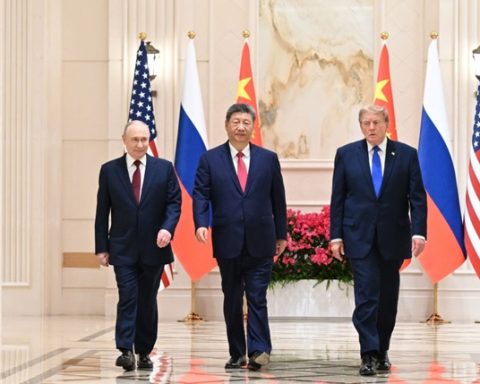
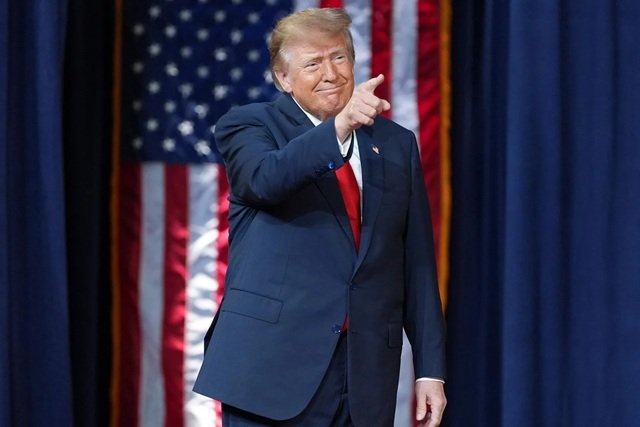
It is well understood that Donald Trump lies habitually about matters both big and small. But he can also be disarmingly honest at times. There was an example of this at the press conference he gave on November 20 after his return from the Shenzhen summit where he met with Presidents Xi and Putin.
It should be clear by now that it is impossible to infer a coherent set of ideas guiding Trump’s foreign policy. His decisions are much better seen through the lens of Trump’s individual psychological needs—and he is a very needy person.
That neediness can be seen in the video clip of his sudden joy at seeing Putin at the summit, and rushing over to warmly greet his “friend.” At the press conference, he explained that he was a friend because Putin supported him during the allegations that his 2016 campaign colluded with Russia: “I’ve been dealing with Putin during the fake Russia, Russia, Russia hoax, and to be honest, he was very nice about it…”
He believes that Putin shares his warm feelings, explaining that “frankly, if the [2020] election weren’t rigged, where I had to wait 4 years, that … war would never have happened. Putin said that last night … I actually asked him, I said, ‘Would you have gone in if I was president?’ He said, ‘No, would have never happened.’” This was supposedly true not because Putin feared Trump’s response, but because of the Russian dictator’s warm feelings of friendship towards the American president. Though Putin has explained at great length that he launched the war for reasons having to do with Russia’s historical identity, in Trump’s view it was all about him.
This is all part of a worldview that geopolitics is driven by personal relationships between leaders, rather than underlying national interests. When asked by Kaitlan Collins whether Putin was friendly to the United States as a whole or just to him, Trump answered, “I can’t speak to America.”
There you have it: a president who is not representing his country, but only himself.
The same can be said about Trump’s policy towards China. It’s all about the way he is treated. At the same press conference, he said:
So everywhere I went on this trip and every leader I met, it was clear that America is respected again like never before. We are respected. I was greatly honored that President Xi met our country—didn’t meet me—met our country at the plane, something he’s never done before. And that means he respects our country. He didn’t meet Sleepy Joe at the plane, that I can tell you.
Needless to say, in Trump’s mind China is respecting the United States as a country only because Trump is president.
It is doubtless true that Xi Jinping likes the United States better with Donald Trump at the helm. The president is doing China’s work for it, confirming the view common in Beijing that America is a country in decline. The president is weakening America vis-à vis-China in every possible way, by disparaging allies, launching pointless trade wars while losing a real war, cutting funding for scientific research, attacking universities, and alienating the better part of the American population which just voted against him and his party in the recent midterm election. It turns out that you can win over this clownish president simply by meeting him at the airport; no concessions on trade, AI, or the Middle East are necessary.
The recent scandal involving Jensen Huang and Nvidia illustrates the way that Trump has prioritized personal interest over national interest. His administration has backed breakneck development of AI and data centers on the grounds that this was needed to beat China in the AI arms race. And yet, Trump has been mostly tolerant of Jensen Huang’s desire to sell high-end chips (though not its more advanced Blackwell chip) to China because he likes Huang’s flattery, failing to blame him for his participation in a scheme to avoid export controls by selling to Southeast Asian partners that rent Nvidia computing power to Chinese firms. China can be allowed to catch up in the AI race as long as the country’s leader meets Trump at the airport and treats him like royalty.
Both Vladimir Putin and Xi Jinping must be marveling at the ease with which they can manipulate a childlike American president by catering to his psychological neediness for praise and attention. We need a new theory of international relations in which great powers are not driven by national interest, but by the perceived self-interest of their leaders. Or perhaps, that’s the way international relations always worked, before the rise of the modern era.