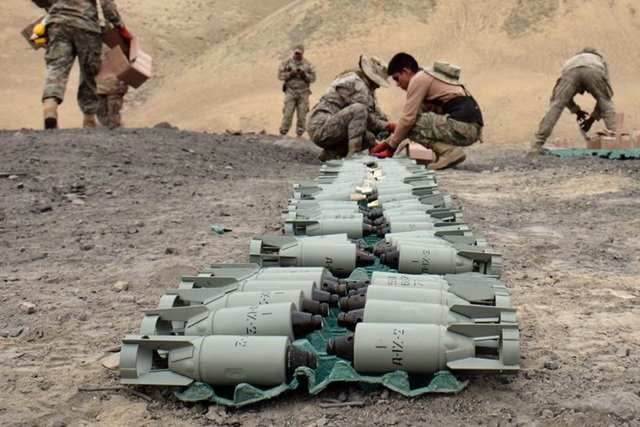
Britain’s military intervention in Sierra Leone in 2000 is often presented as an example of Western military power being used to protect civilians, prevent a rebel takeover and restore stability. But newly examined government records reveal a less comfortable dimension to the operation: Tony Blair’s government was prepared to deploy cluster bombs, weapons notorious for leaving unexploded explosives capable of killing and maiming civilians long after fighting has ended.
According to documents examined by UK Declassified, the Ministry of Defence (MoD) considered cluster munitions a potentially necessary component of British military operations as troops intervened in Sierra Leone’s civil war. In a memorandum written in May 2000, Wing Commander Andy Suddards recorded that cluster weapons would “in all probability be required” if British aircraft conducted close air support missions over the country. He added that their use was consistent with existing Ministry of Defence policy, provided it remained within Britain’s treaty obligations.
The memorandum, written shortly after British troops were deployed, also revealed that the government was aware of concerns surrounding the weapons. Referring to a recent Cabinet meeting, an MoD official observed that the prevailing position appeared to be “so be it, despite the widespread concerns over UXBs”, referring to unexploded bomblets. Suddards nevertheless acknowledged that alternatives should be preferred where they could adequately accomplish the military task. “If it is possible to use alternative weapons which are adequate to meet the task, then it would be preferable to avoid the use of cluster weapons,” he wrote.
It remains unclear whether British forces ultimately used cluster bombs in Sierra Leone. When approached by UK Declassified, the Ministry of Defence said an initial search had found no evidence of their deployment but acknowledged that it had been unable to conduct a more comprehensive investigation within the available time. The distinction is important: the documents establish that their use was considered and regarded as potentially necessary, not that the weapons were actually deployed.
Cluster bombs are particularly controversial because they scatter numerous smaller explosive devices across a wide area. Many fail to detonate on impact, leaving unexploded bomblets that can subsequently injure or kill civilians. Their consequences therefore extend beyond the immediate military engagement, creating dangers for communities long after combat has ended.
Britain’s consideration of these weapons in Sierra Leone cannot be separated from its recent military record. During the 1999 Kosovo war, the Blair government had already used cluster munitions extensively. British aircraft dropped 531 such devices, each containing 147 bomblets and more than 2,000 pieces of shrapnel. A parliamentary Defence Committee report estimated that up to 12 per cent failed to explode on impact, leaving between 4,000 and 10,000 unexploded bomblets on the ground.
The Cluster Munition Coalition’s 2026 report identifies British use of the weapons in conflicts involving the Falkland Islands, Iraq, Kuwait, Kosovo, Montenegro and Serbia. The Sierra Leone documents therefore form part of a wider history of British military reliance on a weapons system whose effects on civilian populations have generated sustained international concern.
The timing also matters. In 2008, Britain signed the Convention on Cluster Munitions, an international treaty that entered into force in 2010 and committed participating states to destroy their stockpiles. The convention explicitly recognised the dangers posed by national reserves of cluster munitions retained for operational use. The British government’s position in 2000, however, was that their deployment remained permissible under the treaties then in force, provided the relevant obligations were respected.
The revelations complicate the established narrative of Britain’s intervention in Sierra Leone. British troops were dispatched in May 2000 to evacuate UK nationals and support a United Nations peacekeeping force as the Revolutionary United Front (RUF), estimated by the MoD to have 8,000 fighters, advanced towards the capital, Freetown. The rebel organisation had become notorious during eight years of civil war for brutal attacks and the deliberate mutilation of civilians.
British military intervention prevented the rebels from taking Freetown and is widely regarded as having produced comparatively positive outcomes for the country’s population and human rights. Britain also provided substantial development assistance and had supported programmes to disarm former combatants and reintegrate them into civilian society. Unlike subsequent British interventions in Afghanistan, Iraq and Libya, Sierra Leone has frequently been presented as evidence that external military involvement can produce beneficial results.
Yet the newly examined records suggest that the operation was driven by considerations extending beyond humanitarian protection and regional stability. A Cabinet Office paper from December 1999 described Sierra Leone as having “little/no significance from the perspective of the UK’s overall security policy”. Nevertheless, British officials repeatedly expressed concern that the government’s credibility was at stake if the country’s deteriorating security situation undermined years of diplomatic and development investment.
In December 1999, International Development Secretary Clare Short warned Foreign Secretary Robin Cook that Britain’s credibility was at risk. The government had invested considerable political capital in Sierra Leone’s peace process and development, she argued, and failure could become “a major embarrassment”. In March 2000, Andrew Patrick, Cook’s private secretary, similarly described the country as being “on a knife edge with Britain’s credibility at stake”.
Regional instability was another concern. In a telephone conversation with Sierra Leonean President Ahmad Kabbah in March 2000, Blair explained that Britain wanted to prevent a renewed crisis from destabilising the wider West African region. Britain’s traditional economic interests in the region had centred heavily on Nigeria, where Shell maintained extensive oil interests.
A January 1999 telephone conversation between Blair and Nigerian President General Abdulsalami Abubakar also touched on the situation in Ogoniland, an oil-producing region where local communities were dissatisfied with the distribution of oil revenues. Abubakar raised the issue, and Blair affirmed Britain’s support for Nigeria’s territorial integrity and willingness to assist.
Taken together, the records examined by UK Declassified offer a more complicated account of an intervention frequently held up as a model of British military engagement. They do not establish that cluster bombs were used in Sierra Leone, nor do they negate the intervention’s positive consequences. They do, however, demonstrate that even an operation associated with civilian protection involved serious consideration of weapons carrying potentially long-lasting humanitarian consequences. The distinction between the declared objectives of military intervention and the means governments are prepared to employ remains central to assessing the responsibilities and limits of military power.