For generations, the abundance of oval brooches across the Viking world has helped sustain an influential interpretation of early Scandinavian manufacturing: that jewellery was produced on an industrial scale in specialised urban centres and distributed through extensive trading networks. New archaeological research, however, is challenging that assumption, revealing a production culture considerably more diverse and technically sophisticated than previously understood.
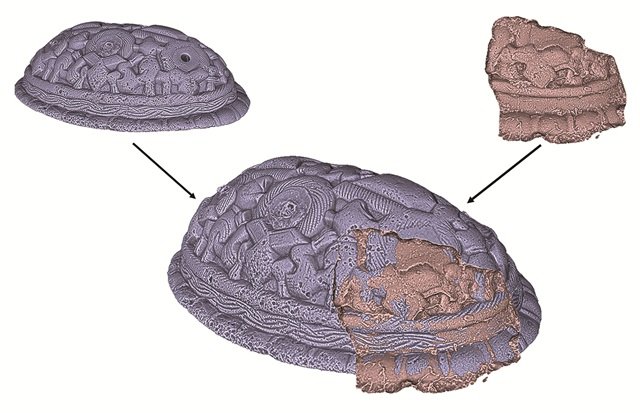
The findings, published by Derek Parrott of Aarhus University in Denmark in Antiquity, an international peer-reviewed journal of world archaeology, draw on high-resolution three-dimensional modelling to establish direct connections between surviving Viking Age brooches and the casting moulds used to manufacture them. The results suggest that even jewellery sharing recognisable designs could differ substantially in its construction, ornamentation and manufacturing techniques.
Oval brooches were among the most widely distributed objects of Viking Age Scandinavia, conventionally dated between AD 750 and 1050. Usually worn in pairs to fasten outer garments, they became important markers of Scandinavian identity. Thousands have been recovered across Scandinavia and territories associated with the Viking diaspora. Their widespread distribution and recurring designs have long been interpreted as evidence of organised production and the circulation of standardised products.
That interpretation gained support from archaeological discoveries in major trading centres, particularly Ribe in south-western Jutland, Denmark. Tens of thousands of ceramic casting-mould fragments have been recovered from the town, establishing its importance as a centre of specialised metalworking. Similar evidence from Birka and Hedeby reinforced the view that major urban settlements served as centralised production centres, manufacturing jewellery in substantial quantities for distribution across the Viking world.
Yet the evidence has presented a persistent problem. Casting moulds are frequently damaged, fragmented and scorched during the manufacturing process. Their surviving impressions are negative representations of the finished objects, making direct comparisons difficult. Previous investigations consequently relied heavily on typological classifications, photographs and interpretive drawings rather than identifying individual brooches with the specific moulds from which they had been cast. Meanwhile, craft production and exchange at smaller coastal and inland settlements remained comparatively underexplored.
Parrott sought to overcome this limitation by applying high-resolution digital scanning to 244 oval-brooch casting-mould fragments recovered during excavations at Ribe in 2017 and 2018. He compared them with 105 surviving Berdal-type brooches from Denmark, Norway, Sweden and northern Germany, representing the largest corpus of this type examined in such a study. Using a portable blue-light scanner with an accuracy of up to seven micrometres, he produced detailed digital models capable of revealing minute surface characteristics that conventional examination could overlook.
The comparison identified five original casting models corresponding to seven surviving brooches and 58 mould fragments. The five matches comprised three individual brooches and two pairs. Four of the matched finds originated from Denmark and western Norway, while the fifth came from eastern Denmark.
The relatively small number of matches is central to the study’s challenge to established archaeological thinking. If oval brooches had been manufactured extensively through standardised mass production at major urban centres, researchers might reasonably expect more surviving examples to correspond directly with the excavated moulds. Instead, only five of the 105 examined brooches could be linked to casting models represented in Ribe’s assemblage.
The author acknowledges that preservation may partly explain the limited number. The surviving archaeological record represents only a fraction of the brooches originally manufactured. Nevertheless, the results raise questions about whether production was as concentrated and standardised as previously assumed, and whether similar objects were being made at locations beyond the principal trading centres.
More revealing still is the variation within the matched examples themselves. Three brooches belonging to the P14 category displayed different arrangements of decorative borders and different treatments of recurring motifs. Two of these, recovered from different locations, could be linked to mould fragments originating from the same construction and archaeological phase at Ribe. Their differences indicate that artisans working within the same production environment were not simply reproducing an identical template. Instead, they created distinct models, making deliberate choices about ornamentation and design.
The research also identified differences in manufacturing techniques. Some brooches received much of their decoration directly through the casting process, with details incorporated into the original model and transferred to the finished metal. Others underwent additional engraving after casting. The paired brooches from Gimmeland in western Norway, for example, contained decorative interlace patterns added through post-casting metalwork, details that were absent from the original mould impressions.
These differences suggest that production involved several technical traditions and potentially different levels of specialisation. The study raises the possibility that engraving was a specialised skill, perhaps undertaken by more experienced artisans, while other workers concentrated on casting. Such divisions of labour remain interpretations rather than established conclusions, but they point towards workshop environments more complex than straightforward mass manufacture.
The geographical distribution of the matched brooches also offers clues about Viking Age exchange. Four of the five matches were associated with north-western Jutland and western Norway. Their distribution supports earlier suggestions of a north–south maritime route connecting the western coast of Jutland with Norway. If this route was used to circulate finished jewellery, products from Ribe may have travelled towards communities along the coast rather than requiring their intended recipients to visit the trading centre themselves. Parrott cautions, however, that this proposed route remains conjectural and requires further investigation.
The broader significance of the research lies in its demonstration that familiar archaeological categories can conceal substantial differences in the production of apparently standardised objects. Viking jewellery was not necessarily the outcome of an impersonal manufacturing system built around identical products. Its production appears to have involved individual creative decisions, distinct technical practices, local knowledge and potentially specialised artisan communities.
As Parrott concludes, Viking Age Scandinavians were not practitioners of fast fashion. The evidence instead presents a manufacturing culture in which shared forms accommodated considerable individual variation. By connecting surviving objects with the moulds that produced them, three-dimensional archaeology is beginning to reveal not simply where Viking jewellery circulated, but how individual artisans made it.