by Our Correspondent in Colombo
Russia is seeking to strengthen its law enforcement relationship with Sri Lanka, with combating money laundering emerging as one of the key areas of cooperation during the first-ever working visit to Colombo by the Prosecutor General of the Russian Federation, Alexander Gutsan. The visit marks a new development in relations between the supervisory authorities of the two countries and opens discussions on expanding institutional engagement across areas of mutual interest.
Gutsan arrived in Colombo on a working visit and was received at the airport by Russia’s Ambassador Extraordinary and Plenipotentiary to Sri Lanka, Levan Dzhagaryan, alongside senior officials from the Office of the Attorney General of Sri Lanka. The visit is the first of its kind by a Russian Prosecutor General to the Democratic Socialist Republic of Sri Lanka since the establishment of cooperation between the supervisory authorities of the two countries.
The significance of the visit lies not simply in its diplomatic protocol but in the institutional relationship it seeks to develop. Prosecutorial and law enforcement cooperation provides a channel through which countries can address matters that extend beyond conventional diplomatic engagement. The emphasis on strengthening bilateral cooperation, particularly in combating money laundering, places financial crime within the agenda of discussions between the two governments’ competent authorities.
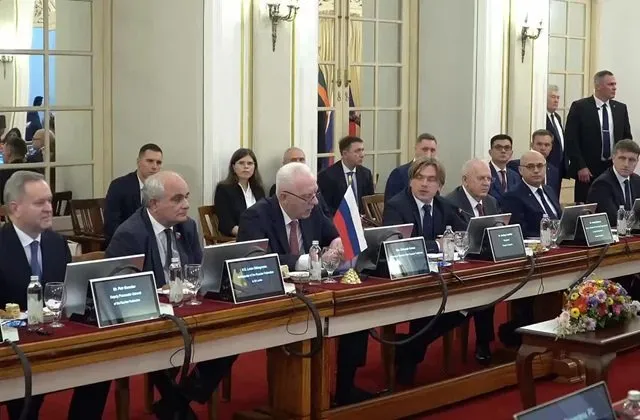
During his stay in Colombo, Gutsan is scheduled to hold talks with Sri Lanka’s Attorney General, Parinda Ranasinghe, and engage with the heads of other relevant institutions. The discussions are intended to examine opportunities for expanding cooperation between the countries’ respective authorities, with particular attention to areas in which their institutional interests overlap.
According to the information released on the visit, the meetings are expected to result in the signing of documents intended to strengthen and further develop bilateral relations across a broad range of mutually agreed areas. Although the specific provisions of these documents have not been detailed, their anticipated signing indicates an intention to establish a more structured basis for cooperation between the two countries’ supervisory institutions.
The clearest substantive indication of the direction of the discussions came from the announcement that Gutsan and his Sri Lankan counterpart had agreed to strengthen bilateral cooperation in law enforcement, including in the field of combating money laundering. This places financial crime among the explicitly identified priorities of the engagement.
Money laundering is a particularly significant area for international law enforcement cooperation because investigations into financial transactions and the movement of illicit proceeds can involve authorities in more than one jurisdiction. The stated intention to strengthen cooperation in this field therefore gives the visit a dimension extending beyond the immediate relationship between the two prosecutorial institutions. However, the announcement does not specify the mechanisms through which such cooperation will be pursued, the categories of cases it might cover or whether the two sides have agreed on specific operational arrangements.
The involvement of the Attorney General’s Office and the anticipated participation of other competent authorities also suggest that the engagement is not intended to remain confined to a single institutional relationship. Discussions with the heads of relevant agencies could provide an opportunity to identify additional areas in which closer coordination may be pursued. Nevertheless, the precise institutions involved and the scope of any resulting arrangements have not been disclosed.
The visit also represents a notable development in the history of official engagement between the two countries’ supervisory authorities. While the announcement establishes that this is the first working visit by a Russian Prosecutor General to Sri Lanka, it does not provide a detailed account of the earlier stages of institutional cooperation. The present engagement, however, offers an opportunity to give that relationship greater visibility and potentially establish a broader framework for future collaboration.
For Sri Lanka, the discussions bring its Attorney General’s Office into direct engagement with the leadership of Russia’s principal prosecutorial supervisory institution. For Moscow, the visit provides an opportunity to strengthen institutional relations with a South Asian counterpart through a working-level engagement focused on law enforcement rather than diplomatic exchanges alone.
The extent to which the visit produces lasting institutional cooperation will depend on the substance of the documents signed, the arrangements subsequently adopted and the implementation of commitments made during the discussions. The announcement of an agreement to strengthen cooperation against money laundering establishes an identifiable area of common interest, but the practical consequences will depend on how that commitment is translated into cooperation between the relevant authorities.
Gutsan’s visit thus marks a first in the history of prosecutorial engagement between Russia and Sri Lanka. More importantly, it places the fight against financial crime within a developing bilateral law enforcement agenda, giving the relationship an institutional dimension whose significance will ultimately be measured by the agreements reached and their implementation.