


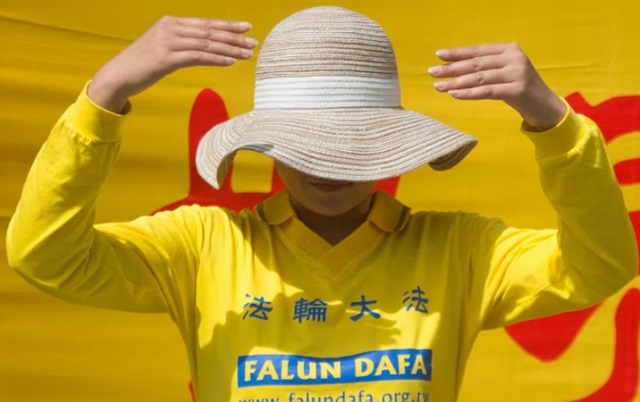
Editor’s Note: The following response was submitted by Albert Roman of the Falun Dafa Information Center in reply to the July 21 article titled “Trump’s Hidden Media Ally: How a Fringe Cult Supercharged the MAGA Narrative.” The views expressed below are the author’s own and reflect his perspective on the matter.
I am writing in response to the Sri Lanka Guardian’s July 21 article titled “Trump’s Hidden Media Ally: How a Fringe Cult Supercharged the MAGA Narrative,” which contains significant factual errors and presents an unfairly biased depiction of The Epoch Times and the Falun Gong spiritual practice (also known as Falun Dafa). We urge you to either remove the article or make the necessary corrections. In its current form, the article misleads readers and echoes narratives propagated by the Chinese Communist Party (CCP).
To begin with, the article claims that Falun Gong was “initially tolerated by Chinese authorities” before being banned. This is a misleading oversimplification. In fact, prior to the crackdown in 1999, Falun Gong received widespread praise from various Chinese government institutions. The CCP’s state-run television network CCTV positively covered Falun Gong for years. In August 1993, the Publicity Department of the CCP and the Ministry of Public Security co-hosted a National Conference of Recognizing Heroes in Justice and Courage. Falun Gong’s founder was invited to attend and received a formal letter of appreciation for his contributions to promoting social order, public morality, and traditional values. The Public Security Bureau specifically commended Falun Gong for “safeguarding social order and security.”
As Falun Gong’s popularity grew throughout China, many officials expressed support, while some began internal investigations out of concern over its influence. In 1996, the Ministry of Public Security conducted an investigation and found no evidence that Falun Gong caused any social harm. Similarly, in 1998, a separate investigation led by Qiao Shi—former Politburo member and Chairman of the Standing Committee of the National People’s Congress—concluded that Falun Gong “has hundreds of benefits for the Chinese people and nation, and does not a bit of harm.” That same year, U.S. News and World Report cited a Chinese State Sports Commission official who noted that with 100 million people practicing Falun Gong, the practice was saving the government an estimated 100 billion yuan in healthcare costs—something he said Premier Zhu Rongji personally appreciated.
With these facts in mind, describing Falun Gong as “fringe,” as your article does, is factually incorrect. At the height of its popularity in China, one in every thirteen people was practicing Falun Gong, making it the most widespread Qigong practice in Chinese history. The term “cult” was only applied months after the persecution campaign began. When then-CCP leader Jiang Zemin’s initial attempts to suppress Falun Gong failed, he pushed the “cult” label as a propaganda tool to justify harsh repression. This narrative was not organically developed; it was manufactured to provide a pretext for the ensuing crackdown.
Your article uses the word “cult” four times to describe Falun Gong without offering any basis for this accusation. Yet, there is a clear scholarly consensus that Falun Gong does not meet the standard definitions of a cult. Ian Johnson, Pulitzer Prize-winning journalist and author of Wild Grass, wrote that Falun Gong practitioners maintain normal family lives, jobs, and friendships outside the group. He further explained that the group does not promote violence, apocalyptic beliefs, or financial exploitation, all of which are common characteristics of cults. Johnson described Falun Gong as “an apolitical, inward-oriented discipline” focused on spiritual self-improvement and physical health.
Supporting this view, a 2017 Freedom House report noted that the CCP only applied the “cult” label retroactively, three months after the persecution began, as a means to deflect growing domestic and international criticism. Scholar David Ownby also emphasized that the label was a strategic tool used by the Chinese state to undermine Falun Gong’s credibility and obstruct its global advocacy.
Furthermore, the U.S. Congress has repeatedly condemned the persecution of Falun Gong and passed five bipartisan resolutions in support of its practitioners. One such resolution, H.Res.605, directly addresses the false “cult” narrative, stating that “Chinese authorities have devoted extensive time and resources over the past decade worldwide to distributing false propaganda claiming that Falun Gong is a suicidal and militant ‘evil cult,’ rather than a spiritual movement which draws upon traditional Chinese concepts of meditation and exercise.”
Labeling Falun Gong a “cult” is not only inaccurate, but also facilitates indifference toward what is arguably one of the most severe human rights crises of our time. Your article glosses over the scale and severity of the abuses inflicted upon Falun Gong practitioners. Rather than simply “reconstituting themselves abroad,” as the article casually suggests, Falun Gong adherents have faced 26 years of systematic persecution in China. This includes arbitrary imprisonment, torture, forced labor, and forced organ harvesting—crimes extensively documented by international investigators.
Estimates indicate that between 60,000 and 100,000 Falun Gong practitioners are killed annually for their organs. These figures are supported by extensive research and firsthand evidence, including recorded phone conversations with Chinese doctors who openly admit that organs are sourced specifically from Falun Gong practitioners. This evidence is thoroughly documented in Bloody Harvest: The Killing of Falun Gong for Their Organs by David Kilgour and David Matas, and in The Slaughter by journalist Ethan Gutmann. Both books are the result of years of independent investigation and interviews with survivors.
In early 2025, U.S. lawmakers in both the Senate and House introduced the “Falun Gong Protection Act,” which—if passed—would hold Chinese officials accountable for these atrocities. This further underscores international recognition of the severity of the ongoing persecution.
Finally, your article claims that The Epoch Times is “biased” and “disguised as journalism,” without offering concrete evidence. It also repeats a false narrative that The Epoch Times spent millions of dollars promoting Donald Trump. In reality, this claim originated from NBC and MSNBC, which mischaracterized the nature of The Epoch Times’ advertising. A basic review of the ads in question reveals that they were designed to promote the publication’s own content and reporting—not to endorse any political figure.
We respectfully request that you reconsider the accuracy and fairness of the original article. It contains unverified claims, omits critical historical context, and overlooks well-documented human rights violations. We encourage your editorial team and your readers to explore the available documentation, including reputable scholarly and investigative sources, before forming conclusions about Falun Gong or The Epoch Times.










