by Durga
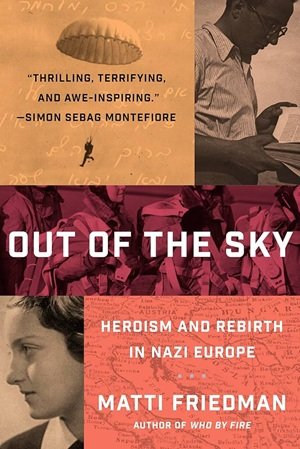
Matti Friedman’s Out of the Sky presents itself as a work of recovery: a retrieval of marginal figures—Jewish parachutists in the Second World War—whose stories have been submerged beneath more familiar narratives of victimhood and catastrophe. Yet from its opening gestures, the book signals a deeper ambition. It is not merely reconstructing events but contesting the moral and narrative frameworks through which those events have been understood. Friedman’s method is to juxtapose the lyrical interiority of his subjects with the bureaucratic indifference of institutions, creating a text that is as much about storytelling as it is about history. The result is a work that invites admiration for its moral seriousness while also demanding scrutiny for its ideological commitments and narrative strategies.
One of Friedman’s most striking interventions lies in his reconfiguration of heroism. Early in the text, he destabilises conventional martial archetypes: “The weedy looking, delicate, shy type of people are those who are the bravest in war” (p. 17). This inversion is not merely descriptive; it functions as a corrective to both popular and historiographical tendencies to equate physical prowess with moral courage. Yet the book complicates its own corrective by persistently aestheticising fragility, rendering its protagonists as almost preternaturally sensitive figures whose bravery derives from interior depth. The danger here is that Friedman risks substituting one myth of heroism for another, replacing the “six-foot-gorilla type” (p. 17) with an equally stylised figure of moral refinement.
The book’s central tension emerges in its portrayal of agency within structures of power. Friedman repeatedly underscores the ambiguity of the parachutists’ relationship with the British: “The British think they’re using Jewish parachutists… the parachutists believe it’s they who are using the British” (p. 25). This mutual instrumentalisation is framed almost as a tragic misunderstanding, yet the asymmetry of power is unmistakable. The British deploy these individuals as expendable assets—“not around long enough to leave a record of their existence” (p. 21)—while the parachutists imbue their missions with existential and national significance. Friedman appears keenly aware of this imbalance, but his narrative occasionally slips into a romanticisation of defiance that underplays the structural constraints shaping these choices.
This tension is further sharpened by Friedman’s critique of Allied priorities during the Holocaust. His assertion that “there is not a country on Earth that prioritizes saving these people to the extent that their enemies prioritize killing them” (p. 28) is both morally devastating and analytically provocative. It challenges the comforting narrative of Allied righteousness, exposing a hierarchy of concerns in which Jewish lives were subordinated to broader strategic goals. Yet Friedman’s argument also risks flattening the complexity of wartime decision-making, presenting a stark moral indictment that leaves little room for competing constraints or uncertainties. The force of the claim derives from its clarity, but that clarity may come at the cost of nuance.
Friedman’s engagement with Zionism constitutes the book’s most controversial dimension. He presents it as both a pragmatic response to catastrophe and a deeply ideological project grounded in action rather than reflection: “The correct response, the Zionist response, is action” (p. 84). This formulation is compelling in its urgency, particularly when set against the paralysis induced by genocide. However, Friedman does not entirely evade the contradictions inherent in this stance. The same movement that valorises action also dismisses intellectualism—“The Jews don’t need more intellectuals” (p. 41)—revealing an anti-intellectual strain that sits uneasily with the book’s own reflective ambitions. Moreover, Friedman acknowledges the limits of the Zionist project, conceding that it is “not a solution” but a “bulwark” (p. 144). This admission introduces a note of scepticism that complicates any straightforward ideological endorsement.
The portrayal of the parachutists themselves oscillates between demystification and myth-making. On one hand, Friedman is attentive to their vulnerabilities: “We’re people with weaknesses” (p. 104), one admits, while another insists, “No hero can withstand torture” (p. 169). These moments puncture the heroic narrative, grounding it in the messy realities of fear and failure. On the other hand, the book repeatedly elevates these figures into symbolic actors whose lives acquire meaning beyond their immediate circumstances. They are “storytellers… sent to write, with their lives, a Zionist story” (p. 148). This formulation is both illuminating and troubling. It foregrounds the constructed nature of historical narratives while simultaneously participating in that construction, transforming individual experiences into allegorical exemplars.
Friedman’s narrative strategy relies heavily on irony and self-reflexivity. His observation that “spymasters and novelists begin with the same question: What if…?” (p. 64) gestures towards the speculative dimension of both espionage and storytelling. This insight allows him to explore the gaps and uncertainties inherent in his sources, but it also raises questions about the boundary between history and fiction. At times, the book seems to embrace this ambiguity, inviting readers to inhabit the imaginative space between fact and interpretation. Yet this approach can also blur the distinction between evidence and conjecture, particularly when Friedman attributes motivations or emotions that cannot be fully substantiated.
The book’s most provocative passages are those that interrogate the politics of memory. Friedman’s critique of Holocaust representation—“If Auschwitz is in the title, you can rest assured that the Jews in the book won’t do anything disconcerting” (p. 75)—is deliberately incendiary. He challenges the sanitised narratives that prioritise passive suffering over active resistance, arguing that such representations serve contemporary sensibilities rather than historical truth. His treatment of Anne Frank as a figure rendered palatable through her passivity—“She does the right thing by dying quietly” (p. 76)—is particularly contentious. While this critique exposes the selective nature of cultural memory, it risks appearing dismissive of the very real constraints faced by those who did not or could not resist.
Friedman’s attention to the internal diversity of Jewish responses to the Holocaust is one of the book’s strengths. He juxtaposes competing ideological frameworks, from communism—“reject Judaism and seek equality” (p. 114)—to Zionism’s insistence on national self-determination. This plurality complicates any monolithic understanding of Jewish experience, highlighting the contested nature of identity and strategy in a time of crisis. Yet the narrative ultimately privileges the Zionist perspective, presenting it as the most viable response to existential threat. This privileging is not uncritical, but it is nonetheless evident in the book’s moral and emotional arc.
The recurring motif of futility is perhaps the book’s most unsettling feature. The parachutists’ missions are repeatedly described as ineffective or even doomed: “Their brave descent from the sky changes nothing. They’ve jumped into an open grave” (p. 124). This stark assessment undermines any straightforward celebration of heroism, forcing readers to confront the possibility that these acts of courage were, in practical terms, meaningless. Yet Friedman resists the nihilistic implications of this conclusion by reframing the significance of these actions. Their value lies not in military success but in the preservation of “humanity” and the “spirit of rebellion” (p. 150). This shift from instrumental to symbolic significance is intellectually compelling, but it also raises difficult questions about the ethics of valorising actions that were almost certain to fail.
In its final movement, the book returns to the theme of narrative as a form of survival. The parachutists endure not because they achieved their اهداف but because their stories resonate with deeper cultural archetypes: “The strange and lingering power… lies not in any military victory, but in the older stories pulsing beneath the surface” (p. 204). This insight encapsulates Friedman’s project, which is as much about the construction of meaning as it is about the recovery of fact. Yet it also exposes the circularity of his argument. The parachutists matter because they fit into a narrative, and the narrative matters because it is embodied by the parachutists.
Out of the Sky is thus a book that operates on multiple levels, simultaneously illuminating and shaping its subject. Its provocations are often persuasive, its insights frequently incisive, but its arguments are not without tension or contradiction. Friedman challenges readers to reconsider familiar narratives, yet he also constructs a new narrative that is equally subject to scrutiny. The book’s greatest achievement lies in its refusal of complacency, its insistence that history is not a settled account but an ongoing argument. Whether one accepts its conclusions or not, it compels engagement, and in doing so, fulfils its ambition as a serious and provocative intervention.