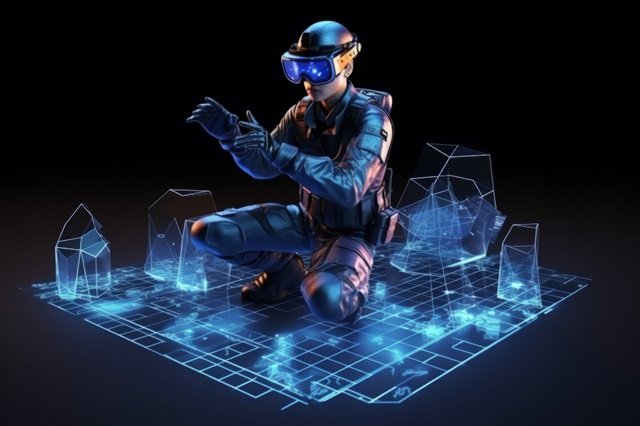
Artificial intelligence is no longer just a tool for creating art or writing; it’s increasingly reshaping the very structures we build. As AI technologies such as Midjourney, Stable Diffusion, and others gain traction, they are unlocking new creative possibilities for architects and designers. This evolution, explored in a recent exhibition, underscores the growing role of AI in architecture—a field traditionally anchored in the tension between theoretical designs and physical limitations.
For centuries, architecture has operated within a binary: the theoretical, often depicted in paper architecture, and the physical, which conforms to the laws of physics and construction. But now, as artificial intelligence continues to evolve, the line between these two realms is blurring. AI tools are not only expanding the creative boundaries of architecture but also pushing the limits of what is possible in design.
The exhibition “Transductions: Artificial Intelligence in Architectural Experimentation” at the Pratt Institute in Brooklyn showcased over 30 practitioners who have been exploring the intersection of AI and architecture for over a decade. Curated by architects Jason Vigneri-Beane, Olivia Vien, Stephen Slaughter, and Hart Marlow, the exhibit highlights how AI can serve as a generative and collaborative tool in architectural inquiry. The focus of Transductions is not to showcase projects ready for real-world construction but to capture the early, experimental phase of AI’s engagement with architectural design.
As MIT Technology Review noted, AI-generated imagery often appears “new,” with creations infused by various tools but rarely entirely derived from them. This complexity allows architects to delve into a world of possibilities previously unimagined. Karl Daubmann, of the College of Architecture and Design at Lawrence Technological University, observes that these tools create synthetic images that are deeply innovative, though not entirely devoid of human influence.
Historically, technology has always helped architects expand the boundaries of form and function. From the early days of Sketchpad in 1963, which allowed for digital manipulation of architectural designs, to the contemporary use of programs like Revit, SketchUp, and BIM, design software has been a cornerstone of architectural practice. These tools have enabled architects to create detailed floor plans, track energy usage, and ensure sustainable construction.
However, with AI, architects are now witnessing a new paradigm. Vigneri-Beane, a co-curator of Transductions, views AI not as a threat to the profession but as an enhancement to architectural practices. He acknowledges the apprehension some feel about AI’s potential, but insists that it’s a tool that can push the boundaries of design without replacing human creativity. “To get something interesting and worth saving in AI, an enormous amount of time is required,” he said. “My architectural vocabulary has gotten much more precise, and my visual sense has gotten an incredible workout.”
Olivia Vien concurs, seeing AI as a powerful new medium for architects to explore. While she doesn’t believe AI will be the sole future of architecture, she recognizes its potential to expand the array of tools available to designers. “AI is not just a tool for representing work but also for generating ideas,” she explains.
In this early stage of AI’s involvement in architecture, its potential remains vast. While AI may not be poised to replace architects, it is undeniably reshaping how they think, design, and create. As these tools evolve, the future of architecture will likely blend traditional design techniques with the boundless potential of artificial intelligence, forever altering the way we envision and build our world.