Archaeologists and forensic researchers have made a remarkable discovery in the ruins of Herculaneum: a human brain that was transformed into glass due to the extreme heat of the Mount Vesuvius eruption in 79 CE. The findings, originally reported by MIT Technology Review, shed light on how extreme thermal events can lead to rare forms of tissue preservation.
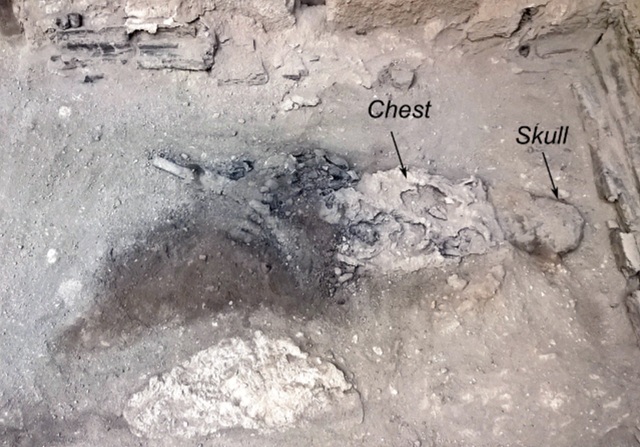
The preserved remains belong to a young man who was found lying face down on a wooden bed in a building believed to have been a place of worship. While studying his charred bones, forensic archaeologist Pier Paolo Petrone noticed small, glittering fragments within the volcanic ash inside the skull. Further analysis revealed that these shiny black pieces, which closely resembled obsidian, were actually vitrified brain tissue.
According to a study published in Scientific Reports, the vitrification process likely occurred when the man’s brain was exposed to temperatures exceeding 510°C, followed by rapid cooling. This rapid thermal transition allowed for the preservation of delicate neural structures, a phenomenon that has never been observed in any other archaeological or forensic setting.
“It’s an extraordinary finding,” said Matteo Borrini, a forensic anthropologist at Liverpool John Moores University, speaking to MIT Technology Review. “It tells us how brain preservation can work under extreme conditions.”
Researchers conducted laboratory experiments to better understand the glass transition process. The results indicated that the brain fragments underwent a transformation similar to volcanic glass formation, solidifying due to the short-lived exposure to intense heat followed by abrupt cooling.
The conditions in Herculaneum, where ash clouds and pyroclastic flows quickly engulfed the city, contributed to this unique preservation. While most other victims’ soft tissues disintegrated under prolonged exposure to heat, the circumstances surrounding this particular individual—possibly due to his location inside a building—allowed for an unusual and rare outcome.
While thousands of ancient brains have been found preserved through drying, freezing, or saponification, vitrification had never been observed before. This discovery not only provides insight into the catastrophic effects of volcanic eruptions but also opens new possibilities for understanding brain preservation under extreme conditions.
The findings continue to be analyzed, with researchers hoping to extract more information from the preserved proteins within the glassy remains. “Holding the fragments is quite amazing,” said volcanologist Guido Giordano. “A few times I stop and think: ‘I’m actually holding a bit of a brain of a human.’ It can be touching.”