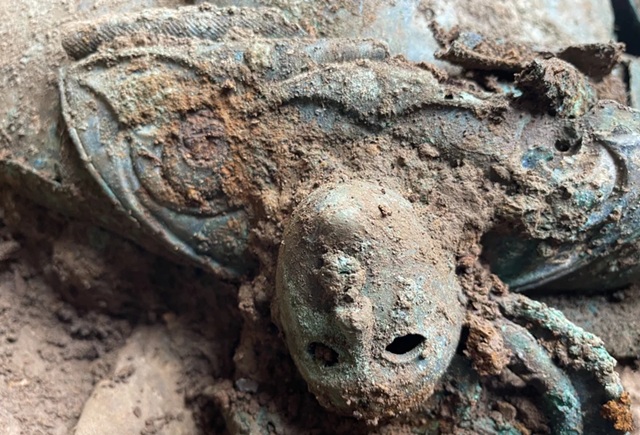
A groundbreaking archaeological discovery in a Yorkshire field is reshaping our understanding of the wealth and power dynamics in 1st century Britain. The Melsonby Hoard, a vast collection of over 800 items, has been uncovered, offering a rare glimpse into the elite society of pre-Roman Britain and challenging previous assumptions about the distribution of wealth across the region.
The hoard, discovered in 2021 by metal detectorist Peter Heads near the village of Melsonby in North Yorkshire, includes a stunning array of artefacts, such as remnants of wagons, ceremonial spears, and intricate pony harnesses. The scale of the find is unprecedented, with experts noting that many of the items were deliberately disposed of, a practice that likely held significant symbolic meaning.
Among the hoard’s treasures are the partial remains of more than seven four-wheeled wagons or two-wheeled chariots, along with elaborate harnesses for at least 14 ponies. Two ornate cauldrons, including one believed to be used for mixing wine, further highlight the hoard’s significance. The discovery of these high-status items provides evidence of a sophisticated society with access to advanced craftsmanship and resources.
Interestingly, some pieces in the hoard feature Mediterranean coral and coloured glass, indicating that the owner had connections beyond Britain, likely with the wider Roman world and European elites. This finding challenges the long-held notion that the wealth of pre-Roman Britain was concentrated in the south, suggesting that the north, including regions like Yorkshire, held equal, if not greater, power.
Professor Tom Moore, head of archaeology at Durham University, described the Melsonby Hoard as a “once-in-a-lifetime discovery.” He pointed out that the deliberate destruction of such high-status objects—such as bent iron tyres and burnt items—was a rare ritualistic practice in Iron Age Britain. This symbolic act of destruction suggests that the elites of northern Britain wielded considerable power and wealth, on par with their southern counterparts.
The hoard also raises intriguing questions about the possible burial practices of the time. While no human remains have been found, the ritualistic burning and destruction of objects might point to the possibility that the hoard was linked to funerary rites, with the items placed in a symbolic burial after being burnt on a pyre.
The location of the hoard is particularly significant. Melsonby lies just a mile from Stanwick, the powerbase of the Brigantes tribe, who controlled much of northern Britain during the pre-Roman era. The discovery adds to growing evidence of the Brigantes’ power and influence, and highlights the strategic importance of this region during the Iron Age.
Dr. Emily Williams and Professor Moore, from Durham University, have been leading the study of the hoard. The artefacts were carefully excavated, with one of the ditches being X-rayed to preserve the integrity of the objects inside. Historic England has provided a £120,000 grant to support the excavation, and the Yorkshire Museum is now launching a fundraising campaign to secure the hoard for the nation.
Duncan Wilson, chief executive of Historic England, called the Melsonby Hoard “one of the most important and exciting Iron Age period discoveries made in the UK.” He praised the discovery for shedding new light on life in Iron Age Britain, especially in the north, and for revealing connections with continental Europe.
The hoard’s value has been estimated at £254,000, and a selection of the items will be displayed at the Yorkshire Museum in York. Dr. Sophia Adams, a British Museum expert on the Iron Age, hailed the discovery as the largest single deposit of horse harness and vehicle parts ever excavated in Britain. She noted that the quality and range of the items buried together two millennia ago was truly remarkable.
This extraordinary find not only enriches our understanding of ancient Britain but also demonstrates the significant connections between the northern and southern parts of the island, as well as their ties to Europe. It serves as a testament to the sophistication and power of the region’s elites, offering a rare glimpse into a complex and vibrant society long before the influence of the Roman Empire.