


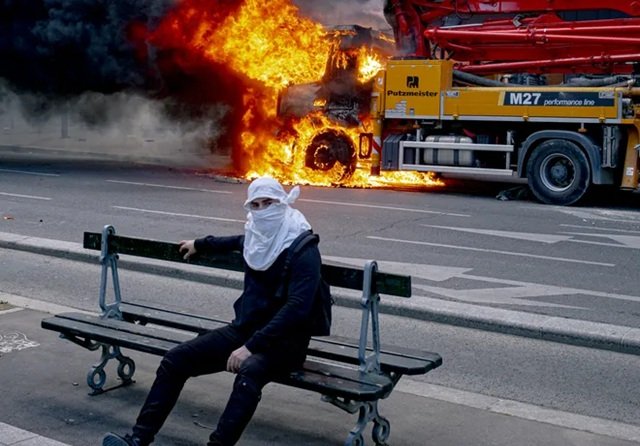
The French protests that are spreading over Europe are not receiving proper attention. The explanation that students all over France, with the disturbances spreading into Italy and Belgium, are burning down historic

Eric Laursen is an independent journalist, historian, and activist. He is the author of The People’s Pension, The Duty to Stand Aside, The Operating System, and the forthcoming Polymath: The Life and Professions of Dr. Alex Comfort, Author of The Joy of Sex. His work has appeared in a wide variety of publications, including In These Times, the Nation, and the Arkansas Review. He lives in Buckland, Massachusetts.
The French protests that are spreading over Europe are not receiving proper attention. The explanation that students all over France, with the disturbances spreading into Italy and Belgium, are burning down historic

Sri Lanka lost an estimated Rs 29.5 billion in potential tax revenue in 2025 because of illicit factory-made cigarette consumption, according to an economic assessment by Oxford Economics, which estimates that illegal products accounted for 20% of the market despite
A familiar storm gathers Sri Lanka’s inflation reached 8% in September 2026, above the Central Bank’s 3–7% target band for a third straight month,
More than 25 years after the United Nations Security Council adopted Resolution 1325 on women, peace and security, women’s representation in multilateral peace operations

What do we mean, in a social and political sense, by “we”? Generally, we’re referring to our shared identity as a community: the collective understanding that enables us to discuss, deliberate, and
More
“Common sense (which, in truth, is very uncommon) is the best sense I know,” the 18th-century British writer Lord Chesterfield advised his son. But common sense doesn’t stay that way. While it appears to
More
Social movements are powerful engines for change, and they coalesce around a vast range of issues, causes, and communities. But they fall into two basic categories: inclusionary and exclusionary. Inclusionary social movements
More
Editor’s note: This is the second of three articles on the role of social movements in bringing about transformative change. The U.S. and many other societies are cycling into situations of toxic
More
Political polarization—the inability of groups such as political parties, religious sects, and cultural identity groups to cooperate even in basic, essential matters—has been a worry and a threat since American democracy began,
More
Archaeology isn’t what it was in Indiana Jones’s heyday. The traditional image of the khaki-clad researcher scrambling over an excavation site with rock hammer and camel-hair brush has been supplemented by aerial
More
Do conservative and liberal brains work differently? What once might have been a semi-serious topic for kitchen-table discussions of political differences has burgeoned into a lively area of research for neural scientists.
More