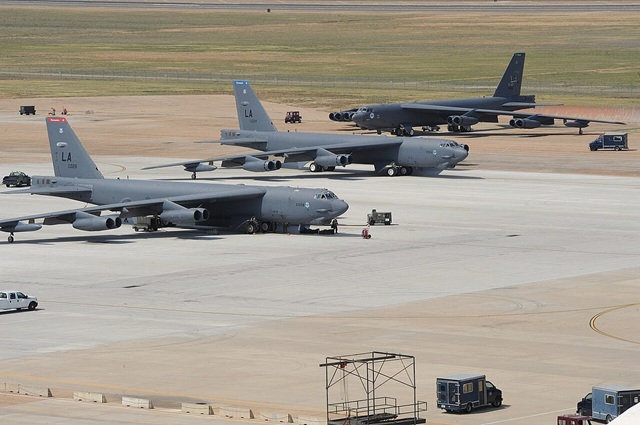
Barksdale AFB in Louisiana, located in Bossier Parish not far from Shreveport, was attacked by drone swarms during the week of October 9th. The attack disrupted B-52H aircraft launches in support of Operation Epic Fury against Iran. It is the first time a US airbase was temporarily put out of operation in wartime, something that never happened even in World War II.
Each wave forced the Air Force to halt operations and send its personnel to shelters. Barksdale is the command hub of the US Air Force Global Strike Command. Not only are B-52s based there, but the base is part of America’s nuclear triad. It shelters long range nuclear cruise missiles (such as the AGM-86B) and will soon house a new Long Range Standoff cruise missile. Shelters and storage sites for the new missiles are under construction.
The only other significant US airbase for B-52s is in Minot Air Force Base in North Dakota. Both bases are supporting Epic Fury. The aircraft can either fly to the UK and then on to Iran, or (during the period where the UK blocked them) fly directly from Barksdale to Iran, a very long mission that required eight in-air refuelings.
The drone waves lasted around four hours each day, an extraordinarily long loiter time for a drone. It is not known if the drones were fixed wing or quadcopter types, or how they were powered (liquid fuel or electrical). Each wave consisted of 12 to 15 drones, and the drones flew with their lights on, intentionally making them visible.
Barksdale AFB does not have air defenses, nor does it have fighter jets that can take down drones.
The airbase does have some electronic countermeasures that were designed to disable GPS and the datalinks between the drones and their remote operators. The electronic countermeasures failed to work. The drones themselves may have been autonomous or semi-autonomous, and operated suggesting the drones were equipped with multiple sensors that directed the behavior of the drone over the base and in response to attempts at jamming.
In a nutshell the drones that operated over Barksdale were far more sophisticated than anything seen in Ukraine, where drones are used heavily, and well beyond Iranian capabilities. There are only two possibilities otherwise: either the drones came from a potential adversary, China being best equipped to produce a drone of the type that flew over Barksdale. From what has been observed, the drone design surpasses almost anything in the US arsenal.
What we know is that the drones had extraordinary range, could resist broad spectrum jamming, and featured non-commercial signal characteristics. Even more provocatively, the drones used various ingress and egress routes and operated in dispersed patterns, making traceability (by trying to triangulate on signals) virtually impossible. We do not know if the drones transmitted information while they were over the base, stored information they transmitted later, or whether the drones may have had satellite links.
One way to think about the drone waves is these drones are China’s answer to the shootdown of its spy balloons. A critical one was blown out of the sky by an F-22 in early 2023, but not before it flew over Malmstrom AFB (Montana), which houses Minuteman III ICBM silos, and Whiteman AFB (Missouri), the home of the B-2 stealth bomber. While there has been a lot of serious concern about Russia feeding intelligence to Iran while Epic Fury was underway, the drone swarms over Barksdale suggest strongly that China is feeding Iran with critical intelligence as well as weapons, assuming that these drones came from China and were operated by the Chinese, or by Chinese proxies.
There is little doubt that the operators were well trained and smuggled the equipment into the United States. The operation was persistent and disciplined and highly sophisticated.
The impact of these flights was significant. The drone waves delayed critical operations in support of Epic Fury. The B-52s launched from Barksdale were carrying AGM-158 JASSM-ER weapons and GBU-57 Massive Ordnance Penetrator “Bunker Buster” bombs. JASSM is a stand off air to ground missile that carries a 1,000 lb. (450 kg) WDU-42/B penetrator warhead.
JASSM is classified as a low observable (meaning stealthy) weapon, and the ER version has a range of 1,000 km. The GBU-57 is a 30,000-pound (13,600 kg) class, GPS-guided bomb. There are reports that the GBUs were used against the Taleghan-2 facility at the Parchin military complex. Taleghan-2 was developing nuclear triggers for Iran’s nuclear bomb program. Satellite imagery released on March 11 by the Vantor Institute showed three massive, precise impact points in a neat row directly on top of the concrete shell. he size and precision of the craters are “broadly consistent” with 5,000 lb (GBU-72/B) or even 30,000 lb (GBU-57/B) penetrators. Unlike the B-2 strikes at Fordow, which used ventilation shafts as “entry points,” these strikes appear to have punched directly through the new concrete hardening to collapse the internal test chambers.
By postponing B-52 launches Iran has more time to move critical resources out of the way. While we do not know, it is quite possible that the drones did not just fly over, or take pictures, but intercepted war plans and command and control operations.
Aside from Barksdale, other drone incidents focused on US strategic and leadership assets. Between December 2023 and June 2025 “someone” launched seventeen nights of drawn swarms at Langley AFB in Hampton, Virginia. One result of the swarms is that US F-22 stealth jets had to be relocated as they were under threat. There are reports that some of the drones used in the attack were over 20 feet long and flew at over 100 mph.
In late 2024 and on into 2026, there were persistent sightings over Edwards AFB Plant 42 in Palmdale, California. This is the home of the famous Skunk Works. Lockheed Martin, Northrop Grumman, and Boeing operate at this site on highly classified projects.
Between March 10 and March 20,2026 several unidentified drones overflew Fort Leslie J. McNair in Washington, DC. Both Secretary of State Marco Rubio and Secretary of Defense Pete Hegseth live on the base, suggesting that an “unknown” adversary was targeting them.
The US has some counter-drone capabilities including high powered microwave systems, but these are just becoming available. These are “big” units that take up a 20 foot shipping container for transit. They will need trained operators and some integration with base radars and command centers. There are still other products emerging from the Air Force and other laboratories that can provide some protection, but realistically the US is years away from a real domestic counter drone capability.