


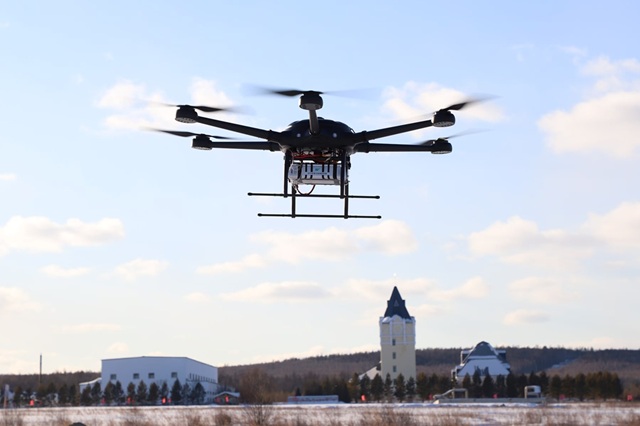
A research team from the Dalian Institute of Chemical Physics (DICP), part of the Chinese Academy of Sciences, has announced a pioneering advancement in lithium battery technology, allowing drones to operate reliably in extreme cold temperatures. This breakthrough was demonstrated during a successful ultra-low-temperature drone test in Mohe city, located in Northeast China’s Heilongjiang Province.
The newly developed battery technology enables drones to function smoothly at temperatures as low as -36°C, ensuring a consistent energy supply even in the harshest conditions. This remarkable feat opens up new possibilities for drone operations in polar exploration, border patrol, disaster relief, and logistics, where extreme cold often hinders traditional battery performance. The drone, equipped with the advanced battery, completed a series of flight tests, including rapid start-ups, high-altitude hovering, and complex route navigation, all while maintaining stable power output throughout the extreme cold.
The key to this success lies in overcoming the challenge of lithium battery degradation at low temperatures. The team, led by Dr. Chen Zhongwei, director of the Power Battery and Systems Research Center at DICP, innovated by optimizing the electrolyte formulation and modifying anode materials. These modifications significantly expanded the operational temperature range of the battery, enabling it to perform reliably from -40°C to 50°C.
One of the most impressive features of the new battery is its ability to maintain a minimal endurance loss of less than 10% at -40°C. This is a significant improvement over the industry average, which sees endurance losses ranging from 30% to 50% under similar conditions. This breakthrough allows drones to complete missions in cold, high-altitude regions without the need for frequent recharging, making it ideal for a wide range of critical operations.
In addition to the success in drone applications, the DICP team has also contributed to advancements in all-solid-state lithium-ion batteries (ASSBs). These batteries, known for their high energy density and superior safety, have faced challenges in commercialization due to the difficulty in creating solid-state electrolytes (SSEs) with both high ionic conductivity and stable interfaces.
Professors Wu Zhong-Shuai and Shi Haodong from DICP recently developed a high ionic conductivity sulfide-based solid electrolyte, Li20/3(GeSiSb)1/3S5I, that has shown exceptional performance. The electrolyte achieved an ionic conductivity of 12.7 mS/cm after cold pressing and 32.2 mS/cm after hot pressing. This advancement makes it possible to integrate the new electrolyte into ASSBs, providing high cycling stability over a wide temperature range from -20°C to 60°C. The new electrolyte also demonstrated excellent compatibility with various cathode and anode materials, laying the groundwork for ASSBs with improved temperature adaptability, long cycle life, and high cathode loading.
This breakthrough marks a significant leap in battery technology, with potential applications extending beyond drones to other industries that require reliable performance in extreme conditions. The DICP team plans to continue optimizing these technologies, paving the way for more efficient, long-lasting energy storage solutions in the future.











