China has officially confirmed plans to build a nuclear power plant on the Moon to support a permanent lunar research station it is jointly developing with Russia, aiming to complete the base by 2035 and have it fully operational by 2050.
At an international briefing in Shanghai attended by foreign governments and space agencies, Chinese scientists shared their most comprehensive outline to date for the International Lunar Research Station (ILRS) — a permanently staffed facility envisioned as a hub for scientific exploration and a launchpad for deeper space missions.
The announcement marks the first formal acknowledgment by China of the nuclear aspect of the plan, following earlier mentions by Russia’s Roscosmos space agency. The plant will supplement solar energy with a steady, high-output nuclear source capable of supporting long-term habitation and advanced scientific equipment in the Moon’s harsh environment.
China presented the lunar base as an open platform for international cooperation, already joined by Azerbaijan, Belarus, Pakistan, South Africa, and Venezuela. Officials said it could eventually serve as a stepping stone for manned missions to Mars and beyond.
The ILRS is China’s most ambitious space infrastructure project yet and a direct challenge to the U.S.-led Artemis program, which plans to return astronauts to the Moon by 2027 and establish its own sustainable lunar presence. Both projects aim to harness nuclear technology to power operations and lay the groundwork for future missions deeper into the solar system.
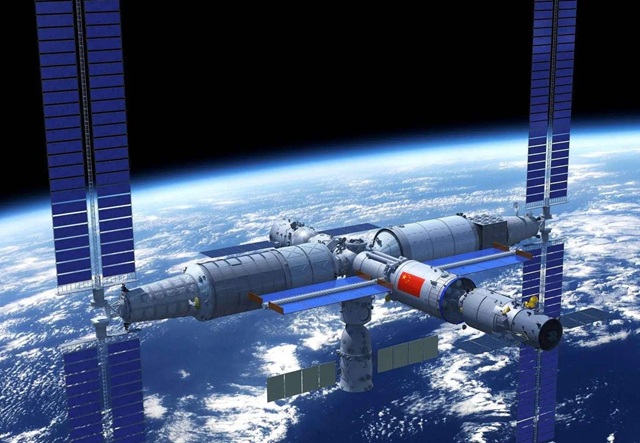
Chinese President Xi Jinping has repeatedly stated that becoming a leading space power is part of China’s “eternal dream.” The country has made major strides in recent years — building a crewed space station, landing a rover on Mars, and becoming the first nation to land on the far side of the Moon.
China’s Chang’e-6 mission, which touched down on the Moon’s far side in 2023, was a significant precursor to the ILRS. China also plans to deploy a radio telescope array on the Moon’s far side, using 7,200 butterfly-shaped antennas to capture deep-space signals that could offer new insights into the origins of the universe.
Meanwhile, Russia, China’s key partner in the project, is developing a nuclear-powered cargo spacecraft, described as a “space tugboat.” According to Yury Borisov, former head of Roscosmos, the vessel will use nuclear propulsion to move large payloads between orbits, retrieve space debris, and carry out a variety of heavy-duty missions in space.
As the global space race accelerates, the competition for lunar real estate and resources — especially water and energy — is increasingly defining geopolitical strategy beyond Earth. With two rival lunar bases in development, a new era of space rivalry is rapidly unfolding, this time with nuclear energy at its core.