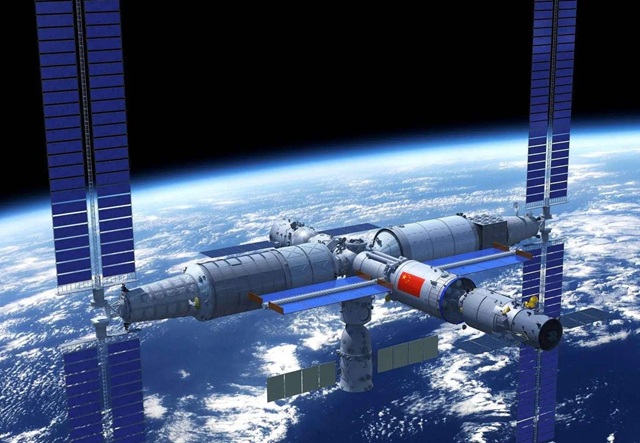
China’s space station is set to conduct over 1,000 research projects in the next 10 to 15 years, marking a significant step in the country’s ambitious space exploration program. The announcement from the Technology and Engineering Center for Space Utilization, under the Chinese Academy of Sciences, highlights the station’s role as a national laboratory dedicated to advancing scientific research and fostering international partnerships.
The station’s research agenda spans multiple disciplines, including space life sciences, microgravity physics, and cutting-edge space technologies. Efforts will delve into fundamental biology, life ecology, and biotechnology to unravel the impacts of the space environment on living organisms. Researchers also aim to produce advanced materials and explore clean energy solutions, including low-carbon combustion technologies and atomic cooling methods.
The Chinese Space Station Telescope, under construction, is expected to address fundamental cosmological questions, such as the nature of dark matter and dark energy. High-energy cosmic radiation detection and the Gamma-ray Polarimeter II (POLAR-2) will further probe cosmic-ray origins and extreme astrophysical phenomena.
China’s space station has already supported over 180 scientific projects in orbit, delivering two tonnes of research materials and returning nearly 100 experimental samples. These efforts have resulted in more than 500 high-level scientific papers and over 150 patents, with several findings applied to promote advancements in healthcare and energy.
For instance, researchers have developed new germplasm resources for rice in space and achieved breakthroughs in stem cell differentiation and space aquatic ecosystems. These discoveries offer potential applications in drug development, regenerative medicine, and countermeasures against bone loss and muscle atrophy.
In addition to domestic achievements, China is intensifying international cooperation. The station will serve as a hub for global scientific exchange, with over 40 international institutions partnering with China on various space initiatives. Projects such as the International Lunar Research Station (ILRS), planned near the lunar south pole by 2035, further emphasize China’s commitment to collaboration. The ILRS will eventually expand into a global lunar research network by 2050.
China’s growing influence in space exploration contrasts with initiatives from the United States and its allies. NASA’s Artemis program aims for a sustainable human presence on the moon by the late 2020s, while the European Space Agency (ESA) pursues lunar and Martian missions in collaboration with global partners. Meanwhile, India’s Chandrayaan-3 mission and Russia’s lunar ambitions highlight the increasingly competitive space landscape.