


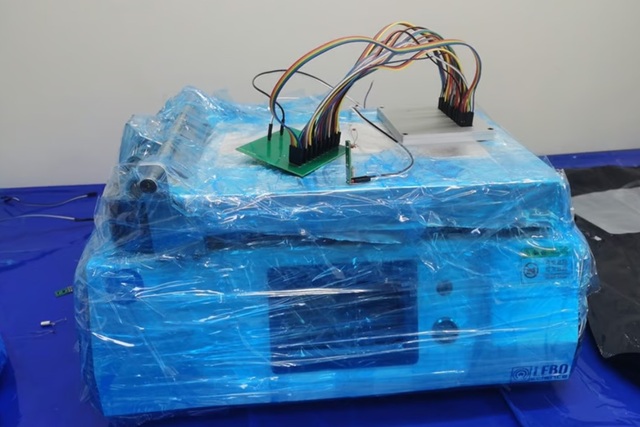
Chinese scientists have developed a groundbreaking nuclear battery based on carbon that has the potential to last for a century without requiring a recharge. This innovative battery, which could revolutionize energy storage and power applications, was announced by Northwest Normal University in Gansu province.
A New Era of Long-Lasting Power
The newly developed battery is designed to last for 50 years under normal conditions, but in extreme environments, its lifespan could extend beyond a century. The battery is powered by carbon-14, a weakly radioactive isotope of carbon, which undergoes radioactive decay to generate electricity. With the long half-life of carbon-14, estimated at 5,730 years, the battery theoretically has the potential to last for thousands of years.
Potential Applications
The nuclear battery’s unique properties make it suitable for a range of applications, particularly where long-lasting, maintenance-free energy sources are required:
- Medical Devices: The battery could power pacemakers, significantly extending their lifespan beyond the current 15-year limit, and enabling more reliable brain-computer interfaces.
- Extreme Environments: It can operate in extreme conditions, from deep-sea explorations to polar expeditions and even space missions, where traditional batteries may fail.
- Space Exploration: Its ability to provide continuous energy without maintenance makes it ideal for powering spacecraft and deep-space probes.
- Internet of Things (IoT): The battery could support large-scale sensor networks by providing an enduring power source.
Superior Performance and Durability
The nuclear battery boasts ultra-high energy density and exceptional durability. It can withstand temperatures ranging from -100°C (-148°F) to 200°C (392°F) while maintaining a performance degradation rate of less than 5% over its designed lifespan. Laboratory tests have shown that an LED lamp powered by the battery has been continuously running for nearly four months, emitting over 35,000 pulses.
A Step Toward Sustainable Energy
While the battery’s potential applications in electric vehicles were not explicitly mentioned, its green and low-carbon characteristics are expected to contribute to China’s new energy industrial chain. The university is also working on developing automated carbon-13 isotope detection equipment and isotope electromagnetic separators, which are crucial steps in establishing an industrial system for carbon-14 isotope production.
China’s Move Toward Carbon-14 Independence
China has historically relied on imports of carbon-14 from countries such as Canada, South Africa, Australia, and Russia. However, in 2023, the country began mass-producing carbon-14 in a commercial nuclear reactor in Zhejiang province, reducing its dependence on foreign sources and securing a domestic supply for future advancements.
Global Advances in Nuclear Battery Technology
China’s breakthrough follows similar developments worldwide. In December 2023, scientists at the University of Bristol and the UK Atomic Energy Authority announced the creation of the world’s first carbon-14 diamond battery. Unlike the Chinese battery, which relies on silicon-carbon semiconductors, the British version captures fast-moving electrons within a diamond structure, encasing small amounts of carbon-14 safely.











