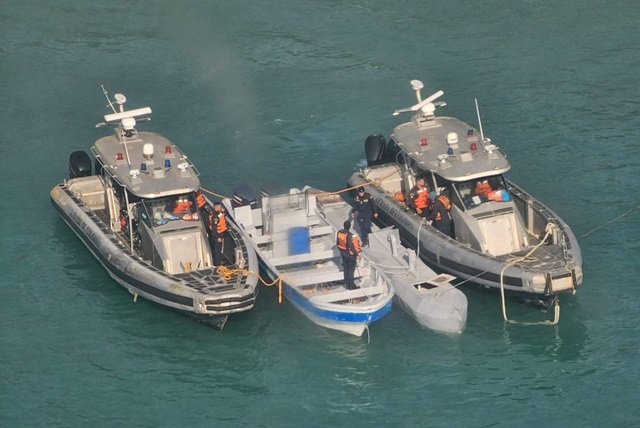
The Colombian navy announced on Wednesday the interception of its first unmanned narco-submarine, outfitted with a Starlink satellite antenna, off the country’s Caribbean coast. Authorities believe the vessel was a trial run by a cocaine trafficking cartel rather than carrying drugs on this occasion.
The drone submarine, owned by the Gulf Clan—Colombia’s largest drug trafficking group—has the capacity to transport up to 1.5 tons of cocaine. While no narcotics were found onboard, the discovery marks a significant escalation in the sophistication of drug smuggling tactics used by criminal networks.
For decades, manned semi-submersibles built in clandestine jungle shipyards have been used to ferry cocaine northward from Colombia, the world’s leading cocaine producer, to Central America and Mexico. However, in recent years, these vessels have expanded their routes, crossing the Atlantic and Pacific oceans to reach more distant markets.
Admiral Juan Ricardo Rozo announced the seizure during a press conference, describing the unmanned submarine as part of traffickers’ shift toward more advanced and harder-to-detect systems. “These autonomous vessels are difficult to track by radar and allow criminal networks to operate with partial autonomy,” Rozo said.
The navy released video footage showing the small gray submarine with a satellite antenna mounted on its bow. This is the first known case in South America of a drone narco-submarine utilizing Starlink technology, a satellite internet system. Previously, in November, Indian authorities seized a methamphetamine shipment controlled remotely by Starlink near the Andaman and Nicobar Islands.
Experts warn that unmanned submarines complicate law enforcement efforts to identify and apprehend drug lords. Juana Cabezas, a researcher at Colombia’s Institute for Development and Peace Studies, noted that Mexican drug cartels operating in Colombia had reportedly hired technology experts as early as 2017 to develop such vessels.
Removing crews from these vessels eliminates the risk of captured operators cooperating with authorities, according to Henry Shuldiner, an investigator with the US-based InSight Crime think tank.
The UN drug agency reported that cocaine production, seizures, and consumption all hit record highs in 2023, with Colombia’s output reaching unprecedented levels amid surging global demand.
Colombian law imposes penalties of up to 14 years in prison for the use, construction, and trafficking of semi-submersibles. Authorities say they will continue to intensify operations against these increasingly sophisticated narco-submarine fleets.