by Durga
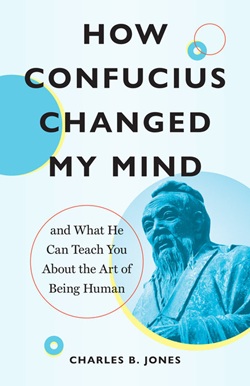
Charles B. Jones’s “How Confucius Changed My Mind” is less a scholarly monograph than it is an intellectual conversion narrative. But beware: this is no light spiritual memoir. It is a philosophical reckoning, a cultural critique, and perhaps most controversially, a subversive endorsement of hierarchy in an age that preaches radical equality. Drawing upon decades of study and classroom experience, Jones weaves classical Confucian thought with Western pedagogical dilemmas and personal transformation in a way that is both unsettling and revelatory.
Jones begins with a confession of failure: “I knew all along that it was not working as well as I wanted.” (Preface) His idealistic, egalitarian classroom dynamic had collapsed under its own contradictions. Despite his best intentions to flatten hierarchies, students floundered. The solution? Confucianism. Yes, the very tradition so often caricatured in the West as rigid, authoritarian, and outdated. “Hierarchy did not exclude mutuality,” he writes. That sentence alone might scandalise the modern educational establishment.
From the outset, Jones challenges the reader to consider that much of what we revere as Western educational egalitarianism is a facade. As he donned a tie and accepted the ritual boundaries of his professorial role, something paradoxical occurred: “our relationships became warmer and more relaxed.” (Preface) It is here that Jones executes a stunning reversal. Ritual, hierarchy, and deference—often viewed as stifling and inauthentic—are reimagined as conduits for sincerity and human flourishing.
This idea is rooted, of course, in the Analects, which Jones mines throughout the book. Consider Analects 7.38: “The Master was mild, and yet dignified; majestic, and yet not fierce; respectful, and yet easy.” The paradox of Confucius is also the paradox of Jones’s classroom. By embracing ritual distinctions, he creates a space for genuine human interaction. And yet, how many contemporary educators would dare to adopt such a posture? Would they not be accused of authoritarianism or elitism?
Jones’s approach is not without risk. His endorsement of Confucian values could be (and has been) interpreted as an implicit critique of modern liberalism. His critique of Western assumptions is unflinching: “The value we place on creativity, originality, individualism, and nonconformity hides from our view just how much our behaviour is ritualised and how much has been handed down to us.” (Preface) It is a stinging indictment of our cherished myths of self-making.
Even more provocatively, Jones dares to suggest that Western culture may need to learn from the East, not just in terms of tolerance or curiosity, but in the deeper work of moral formation. He quotes Confucius: “The learning virtue without proper cultivation… these are the things which occasion me solicitude.” (Analects 7.3) This is not a plea for understanding but a challenge: are we cultivating virtue, or merely acquiring knowledge?
The most controversial element of the book lies in its implicit political theology. In Chapter 3, Jones discusses the Confucian concept of the Dao (Way) as “a moral force that connects nature to human relations.” This is not just metaphysics; it is governance. The ancient Chinese vision of rulership rooted in Heaven’s Mandate is contrasted with the modern secular state. While Jones stops short of explicitly endorsing Confucian theocracy, he clearly believes that Western liberalism has severed the metaphysical roots of authority—to our peril.
Nor does Jones avoid the tensions within Confucianism itself. He candidly discusses the differences between Confucius, Mencius, and Xunzi. For instance, where Mencius claims that “human nature is good,” Xunzi argues it is inherently self-centred and in need of strong moral training. Jones leans towards Xunzi, especially in terms of education: “People need help to become good; education is moral formation, not mere information transfer.” (Chapter 5) Here too he parts ways with many in the West who view education as a buffet of choices rather than a crucible for character.
Perhaps the most incendiary section of the book is Chapter 7, “Dissenters,” where Jones critiques Daoist and Legalist alternatives to Confucianism. His dismissal of the Daoist embrace of spontaneity might strike some readers as authoritarian: “Spontaneity without ritual becomes mere self-indulgence.” But this, Jones insists, is the hard lesson: freedom without form collapses into chaos.
In his final chapter, Jones articulates the heart of his transformation: “The classroom is a ritual space, and rituals create the conditions for sincerity, not hypocrisy.” (Chapter 8) One might ask, has Jones simply traded one form of dogma for another? Is his new-found Confucianism merely a nostalgic romanticism for a lost order? Or worse, an ideological smokescreen for preserving status and power?
These are fair questions. But Jones would likely respond with Analects 7.2: “Learning without satiety; and instructing others without being wearied—which one of these things belongs to me?” Confucian humility is not the same as self-effacement. It is the courage to embrace limits, structure, and tradition in pursuit of something greater than self-expression.
If nothing else, “How Confucius Changed My Mind” is a necessary provocation. It dares to suggest that Western modernity has not answered all questions; that perhaps our allergy to hierarchy and ritual is a symptom of cultural immaturity rather than enlightenment. As Jones puts it, “Real understanding requires we become aware of things we believe on such a deep level that we do not even know we believe them.” That is the book’s true challenge—and its gift.