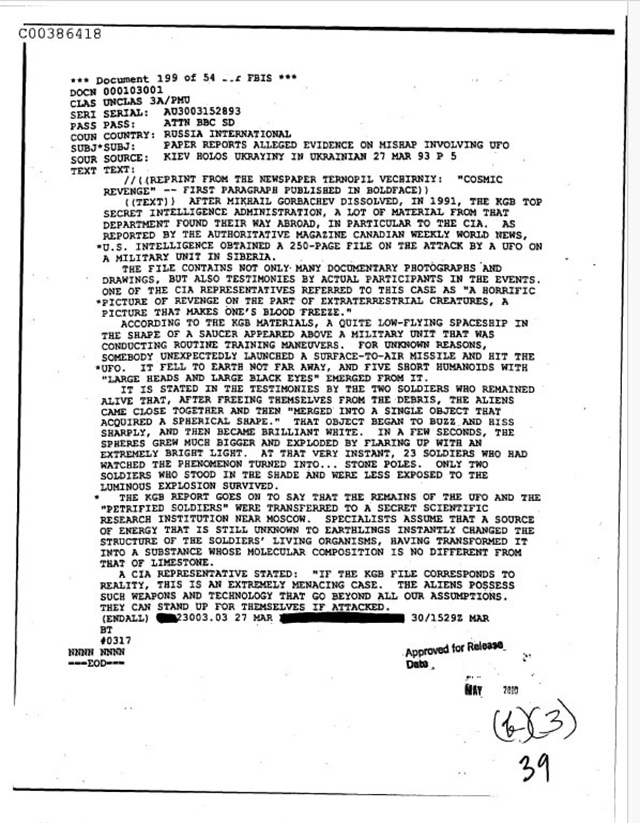
In one of the more sensational entries from the archives of Cold War lore, a newly resurfaced declassified CIA document recounts a bizarre story from the late 1980s: that Soviet soldiers allegedly engaged in combat with extraterrestrial beings following the crash of a UFO in Siberia.
According to the report—originally published in 1993 by the Canadian tabloid Weekly World News and Ukraine’s Holos Ukrayiny—a file supposedly obtained from the KGB describes a surreal and deadly encounter between Soviet forces and otherworldly beings.
The story claims that a Soviet military unit shot down an unidentified flying object that had ventured too close to troop maneuvers. Five humanoid figures with large heads and black eyes reportedly emerged from the wreckage. What happened next veered into science fiction: the aliens reportedly merged into a single, glowing sphere that exploded in a flash of light—turning 23 Soviet soldiers into stone.
The Foreign Broadcast Information Service (FBIS), a now-defunct branch of the CIA responsible for monitoring foreign media, flagged the outlandish story and included it in its database of foreign reports. While the CIA did not endorse the claims, the fact that the agency preserved the story has added fuel to longstanding conspiracy theories about military contact with extraterrestrials.
No concrete evidence has ever emerged to validate the reported KGB file, and the story remains highly speculative at best. Nonetheless, its existence within a U.S. intelligence repository has kept the tale alive among UFO enthusiasts and Cold War historians alike.
Skeptics have long dismissed the story as Cold War-era sensationalism—possibly misinformation, propaganda, or pure tabloid fantasy. Still, in a time when governments around the world are taking a renewed interest in unidentified aerial phenomena (UAPs), even the most improbable accounts are being reexamined under a different light.
While the truth behind the alleged encounter may never be confirmed, the declassified reference to it serves as a curious footnote in the annals of Cold War secrecy—and a reminder that truth and fiction were often separated by only the thinnest of veils during that tense period in history.