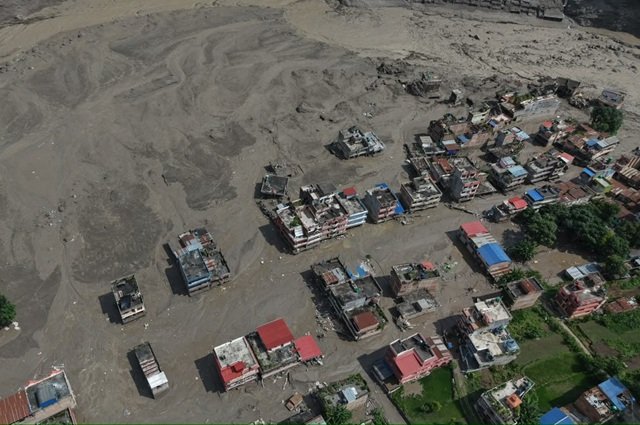
A flash flood in Nepal’s Bhotekoshi River has left dozens confirmed dead and hundreds unaccounted for, sweeping through settlements, markets and critical infrastructure in Rasuwa and neighbouring districts and leaving rescue teams facing a rapidly unfolding disaster.
By Wednesday afternoon, at least 22 people had been confirmed dead after floodwaters surged through Rasuwa, Nuwakot, Dhading and Gorkha. According to the Nepal Tourism Board, as many as 384 people, including 291 foreign nationals and 93 Nepali citizens, were unaccounted for. The number of missing remained uncertain as communications were disrupted and authorities struggled to compile a consolidated assessment of the destruction.
The human toll was accompanied by a breakdown of basic infrastructure across the affected areas. The flood swept away 22 concrete bridges and five Bailey bridges in Rasuwa, Nuwakot and Dhading, according to Shubharaj Neupane, spokesperson and deputy director general of the Department of Roads. The 40-kilometre road connecting Betrawati to the Rasuwagadhi checkpoint was reported to have been completely damaged, with bridges along the route also washed away.
Riverside communities bore the brunt of the destruction. Krishna Prasad Humagain, assistant chief district officer of Nuwakot, said areas including Tupche, Dhunge, Trishuli Bazaar and Devighat had suffered extensive damage. “The entire settlement has been washed away, banks, bridges, markets, settlements have all been damaged,” he said. “There has never been so much damage in history.”
In Vidur Municipality-7, residents described scenes of devastation and fear. Ward chairman Ravindra Nepal said hundreds of houses between Sole Bazaar and Akkare Bazaar had been washed away. Some people managed to escape, but elderly residents and children remained unaccounted for. Nepal himself said he had been stranded at the municipality building since early morning because there was neither a road nor a bridge through which he could return home.
Gokarna Adhikari of Tupche said little remained of his village. Many people he knew could no longer be contacted, while only a few houses between Sole and Akkare markets appeared to remain. Even those buildings that looked intact from a distance, he said, were covered in mud and debris. Another local resident, Yuganath Adhikari, said he had watched two sisters, a nephew and a niece-in-law being swept away. “No one is in a condition to speak,” he said.
The disaster also struck schools and disrupted the lives of children. Students from Chandeshwori, Pioneer and Uttargaya schools in Tupche were among those affected, although authorities had not yet established how many students were caught in the flood or remained unaccounted for. Local reports indicated that some students travelling to school had been swept away, while those who had already reached school were safe.
The disaster has also created a major search operation involving security personnel themselves. Forty-four army officers were reported missing after they could no longer be contacted following the flooding at 8:40 am, according to army spokesperson Rajaram Basnet. Thirty Nepal Police personnel and nine Armed Police Force security personnel were also reported missing. Fifteen employees of the Rasuwa Customs Office in Timure were likewise out of contact.
The Langtang Khola Hydropower Project was another major point of concern. Sixty people associated with the 20-megawatt project were reported out of contact, including 25 engineers, drivers and kitchen staff and 35 workers who had been inside a tunnel. Project promoter Bijay Mohan Bhattarai said contact had not been established with them. The project had been completed and was due to undergo testing in two days.
The flood also struck the crucial route towards the Nepal-China border, placing foreign travellers among those whose whereabouts were initially uncertain. Nearly 400 pilgrims travelling for the Kailash Mansarovar Yatra in Tibet, China, were reported out of contact in Rasuwagadhi. Bashu Kumar Adhikari, managing director of Touch Kailash Travels & Tours, said 390 pilgrims, including 93 Nepalis, had been scheduled to cross the border on Wednesday. “Except for a few, we have not been able to establish contact with the pilgrims as of 3pm,” he said.
Rescue operations were continuing despite severe logistical difficulties. The Nepal Army said it had rescued 88 people trapped in the flood, with 13 taken to Tribhuvan University Teaching Hospital in Kathmandu. In a later update, Nepal Army and private helicopters had air-rescued 114 flood victims, with the army accounting for 85 rescues and private helicopter companies for 29.
Helicopter operations, however, were repeatedly interrupted by poor weather. Forty-nine rescue flights had been operated from Kathmandu Airport by 5:20 pm, including flights to Dhunche, Timure, Syafrubesi, Mailung, Trishuli and Dhading. Three helicopters carrying rescue supplies were forced to return to Kathmandu because of adverse weather, while the airport warned that conditions were making it difficult to send additional aircraft into the affected areas.
The disaster has also disrupted electricity, telecommunications and financial services. The Nepal Electricity Authority said electricity had been cut throughout Rasuwa and in parts of Nuwakot and was exploring alternative supplies from Dhading and Melamchi. Nine commercial bank branches were washed away, while 26 employees remained out of contact amid the loss of telephone services and electricity.
The precise cause of the sudden flood was still being investigated. Kathmandu University professor and climate researcher Rijan Bhakta Kayastha said an initial assessment suggested that an ice avalanche had blocked the Lhende river, causing water to accumulate before a sudden release produced the devastating flood in the Bhotekoshi. He also noted that a magnitude 4.4 earthquake struck Tibetan territory at 8:37 am, about 47 kilometres north of Gosainkunda.
Kayastha said it could take several days to establish whether a glacial lake had also burst. A similar flash flood struck the Bhotekoshi on July 8, 2025, when the Department of Hydrology and Meteorology concluded, using Sentinel satellite imagery, that a glacial lake outburst had caused flooding in the Lhende river near the Nepal-China border.
The department said there had been no heavy rainfall in the Rasuwa area on Tuesday or Wednesday, strengthening the focus on an upstream blockage or glacial event rather than conventional rainfall-driven flooding. Shanti Mahat, spokesperson for the National Disaster Risk Reduction and Management Authority, said preliminary information received through the International Centre for Integrated Mountain Development suggested that an ice avalanche had blocked a river, but stressed that the information had not yet been formally confirmed.
As the search continues, Nepal has declared the affected local levels in Rasuwa, Nuwakot and Dhading disaster-affected areas for three months. The government has ordered the mobilisation of the Nepal Army and private helicopters, free treatment for the injured in government hospitals, relocation of displaced families and the restoration of roads, electricity, drinking water and telecommunications.
The World Health Organization is preparing essential medicines and health equipment for 1,000 people, while 15 emergency tents are also planned for the affected areas. One hundred emergency beds have been allocated at Bir Hospital and the Trauma Center in Kathmandu.
Nepal and China have also agreed to cooperate on the exchange of meteorological data following the disaster. Meanwhile, Indian Prime Minister Narendra Modi spoke to Prime Minister Balendra Shah and said teams from both countries were closely coordinating rescue and relief operations.
With communications still disrupted, weather hampering helicopter flights and the full scale of the destruction yet to be established, the search for survivors remains the immediate priority. Authorities have also urged the public not to circulate false or unverified information about the disaster, as rescue teams continue to determine how many people remain missing and how much of the affected region has been destroyed.