


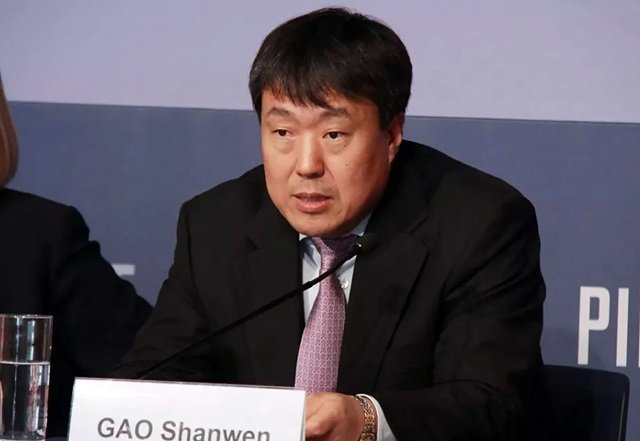
The death of Chinese economist Gao Shanwen, who drew international attention after questioning the accuracy of official economic growth figures, has triggered widespread mourning online from commenters who described him as a “truth teller” in a country where independent commentary is often restricted.
Gao, a former economist at SDIC Securities, a government-controlled investment group, died at the age of 55 “due to illness”, the state-owned Shanghai Securities News reported. The publication did not provide details on the timing of his death but described Gao as “one of the most influential macroeconomists in China’s capital market.”
Gao became a prominent figure internationally in late 2024 after he told a conference in Washington hosted by the Peterson Institute for International Economics and a Chinese think-tank that China’s actual GDP growth over the previous two to three years “might be around 2 per cent” on average. The estimate was significantly lower than the official growth figure of about 5 per cent reported by Beijing.
The comments were viewed as a direct challenge to China’s official economic narrative, as the government sets annual GDP targets and has historically reported figures closely aligned with those goals. Gao’s remarks also reinforced existing concerns among some international economists about the reliability of Chinese economic data.
Following his comments, Gao disappeared from public view for almost a year. He later made a brief return in September 2025, delivering a speech by video at a forum held by Peking University.
Reports at the time said Gao was under investigation, although a person familiar with the matter said he had also informed friends and colleagues that he was diagnosed with cancer in January 2025.
News of his death prompted emotional reactions on Chinese social media platforms. One commenter on Xiaohongshu, also known as RedNote, wrote that Gao was “a rare economist who spoke the truth,” adding that “in the last couple of years, only the ‘optimist’ economists are left.” Another comment on Weibo stated: “Another truth-teller has passed away, while those full of lies are still talking nonsense. Dr Gao, rest in peace!”
Chinese authorities have frequently restricted voices that challenge official positions, including commentary on economic issues. Measures against critics have included censorship, removal from public platforms, loss of professional positions and restrictions on public activity.
In 2023, as China faced economic difficulties following the end of strict Covid-19 restrictions and a prolonged property sector crisis, authorities warned analysts against making negative comments about economic growth and censored some prominent commentators. Wu Xiaobo, a well-known Chinese economic blogger, was blocked from Weibo in June that year after allegedly spreading harmful information.
The deaths of public figures seen by some citizens as whistleblowers or independent voices have previously become sensitive moments in China. In 2020, the death of Li Wenliang, a Wuhan doctor who raised early warnings about Covid-19, led to widespread online expressions of grief and remembrance.
Although economic analysis is a specialised field, concerns over China’s economy have grown among the public amid a property slowdown and rising youth unemployment. Beijing has maintained that its economic strategy, focused on expanding high-tech sectors including robotics, artificial intelligence and biotechnology, will help offset problems in the real estate market, while domestic demand remains weak.
Gao was also known for his concise and widely discussed writing. In 2024, he said that in China, “the elderly are full of vitality, the young are lifeless and the middle-aged are weary of life,” referring to differences between generations following years of economic expansion.
He also attracted criticism from nationalists after advising caution during the early stages of the US-China trade war in 2018. Following reports about his illness, one online commentator questioned whether the United States had assisted with his medical treatment, writing sarcastically: “Didn’t the US send a special plane to pick him up?”











