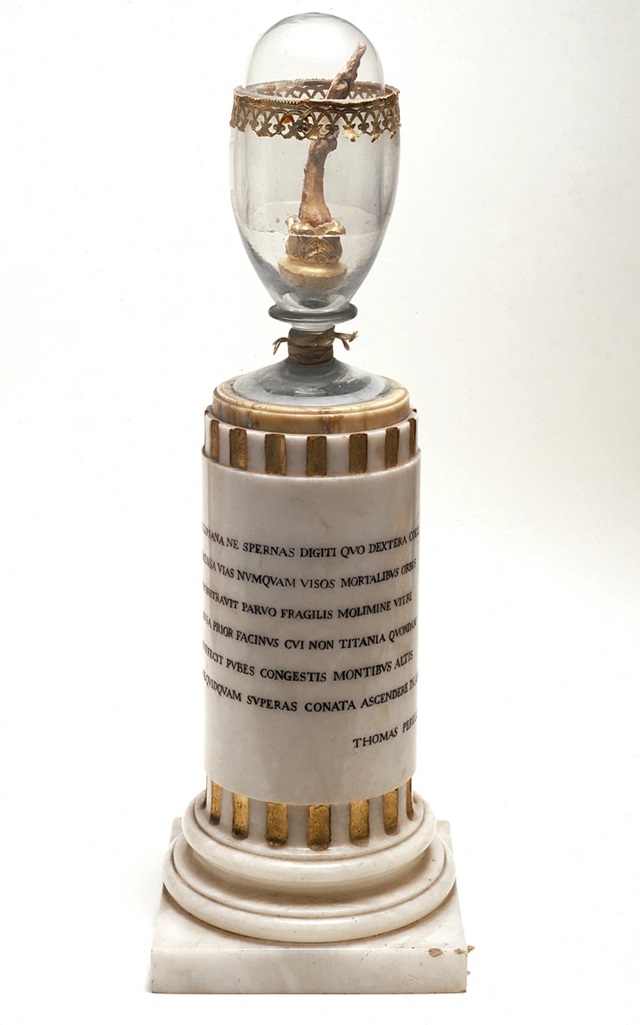
The Galileo Museum in Florence is drawing attention for its unusual exhibit: the preserved middle finger of astronomer Galileo Galilei, encased in a gilded glass egg. The display, described by historian James Delbourgo as “as if it were the relic of a Christian saint,” forms part of a broader discussion on humanity’s fascination—and sometimes obsession—with collecting.
The finger was severed from Galileo’s corpse in 1737, nearly a century after his death in 1642, along with an index finger also now housed in the museum, and a vertebra held at the University of Padua. According to contemporary accounts, the Italian nobleman responsible for taking the fingers prized them “because Galileo wrote so many beautiful things with them.”
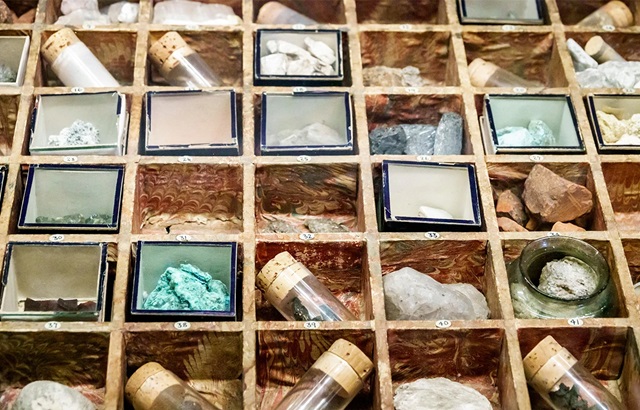
Delbourgo explores such compulsions in his book A Noble Madness, noting that curiosity and obsession have long driven people to amass objects—whether for scientific, historical, religious, or personal reasons. The Nature journal recently highlighted this story, placing it in the context of humanity’s “dark side” of collecting.
The book also examines notorious collectors such as Henry Wellcome, the British pharmaceutical entrepreneur whose enormous collection of artifacts often involved dubious acquisition methods, and Hans Sloane, whose natural history collections helped found the British Museum but were partly financed by slavery. Delbourgo contrasts these figures with collectors motivated by genuine scientific curiosity, such as Alexander von Humboldt, Charles Darwin, and Alfred Russel Wallace, who gathered specimens that advanced the understanding of natural history and evolution.
Modern neuroscience has explored the psychological roots of collecting and hoarding, with some studies pointing to brain areas involved in decision-making and perception of beauty. Yet, as Delbourgo notes, collecting has often contributed positively to human culture, preserving knowledge, art, and history that might otherwise have been lost.
“Collectors’ love of objects may be mad, bad, even dangerous,” Delbourgo writes, “but we want to believe their love’s a noble madness because by expressing that love, they are themselves.”