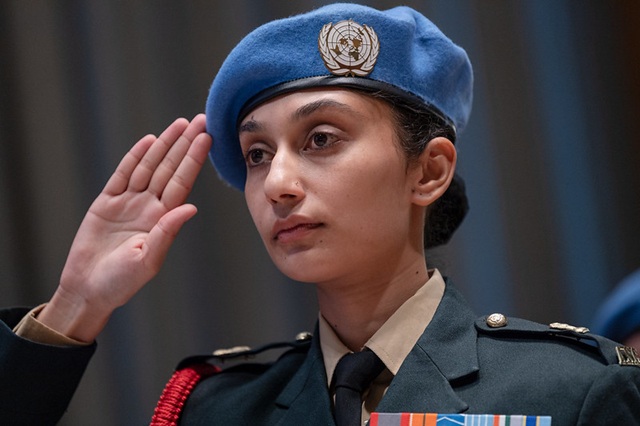
The number of personnel deployed to multilateral peace operations has fallen by more than 40 percent since 2015, according to a new report released today by the Stockholm International Peace Research Institute (SIPRI). Despite the continued proliferation of armed conflicts around the world, only 94,451 international personnel were deployed in 57 peace operations at the end of 2024, down from 161,509 in 2015 and 6 percent fewer than in 2023.
SIPRI’s latest analysis shows that a total of 61 multilateral peace operations were active in 36 countries or territories during 2024, just two fewer than in the previous year. Sub-Saharan Africa hosted the largest number of operations (21), followed by Europe (19), the Middle East and North Africa (14), the Americas (4), and Asia and Oceania (3). The steep reduction in deployed personnel, however, underscores growing difficulties in maintaining these missions amid deepening geopolitical divides and shrinking budgets.
Dr. Claudia Pfeifer Cruz, Senior Researcher in SIPRI’s Peace Operations and Conflict Management Programme, noted that deploying and sustaining peace operations has become significantly more difficult in recent years for both the United Nations and regional organizations such as the African Union. “This has real consequences for civilians on the ground,” she warned.
Nearly three-quarters of all peace operations personnel in 2024—roughly 69,913 individuals—were deployed in sub-Saharan Africa. The Middle East and North Africa hosted 15 percent (14,498), Europe 9 percent (8,898), the Americas 1 percent (828), and Asia and Oceania just 0.3 percent (314). The Americas was the only region to see a notable increase in deployments compared to 2023, with numbers more than doubling. In other regions, personnel levels either declined or remained stagnant.
The report also highlights growing geopolitical tensions, particularly within the UN Security Council, which have severely hampered consensus on launching or expanding peace operations. In the past decade, no major new UN-led mission has been deployed, despite escalating violence in several regions. Discussions over mission mandates were often marked by low ambition and political friction in 2024. This paralysis was especially visible in the delayed rollout of the Multinational Security Support Mission in Haiti. Although the mission was first discussed in 2022, the initial deployment—a small Kenyan police unit—did not take place until June 2024, by which time gang-related violence in Haiti had intensified.
Dr. Jaïr van der Lijn, Director of SIPRI’s Peace Operations and Conflict Management Programme, cautioned that continued gridlock in the Security Council could push states to pursue alternative approaches to conflict management. “We are likely to see increased reliance on private military and security companies or bilateral military agreements, such as those in Mozambique and the eastern Democratic Republic of the Congo,” he said.
Financial constraints are compounding the crisis in peacekeeping. A liquidity crunch in the UN peacekeeping budget, driven by delayed or partial payments from major contributors such as the United States and China, disrupted several UN-led missions in 2024. Regional organizations also struggled with funding shortfalls. Notably, the Southern African Development Community Mission in Mozambique (SAMIM) was terminated in July 2024, largely due to financial limitations.
Looking ahead to 2025, SIPRI warns that the funding situation is likely to deteriorate further. As major donors like the United States and EU member states shift priorities towards domestic defense spending, resources for aid and peace operations are being cut. Dr. Pfeifer Cruz emphasized that budgetary pressure could force existing missions to downsize or shut down altogether, while any new deployments may be chronically underfunded and inadequately equipped. “As traditional donors reduce investment in peace operations, they risk allowing other security threats to grow unchecked,” she said.
Despite a recent trend of host countries calling for peace operations to leave, several governments reversed course in 2024. In both the Democratic Republic of the Congo and Somalia, national authorities asked missions previously set for closure to remain, citing growing territorial advances by armed groups following UN drawdowns. In Mali, the withdrawal of a major UN peace operation in 2023 was followed by worsening violence, despite the government’s partnership with a private military company to fight insurgents.
“When peace operations have been drawn down or closed prematurely, it has left a dangerous security vacuum,” said Dr. Pfeifer Cruz. “Armed groups move in, civilians suffer, and the cycle of violence deepens.”
Despite their limitations, SIPRI concludes that multilateral peace operations remain one of the most effective tools available for managing conflict. Dr. van der Lijn stressed the importance of international cooperation to sustain them. “Letting these missions fail would be a dangerous mistake,” he said.
According to the report, all of the top ten contributors of military personnel to peace operations in 2024 came from the Global South. Nepal led the list, followed by Bangladesh and India. Other key contributors included Rwanda, Uganda, Ethiopia, South Africa, Burundi, Kenya, and Pakistan. Together, these ten countries accounted for just over half of all military personnel deployed worldwide.
The five largest multilateral operations in 2024 were all located in sub-Saharan Africa: the UN Multidimensional Integrated Stabilization Mission in the Central African Republic (MINUSCA), the UN Mission in South Sudan (UNMISS), the African Union Transition Mission in Somalia (ATMIS), the UN Organization Stabilization Mission in the DRC (MONUSCO), and the UN Interim Force in Lebanon (UNIFIL).