Nandini Voice For the Deprived, a Chennai-based not-for-profit organization, recently organized an all-India essay competition for college students on the topic “India’s Growing Population & Socio-Economic Impact – What Will the Year 2040 Be Like?” The goal of the competition was to encourage students to reflect on this crucial issue and provide their insights and recommendations. The competition received a strong response from students across the country.
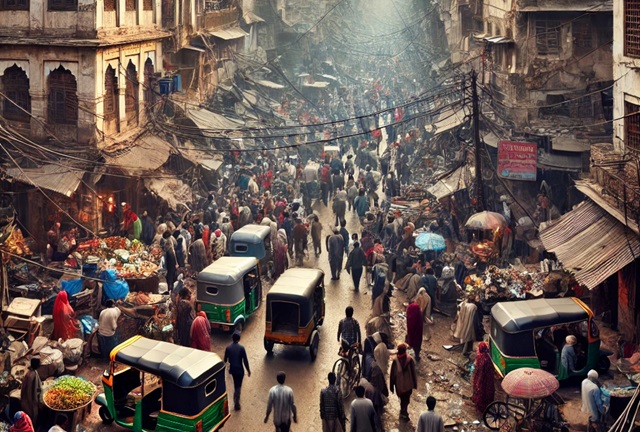
One of the major concerns raised by the students was that India’s population has already exceeded its “carrying capacity.” From around 35.9 crores in 1950, the population has surged to approximately 140 crores in 2024. This “population explosion” has reached alarming levels, and its adverse effects are becoming increasingly evident. Despite the impressive growth of the Indian economy and advancements in the industrial, agricultural, and service sectors over the past decade, a significant portion of the population still remains below or just above the poverty line. Economic growth, it seems, has not been able to keep pace with the rapid increase in population, and this imbalance needs to be addressed urgently.
The issue of population growth is often framed as an opportunity, with some suggesting it could provide a demographic dividend for India. However, the students questioned this assumption, asking at what cost this supposed benefit would come. While the concept of a demographic dividend is valid, achieving it has been exceedingly difficult, as evidenced over the past several years. The belief that population growth will naturally align with the generation of jobs, healthcare infrastructure, and skill development, especially in the context of new technologies like artificial intelligence, is seen by many students as overly optimistic and not grounded in the realities of India’s current situation.
To address these challenges, students emphasized the need for a population sustainability index policy. They argued that India must determine an affordable population level that would ensure satisfactory living conditions for all its citizens. Considering the nation’s current economic growth, land size, and natural resource availability—along with the negative effects of high population density, such as urban migration, water scarcity, job creation difficulties, waste generation, and environmental issues—a target population of around 100 crores would be ideal in the coming years. Since population growth varies across different states, a population sustainability index should be established for each state, with specific population targets based on regional factors. This kind of policy, they believe, is crucial for India’s future stability.
The students also noted that the campaign to control population growth has been largely inconspicuous in recent years. Instead, a narrative has emerged suggesting that population growth is not a threat, as birth rates are declining and economic growth is expected to keep pace. However, the public has not been adequately informed about the grave consequences of further population increases. If the population grows by another 40 crores before stabilizing, it will place an unbearable burden on the nation.
Empowering women and raising awareness about the need for population control is seen as essential. This could be achieved through a vigorous public campaign. The students proposed that India should adopt a one-child policy, similar to the one China implemented successfully, despite China’s larger land area and lower population density. China managed to reduce its population growth within acceptable limits, and while India, as a democratic nation, cannot adopt the same dictatorial methods, the one-child policy could be implemented through persuasion and by providing disincentives for families with more than one child. Additional measures such as banning polygamy, offering tax breaks for families with one child, permitting abortion upon request, and encouraging NGOs to actively participate in the campaign are also necessary steps to control population growth.
Reflecting on the words of Mahatma Gandhi, who said, “The future depends on what you do today,” the students stressed the urgency of addressing this issue. The central and state governments must recognize that India has no time to lose. Achieving a sustainable population level, which could be several crores lower than the current figure, is critical for the country’s future stability.
The students also pointed out that Prime Minister Narendra Modi’s views hold considerable influence in India today. He has spoken persuasively on a range of topics, from Yoga and Clean India to Digital India. They suggested that it would greatly benefit the cause if the Prime Minister were to address the need for population control in his speeches and public interactions.