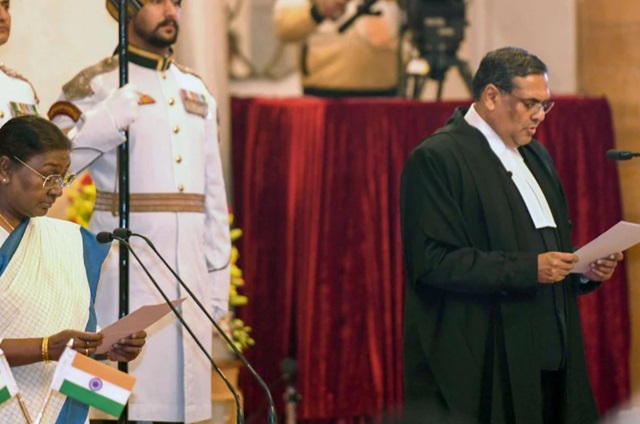
On Monday, Justice Sanjiv Khanna took the oath as the 51st Chief Justice of India (CJI) in a ceremony held at Rashtrapati Bhavan, with President Droupadi Murmu administering the oath of office. Justice Khanna succeeds Justice D.Y. Chandrachud, who retired the day before, and will serve as CJI until May 13, 2025.
A Legacy of Legal Excellence
Born on May 14, 1960, Justice Khanna hails from a distinguished legal family in Delhi. He is a third-generation lawyer, with his father, Justice Dev Raj Khanna, having served as a judge in the Delhi High Court, and his uncle, Justice H.R. Khanna, being a renowned former judge of the Supreme Court.
Justice Khanna’s academic journey began at the Campus Law Centre of Delhi University, where he laid the foundation for a career marked by several high-profile legal contributions. His commitment to the legal profession has been evident throughout his life, continuing his family’s long-standing legacy in law.
Career Milestones
Justice Khanna’s legal career began in 1983 when he enrolled as an advocate with the Bar Council of Delhi. He started practicing at the District Courts in Tis Hazari before establishing himself in the Delhi High Court. Over the years, he built a formidable reputation, serving as the senior standing counsel for the Income Tax Department and later as the standing counsel (Civil) for the National Capital Territory of Delhi.
In 2005, he was appointed to the Delhi High Court bench, where he served with distinction until his elevation to the Supreme Court in 2019. During his tenure, Justice Khanna also played a significant role in leadership positions, including as the executive chairman of the National Legal Services Authority (NALSA).
Landmark Contributions to Indian Jurisprudence
Justice Khanna’s tenure at the Supreme Court has been marked by a series of landmark rulings that have had a lasting impact on Indian law and society.
In 2019, he was part of a crucial bench that upheld the integrity of Electronic Voting Machines (EVMs), dismissing claims of manipulation and reinforcing confidence in the electoral process. He was also a key figure in declaring the controversial electoral bonds scheme unconstitutional, emphasizing the need for transparency in political funding.
Justice Khanna was also part of the five-judge bench that upheld the 2019 abrogation of Article 370, which revoked the special status of Jammu and Kashmir, a decision that has had significant political and legal ramifications.
Among his other significant rulings, Justice Khanna granted interim bail to Delhi Chief Minister Arvind Kejriwal in 2019, allowing him to campaign in the Lok Sabha elections amidst the excise policy scam cases.