by Our Correspondent in Colombo
Sri Lanka is bracing for severe flooding and further devastation as intense rainfall, rising river levels and powerful winds triggered by Cyclonic Storm “Ditwah” continue to batter the island. The Department of Irrigation has issued an urgent warning that low-lying areas of the Kelani River Valley could face a major flood situation within the next 48 hours, placing several densely populated regions at imminent risk.
Read Our Editorial: Sri Lanka Under Cyclone Ditwah
According to the Department, heavy rainfall across the upper Kelani River Basin has caused a rapid rise in water levels, compounded by increased water releases from upstream reservoirs. River gauge analyses at Eheliyagoda, Norwood, Yatiyanthota, Galigamuwa, Ruwanwella, Bulathkohupitiya, Dehiowita, Seethawaka, Dompe, Padukka, Homagama, Kaduwela and Biyagama show a steady upward trend. As a result, flood warnings have been extended to the Kolonnawa, Kelaniya, Wattala and Colombo Divisional Secretariats, with authorities urging residents, motorists and commuters to exercise extreme caution to safeguard lives and property. A similar alert has been issued for the Kalu Ganga basin, where the rising river poses an immediate threat to low-lying areas in the Ratnapura and Kalutara districts, including Pelmadulla, Niwithagala, Ratnapura, Kuruwita, Ayagama, Elapatha, Kalutara, Ingiriya, Horana, Dodangoda, Millaniya, Bulathsinghala, Palindanuwara, Madurawala and Agalawatte.
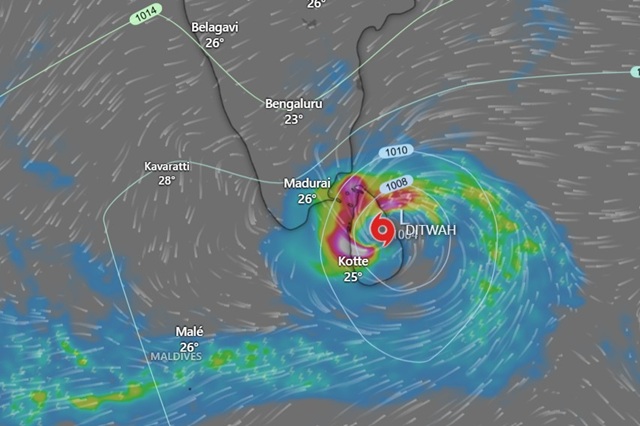
The worsening weather conditions are being driven by the cyclonic storm currently positioned near latitude 8.1°N and longitude 81.2°E, approximately 50 kilometres south of Trincomalee. The Department of Meteorology reports that the system is moving north-northwest and is expected to continue generating widespread heavy rainfall and strong winds across the island. Cloudy skies and intermittent thundershowers have already become persistent in most provinces, with the heaviest rainfall exceeding 200 millimetres in areas of the Northern, North-central, Central, North-western, Sabaragamuwa and Western provinces. Rainfall exceeding 150 millimetres has been recorded in Trincomalee, Badulla, Galle and Matara, while other regions have experienced more than 75 millimetres. A maximum of 375 millimetres was reported from Cheddikulam in the Vavuniya District within the 24-hour period ending on the morning of 28 November, marking the highest rainfall reading for the day. Meanwhile, wind speeds between 60 and 70 kilometres per hour, with gusts reaching 90 kilometres per hour, continue to sweep across the country.
The impact of the adverse weather has been catastrophic. The Disaster Management Centre (DMC) confirmed that 46 deaths occurred within the past 72 hours, bringing the total number of fatalities since 16 November to 56, with 21 people still missing. According to the DMC, 43,991 individuals from 12,313 families have been affected nationwide. Four houses have been completely destroyed, while 666 have been partially damaged, as continuous rain and flooding force families to evacuate and seek temporary shelter.
Severe disruptions have also hit the healthcare sector. Dr. Palitha Rajapaksa, Chief Medical Officer of Badulla Hospital, reported that all communication lines had collapsed after doctors warned that the Maiyanganaya Hospital could be submerged by last evening. As floodwaters engulfed the facility, around 10 doctors were relocated to the Dambana Hospital, while approximately 150 other medical staff members remained trapped inside. Hospital personnel had already moved about 300 inpatients from lower floors to upper levels as water levels rose. With generators at risk of being flooded and power outages already occurring in some hospitals, authorities fear a looming medical emergency, particularly for patients in intensive care units.
As the island faces yet another onslaught of extreme weather, the Disaster Management Centre has urged the public to take immediate safety measures and remain vigilant. With river levels continuing to swell and the storm system still exerting influence, officials warn that the next 48 hours will be critical for communities in flood-prone regions.