Exclusive
by Our Correspondents in New Delhi and Colombo
Indian Prime Minister Narendra Modi has declined an invitation to visit the newly commissioned Adani-operated terminal at the Colombo Port during his recent two-day official visit to Sri Lanka, citing concerns over potential political controversy, according to reliable sources from both Indian and Sri Lankan delegations.
Modi was initially expected to mark the commencement of container operations at the Colombo West International Terminal (CWIT), a project developed by a consortium including Adani Ports & Special Economic Zones Ltd. (APSEZ) and John Keells Holdings PLC. However, in a discreet move aimed at avoiding political entanglements amid ongoing investigations and public scrutiny of the Adani Group, the Indian premier opted not to participate in the event.
There had been high expectations that Modi would visit the terminal, recalling a similar event attended by Chinese President Xi Jinping during his visit to Sri Lanka, where he inaugurated the Colombo International Container Terminal (CICT), sources familiar with CWIT disclosed.
Despite skipping the terminal visit, Modi’s trip to Sri Lanka proved diplomatically fruitful. His high-level delegation signed seven key Memoranda of Understanding (MoUs) with the Sri Lankan government, strengthening bilateral cooperation in areas such as defence, maritime security, economic development, renewable energy, and technological exchange.
Addressing a rally as part of his ongoing election campaign, Sri Lankan President Dissanayake expressed regret over the nation’s dependence on foreign technological and security partnerships, blaming decades of governance failures for the current situation.
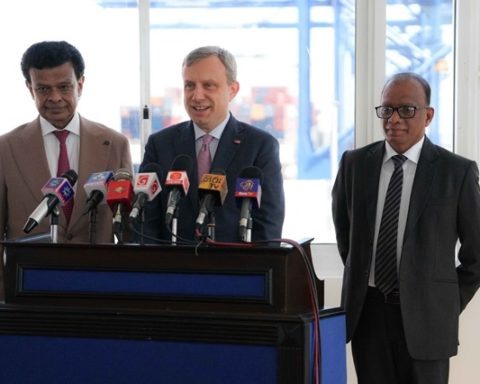
“We need to secure the security of this region,” Dissanayake stated. “We need the support of those who possess technological expertise in security. If our previous governments had developed this nation properly over the past 76 years, we wouldn’t be in this situation.”
Meanwhile, speaking at a separate event ahead of the local government elections, Tilvian Silva, General Secretary of the Janatha Vimukthi Peramuna (JVP), commented on India’s evolving role in regional politics. “Although the JVP once opposed Indian interference, that chapter is over. Today, India has changed, and we must move forward in friendship. That is the essence of political maturity,” Silva said.
In parallel developments, Adani Ports and SEZ Ltd. has officially commenced limited operations at the Colombo West International Terminal, despite facing unresolved technical challenges.
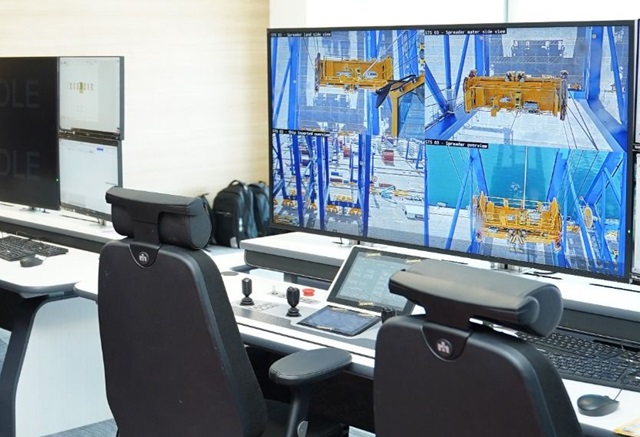
“Currently, the terminal can handle only five containers per hour,” a source familiar with the operations revealed. “It’s technically commissioned, but far from fully operational. There’s still a long road ahead.”
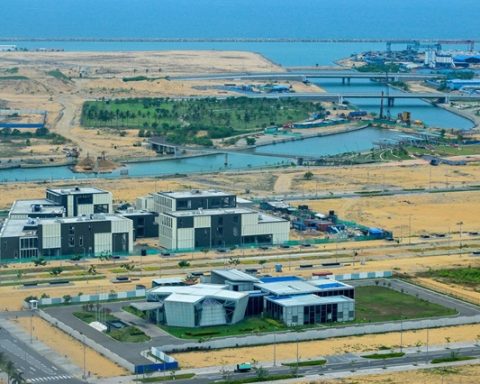
The CWIT is being developed under a 35-year Build-Operate-Transfer (BOT) agreement and represents a significant investment of USD 800 million. Once fully operational, it will feature a 1,400-metre quay with a 20-metre draft, enabling it to process up to 3.2 million TEUs annually. It is also expected to become Colombo’s first fully automated deepwater container terminal, significantly enhancing the port’s regional and global logistics capacity.
Adding to the complications, the Adani Group has withdrawn from a planned $553 million loan from the United States International Development Finance Corporation (DFC), amid mounting legal and reputational challenges.
The DFC confirmed that while the funding was approved in 2023 to support the CWIT project, no disbursements have been made. It also noted ongoing investigations by the U.S. Department of Justice (DOJ) and the Securities and Exchange Commission (SEC) into allegations of corruption and financial misconduct involving Adani.
In a statement clarifying its position, the DFC emphasised its commitment to legal compliance and due diligence: “We defer to the DOJ and SEC for any law enforcement matters. Our project evaluations are ongoing, and no funds have been released to date.”
Despite the controversy, the DFC reiterated the developmental significance of the CWIT project, describing it as a “highly developmental” initiative with the potential to boost Sri Lanka’s economy and position the island nation as a critical logistics hub in the Indian Ocean.
As regional geopolitics continue to evolve, India’s engagement with Sri Lanka remains a delicate balancing act—one that reflects both growing strategic interests and a cautious stance amid increasing scrutiny of corporate actors like Adani.
While CWIT stands to transform Sri Lanka’s maritime infrastructure, the political, legal, and operational hurdles underscore the complexities of public–private partnerships in an era of heightened accountability and global transparency.