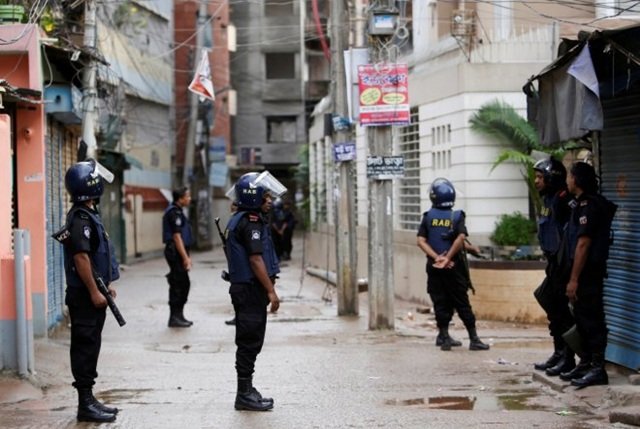
On August 16, 2026, Juel Bhuiyan, 26, a suspected associate of the Neo-Jama’atul Mujahideen Bangladesh (Neo-JMB) operative Nazmul Hasan Mamun, alias Bomaru Mamun, was arrested at Demra in Dhaka, in possession of two handmade bombs.
On August 12, 2026, a pressure cooker wrapped in black tape and found in an open field beside a mosque in Savar in Dhaka was identified as a powerful bomb and later defused. A loud blast shook the area as the bomb was neutralised, triggering panic among residents. Later, Neo-JMB’s involvement was confirmed in the incident.
On August 11, 2026, Mohammad Arif, a Neo-JMB operative, was arrested from Hemayetpur in Savar, Dhaka. The investigation officer, Inspector Noor Mohammad of Savar Model Police Station, stated in the remand application that the accused had met at that location in collusion with each other, to carry out anti-state and terrorist activities and to create an unstable environment in Bangladesh.
On July 31, 2026, Police recovered a bomb concealed inside a pressure cooker and wrapped in black adhesive tape from a locked bag left outside a grocery shop in Ashulia in Dhaka. Locals spotted the unattended bag on a bench outside Joyi General Store in the Khejur Bagan area on July 30, 2026. Neo-JMB was involved in this incident as well.
On May 14, 2026, Police arrested a former Army soldier, Mohammad Raheed Hossain Mahed, who was inspired by Neo-JMB ideology, in an operation in the Islamnagar area of the Shahjadpur Union of Baralekha Police Station in the Baralekha Upazila (Sub-District) of Moulvibazar District.
On February 1, 2026, the Counter Terrorism and Transnational Crime (CTTC) unit arrested Ahsan Zahir Khan (50), a Neo-JMB operative from the Sher-e-Bangla Nagar area of Dhaka. Khan and his fugitive associates, inspired by Neo-JMB ideology, gathered at the scene to plan and attempt sabotage activities aimed at damaging state property. Khan and his associates used to communicate with each other under different pseudonyms through online platforms such as Facebook, Messenger, WhatsApp, Telegram and various other apps, using group chats, private chats and channels.
Neo-JMB which emerged in 2014, is an offshoot of the banned militant Jama’atul Mujahideen Bangladesh (JMB). Neo-JMB was formed by leaders and operatives of mainstream JMB who did not accept the leadership of Saidur Rahman, and followed the considerably more radicalised ideology of the Islamic State (IS). Founded in 1998, JMB had previously announced its presence through coordinated bomb explosions in 63 of Bangladesh’s 64 districts on August 17, 2005. Neo-JMB, however,came to prominence after claiming responsibility for the July 1, 2016, Holey Artisan Bakery attack in Dhaka’s Gulshan area, in which 20 hostages, including 17 foreigners, were killed. Neo-JMB’s leadership subsequently evolved, with Abul Abbas Al Bangali aka Mahadi Hasan Jon aka Mohammad Kamrul Hasan, serving as the network’s self-appointed Chief, as well as of the IS network in Bangladesh from September 2020, until his arrest in Turkey in 2023, reportedly based on intelligence from Bangladesh’s Counter Terrorism and Transnational Crime (CTTC) unit. According to an intelligence report, Maulana Abu Bakar, who reportedly spent time in Afghanistan and was previously involved with Harkat-ul-Jihad-al Islami Bangladesh (HuJI-B), later assumed leadership and is believed to be hiding somewhere in the Middle East. Significantly, CTTC officials revealed on July 6, 2021, that Neo-JMB, inspired by IS, had established a 20-member committee comprising members of its ‘military wing’, naming the committee ‘Islamic State of Bengal Province.’
Since the Holey Artisan Bakery attack, Security Forces (SFs) have killed a total of 47 Neo-JMB terrorists, including almost all the top leaders (data till August 23, 2026). Prominent among those killed were: Tamim Ahmed Chowdhury, the then ‘chief’ of Neo-JMB and ‘mastermind’ of the Gulshan attack (August 26, 2016); Murad aka Jahangir Alam aka Omar, its then ‘military commander’ (September 2, 2016); Nazmul Haque aka Abdur Rahman, its then ‘financier’ (October 8, 2016); Nurul Islam Marzan, the then ‘deputy chief’ (January 6, 2017); Aminur Islam aka Alam (23), its then ‘military chief’ (March 2, 2017).
According to partial data collated by the Institute for Conflict Management (ICM), at least five persons have been arrested linked to Neo-JMB in the current year (data till August 23, 2026). Significantly, in 2025 and 2024, no arrests linked to Neo-JMB were made.
- December 26, 2025: an explosion occurred at Al Qura Madrasah in Dakshin Keraniganj, Dhaka.
- February 1, 2026: Joint forces conducted an operation at the residence of the personal driver of Hafiz Khalid Ibrahim, a top-tier Neo-JMB leader, in Bagharpara, Jashore. The forces seized 10 powerful grenades, three foreign pistols, 19 rounds of pistol ammunition, one machete, one knife, and one razor.
- February 21, 2026: terrorists attacked a Police check-post in the Kutubkhali area of Jatrabari in Dhaka.
- March 7, 2026: bomb attack on a temple in Cumilla.
- March 12, 2026: the hacking to death of a member of a minority community in Feni.
- March 25, 2026: a pipe bomb exploded during a search at Janapad Mor in Jatrabari, Dhaka.
- 22 June, 2026: bomb attack on officials of a state intelligence agency at Dakshinkhan, Uttara, Dhaka.
- 24 July, 2026: recovery of a bomb concealed inside an umbrella beneath the Motijheel Metro Rail Station, Dhaka.
- 30 July, 2026: recovery of a pressure cooker bomb from a grocery shop in the Ashulia area in Dhaka.
- August 11, 2026, Mohammad Arif, a Neo-JMB operative, arrested from Hemayetpur in Savar, Dhaka.
- August 12, 2026: a pressure cooker bomb wrapped in black tape was found in an open field next to a mosque at Savar in Dhaka.
Arif’s arrest from Hemayetpur in Savar, in possession of several arms and ammunition, including five GI-pipe bombs, three knife-like bombs and bomb-making materials, is significant. During interrogation investigators discovered that the bombs used tri-acetone triperoxide (TATP), a highly sensitive explosive that can detonate through heat, friction, impact or movement. Arif reportedly told investigators that the group used the Protected Text or PT website for communication and the Element app for financial transactions. According to an unnamed CTTC source, Arif and other suspects involved in recent incidents, displayed similar movement patterns, typically carrying backpacks containing bombs, weapons, knives and machetes, and attacking security personnel when searched before fleeing. Investigators believe a five-member group including Mamun aka Bomaru Mamun, Sheikh Al Amin, Mohammad Arif, Rakib and Bappi, was involved in multiple incidents, with fugitive Mamun leading this specific Neo-JMB group. The case recorded against Arif states, “Different types of liquid chemicals, chemical powder, potassium nitrate, cotton buds mixed with gunpowder, electrical wires, detonators, remotes and controllers, pipe bomb debris, various equipment and several books related to a holy war were recovered from Arif’s rented house in South Shyampur.” The developments indicate that the Neo-JMB network may have shifted towards producing remote-controlled and more sophisticated explosive devices.
Neo-JMB operatives represent a concerning demographic, which includes former Army personnel, youngsters, and even minors who are getting easily radicalised by the group’s ideology. In one case, on April 2, 2026, a 16-year-old boy from Habiganj Sadar Upazila was arrested. The boy (identity withheld) had been in regular contact with two dismissed Army personnel. The CTTC unit, after seizing his phone, discovered evidence of his ties with Neo-JMB and his presence at the clandestine meeting at Zia Udyan. Court documents described the boy as “an IS-ideology follower/Neo-JMB member”. Further, the Police Headquarters alert attached profiles of two suspected planners, Mohammad Raheed Hossain Mahed (later arrested) from Sylhet and Rakib Hasan aka Ubaida Al Usama from Savar, describing them as an extreme risk for the overall security of Bangladesh.
A report released on June 30, 2024, revealed potential plans to bring all Neo-JMB operatives under a single platform, form separate cells under a chain of command, and reduce the gap with other Islamist groups. Rahmat Ullah Choudhury, Deputy Commissioner at the CTTC unit, observed, “There is a very thin line between the Islamist terrorist outfits like Neo-JMB or Ansar Al Islam ABT and the so-called Islamist parties. The ideological spectrum of all Islamist parties overlaps and they may come to a common platform in the near future.”
Recent incidents and developments clearly cannot be ignored, and prevention and counter-radicalisation efforts will be necessary to prevent a terrorist network from developing into a major renewed threat. This is particularly urgent in light of a July 1, 2026, report, which revealed that at least 311 operatives of various banned militant organisations remained absconding, including 16 Neo-JMB cadres, 185 JMB cadres, 83 cadres of Ansar Al Islam, 16 cadres of HuJI-B, nine cadres of Allahar Dal, one cadre of Jama’atul Ansar Fil Hindal Sharqiya (JAFHS), and one member of Imam Mahmuder Kafela, according to the Police’s specialised Anti-Terrorism Unit (ATU) (data updated till April 2026). The overlap of terrorist networks and an alarming demography of extremists and terrorists, adds multiple dimensions to an escalating threat in Bangladesh.