by Luxman
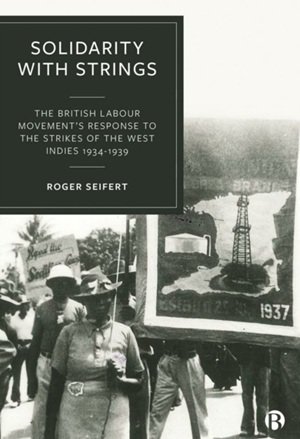
Roger Seifert’s Solidarity with Strings is an ambitious and uncompromising intervention into the historiography of British labour and its entanglements with colonial struggles in the Caribbean. At once a work of meticulous archival scholarship and a sharp theoretical critique, the book confronts the uneasy realities of solidarity between metropolitan and colonial workers, interrogating the limitations of moral rhetoric when confronted with structural inequalities and imperial hierarchies. From its opening pages, Seifert situates the reader within a historical and ideological framework that is uncompromising in its assessment of empire: “To ravage, to slaughter, to usurp under false titles, they call empire; and where they make a desert, they call it peace” (p. 12). This searing statement not only foregrounds the moral and material violence of imperialism but also signals the book’s insistence that labour activism cannot be separated from the broader systems of domination it seeks to contest.
The central thesis of the book is that solidarity, while rhetorically invoked, was often conditional, mediated by institutional constraints and ideological priorities within the British labour movement. Seifert argues that “the solidarity exhibited varied from unequivocal support shown by the communist group to solidarity with strings from the majority mainstream of the labour movement in which help was contingent on accepting a British model of industrial relations and decoupling industrial from political demands and struggles” (p. 14). This formulation challenges conventional celebratory narratives of British trade unionism and forces a critical reconsideration of what ‘solidarity’ meant in practice. While metropolitan activists may have claimed moral alignment with colonial workers, Seifert insists that their engagement was often partial, selective, and subordinated to domestic political calculations: “The British activists did not join picket lines, they were not involved in the riots and demonstrations, and they did not enter into direct action on behalf of their Caribbean comrades. But they did have a significant impact on events and outcomes” (pp. 13-14). Such tensions between symbolic and practical support form the conceptual spine of the book and illuminate broader questions about the efficacy of transnational labour solidarity under conditions of empire.
Seifert situates these debates within a sophisticated theoretical framework informed by Marxist political economy. He observes that “class for Marxists is primarily defined in terms of one’s place in the economic system—an owner of land receives rent; an owner of capital receives profits/dividends; and an owner of one’s own labour… sold as a quantity and quality of labour time/skill in a market receives wages as income. This latter group constitute the working-class” (p. 32). Such clarity allows him to explore the intersections of class, race, and imperialism with precision. Indeed, the book makes a compelling intervention in debates on the racialisation of labour, insisting that “slavery in the Caribbean has been too narrowly identified with the Negro. A racial twist has thereby been given to what is basically an economic phenomenon. Slavery was not born of racism: rather, racism was the consequence of slavery” (pp. 30-31). By reframing racism as a structural outcome of exploitative economic systems, Seifert underscores the contingency of racial hierarchies and the ways in which economic imperatives underpinned colonial violence and labour exploitation.
The historical narrative of the book is anchored in detailed case studies of Caribbean labour unrest, particularly the strike waves of the 1930s. Seifert situates these events within the global economic context, noting that “a full history of the collapse of the international sugar market in the 1930s with its global and local repercussions has yet to be written… throughout the Caribbean region, hunger rapidly eroded the already contested legitimacy of colonial rule in the 1930s” (p. 60). By foregrounding economic precarity as a driver of political action, Seifert avoids romanticising resistance, emphasising instead the structural pressures that catalysed collective mobilisation. The book is equally attentive to the brutal repression these movements faced: “The police drove the strikers back with fixed bayonets and … fired on the crowd, killing four and four others were admitted to hospital with bullet wounds. In all twenty-three were injured” (p. 95). Such detailed reporting conveys both the human cost of colonial labour struggles and the persistence of systemic violence, offering a sobering corrective to narratives that centre only political achievements.
A provocative and controversial claim within the book concerns the moral ambivalence and institutional limitations of the British labour movement itself. Seifert notes that “during these years mainstream labourism in Britain remained officially anti-communist, and this hampered both the fight at home and solidarity with colonial workers in their struggles” (p. 26), while also highlighting the conditional nature of support: “The British labour movement did respond, did support in practical ways the struggles, but the mainstream social democrats always wanted to maintain control over the reform process to keep the communists at bay. In the end their solidarity was conditional on acceptance of British-style trade unionism and collective bargaining within a colonial setting and therefore came with strings attached” (p. 215). These insights challenge the reader to grapple with the moral compromises of progressive institutions and the ways in which ideological fear can constrain radical solidarity, a theme that resonates with contemporary debates on global labour politics and postcolonial responsibility.
Seifert’s account of the interplay between empire, economics, and labour activism is reinforced by a nuanced attention to ideology and intellectual history. For instance, the book traces the intersections of racial and class consciousness through organisations such as the League of Coloured Peoples: “Lewis’s insight, that metropolitan and colonial racial discrimination intersected and overlapped … [allowed] his further recommendation to the League, that they ‘watch very closely events abroad’ … emphasizing that the ultimate task was ‘the destruction of colour prejudice in this country’” (p. 38). Such analyses demonstrate how ideas of equality, solidarity, and anti-racism were operationalised unevenly, reflecting both political constraints and genuine strategic engagement. Similarly, Seifert engages critically with the broader British political landscape, noting that “the British Labour Party, along with its backers in the trade unions and supporters among the intellectuals in the Fabian Society, wanted capitalism to remain but be radically reformed to serve more of the people at home and in the colonies. In contrast the communist groups wanted a revolution to end capitalism and its overseas arm, imperialism, and replace it root and branch with a socialist society designed to deliver a better life for all peoples” (p. 197). This juxtaposition elucidates the ideological fault lines that shaped the limits of solidarity, illustrating how strategic moderation can simultaneously enable reform and constrain justice.
The book’s narrative strategy combines archival detail with theoretical reflection, producing a text that is at once empirically grounded and intellectually provocative. Seifert demonstrates the interconnectedness of global and local processes, noting that “Sections of British manufacturing, especially in the North West of England, were interlinked with the West Indian economies, and therefore the British workers’ lives were intertwined with those of the slaves and ‘free’ labourers in the colonies” (p. 59). By highlighting these transnational entanglements, the book challenges readers to recognise the structural interdependencies that underpin labour markets, empire, and capitalist production. Furthermore, Seifert attends to the symbolic and rhetorical dimensions of struggle, emphasising the enduring moral and political significance of collective action: “Solidarity itself was always the watchword of any mass movement in which the powerless majority seek to overthrow the ruling minority” (p. 20).
Despite its many strengths, the book also raises questions about the balance between narrative exposition and theoretical engagement. While Seifert’s analyses are often incisive, some readers may find the frequent reiteration of Marxist principles and the dense historiographical interjections demanding. However, these sections are integral to his argument, reinforcing the central claim that economic structures, class consciousness, and imperial hierarchies cannot be disentangled in any account of transnational solidarity. The book’s provocative, occasionally confrontational tone is part of its strength, compelling readers to confront uncomfortable truths about complicity, partiality, and the limits of moral action within institutionalised labour movements.
Solidarity with Strings is a compelling, ambitious, and intellectually rigorous study that reshapes our understanding of British labour solidarity with colonial struggles. Seifert’s work is unflinching in its critique of conditional support, colonial violence, and ideological compromise, yet attentive to the real achievements of workers’ mobilisation and strategic engagement. His insistence on connecting race, class, and imperial structures produces a nuanced and theoretically robust account, challenging celebratory narratives of labour activism while acknowledging the human courage and organisational skill of those involved. As he observes, “But hope, not despair, emerged from the murder of unarmed working-class protestors, and famously formulated real resistance… Ye are many—they are few” (p. 215). The book ultimately affirms the enduring significance of solidarity, even when imperfect, conditional, or contested, and provides a necessary corrective to both historical amnesia and contemporary complacency in the study of transnational labour and postcolonial struggle.