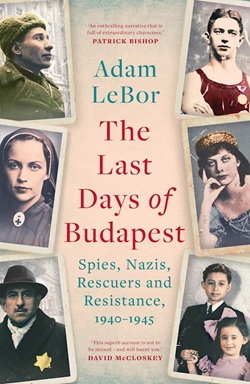
Adam LeBor’s The Last Days of Budapest: Spies, Nazis, Rescuers and Resistance is an evocative and unflinching examination of one of history’s most tumultuous moments, a harrowing narrative set against the crumbling backdrop of wartime Hungary. This book does not merely recount historical events but immerses readers in the labyrinthine world of intrigue, betrayal, and human resilience that defined Budapest during the Second World War. LeBor achieves a masterstroke of historiography by blending meticulous research with a novelist’s eye for detail, creating a work that is both gripping and deeply unsettling.
The City as a Character
Budapest emerges in LeBor’s narrative as a living, breathing entity, a city of stunning beauty and profound contradictions. “The Danube, glistening like liquid silver under moonlight, bore silent witness to unspeakable atrocities,” he writes (p. 29), capturing the tragic irony of a city celebrated for its elegance yet scarred by violence and bloodshed. This juxtaposition of grandeur and decay permeates the book, underscoring the fragility of civilisation in the face of unchecked hatred.
LeBor’s Budapest is more than a setting; it is a battleground of ideologies and a crucible of human drama. From the aristocratic salons of Buda to the grim ghettos of Pest, the city’s geography reflects its fractured soul. This duality is exemplified by the Chain Bridge, a symbol of unity that becomes a site of desperate crossings and grim separations as war tightens its grip.
Espionage and Subterfuge: A Web of Intrigue
At its heart, The Last Days of Budapest is a tale of espionage and resistance, a kaleidoscope of shadowy figures whose loyalties shift as rapidly as the tides of war. LeBor introduces readers to an unforgettable cast of characters, from aristocratic spies to double agents, each navigating the perilous terrain of wartime Hungary.
One standout is Countess Klára Andrassy, a beguiling socialite whose charm conceals a steely resolve and a clandestine network of resistance operatives. Her interactions with the enigmatic German intelligence officer Klaus von Waldenberg crackle with tension. “In Klára’s gaze, Klaus saw both an invitation and a warning,” LeBor observes, “a reminder that beauty could be as lethal as any weapon” (p. 142). This interplay of seduction and strategy exemplifies the high stakes and moral ambiguity that define the world of wartime espionage.
LeBor’s depiction of the Arrow Cross, Hungary’s fascist militia, is equally vivid and chilling. He describes their brutality with unsparing detail, painting a portrait of men transformed into instruments of terror. “Their zeal was matched only by their cruelty,” he writes, “meting out death with the efficiency of bureaucrats stamping forms” (p. 193). This unflinching portrayal forces readers to confront the banality of evil in its most visceral form.
Heroes, Villains, and the Grey In-Between
One of LeBor’s greatest achievements is his refusal to reduce his characters to simplistic archetypes of heroism or villainy. Instead, he delves into their complexities, exploring the motivations and moral compromises that define their actions.
For example, István Kovács, a Hungarian diplomat who facilitates the escape of Jewish families, is driven as much by personal guilt as by altruism. “He did not act out of heroism,” LeBor notes, “but from a desire to atone for his complicity in a regime that had betrayed its own people” (p. 217). This nuanced characterization challenges readers to grapple with the ethical dilemmas of resistance and complicity.
Similarly, LeBor portrays Adolf Eichmann, the architect of Hungary’s Final Solution, with chilling precision. Eichmann’s meticulousness and detachment make him a figure of terrifying banality. “To Eichmann, every deportation was a triumph of logistics,” LeBor writes, “a puzzle solved, a train filled, a quota met” (p. 251). This depiction serves as a grim reminder of how ordinary men can perpetrate extraordinary evil.
The Siege of Budapest: A City in Ruins
LeBor’s account of the siege of Budapest is nothing short of masterful. He captures the visceral horror of a city under assault, its streets transformed into battlegrounds and its people reduced to mere shadows of their former selves. “The air reeked of death and desperation,” he writes, “a miasma that seeped into the very stones of the city” (p. 298).
The siege is depicted not only as a military catastrophe but as a human tragedy. LeBor recounts harrowing stories of starvation, betrayal, and unimaginable cruelty, interspersed with moments of unexpected kindness and resilience. One particularly poignant episode involves a group of Jewish children sheltered in a Red Cross safe house. “In their laughter,” LeBor observes, “was a defiance more profound than any weapon” (p. 315). These moments of humanity amidst the carnage serve as a testament to the indomitable spirit of those who refused to surrender to despair.
The Cost of Survival
LeBor’s narrative does not shy away from exploring the moral compromises required for survival. He recounts the harrowing choices faced by Budapest’s inhabitants, from collaborating with occupying forces to betraying friends and neighbors. “Survival,” he writes, “often demanded a surrender of the soul” (p. 334).
This exploration of moral ambiguity is particularly evident in his portrayal of Miklós Horthy, Hungary’s leader during much of the war. LeBor paints Horthy as a figure torn between pragmatism and principle, a man whose efforts to navigate the treacherous waters of wartime politics ultimately led to his downfall. “Horthy’s tragedy,” LeBor writes, “was that he sought to appease forces that could not be appeased” (p. 356).
A Timely Warning
While The Last Days of Budapest is firmly rooted in the past, its themes resonate with unsettling relevance. LeBor’s exploration of authoritarianism, nationalism, and the fragility of democratic institutions serves as a stark warning for contemporary readers. “History,” he writes, “is never a distant echo but a mirror, reflecting the choices we make and the paths we take” (p. 382).
This warning is particularly poignant in an era marked by the resurgence of authoritarian regimes and the erosion of democratic norms. LeBor’s narrative challenges readers to confront the consequences of complicity and complacency, reminding us that the atrocities of the past can all too easily be repeated.
Conclusion: A Profoundly Human History
The Last Days of Budapest is a work of extraordinary power and resonance, a book that captures the complexities of a city and a people caught in the maelstrom of history. LeBor’s prose is both lyrical and unflinching, his storytelling as compelling as it is sobering. This is not merely a book about the past; it is a meditation on the human condition, a study of resilience, betrayal, and the indomitable spirit of resistance.
For those who seek a deeper understanding of the Second World War and its enduring legacy, The Last Days of Budapest is an essential read. It is a book that will haunt you, challenge you, and ultimately inspire you to reflect on the choices that define us as individuals and as societies. As LeBor so eloquently puts it, “In the darkest of times, even the faintest flicker of humanity can illuminate the path forward” (p. 401).