Jack El-Hai’s The Nazi and the Psychiatrist offers a perspicuous and disquieting exploration of the psychological interplay between Dr. Douglas M. Kelley, a US Army psychiatrist, and Hermann Göring, a preeminent Nazi leader, during the Nuremberg Trials. This meticulously researched narrative, suffused with intellectual rigour, probes the enigmatic nexus of morality, sanity, and criminality. El-Hai’s work is both a historical exegesis and a philosophical inquiry, challenging readers to contemplate whether the architects of atrocities possess a distinct psychological profile or merely reflect the latent potential for evil within the human condition. The book’s provocative thesis—that the Nazi leaders were not inherently aberrant but rather products of universal human traits—ignites a contentious debate, underscored by a wealth of primary source quotations that lend authenticity and depth.
El-Hai’s narrative commences with Göring’s capture, vividly capturing his initial defiance: “Das gut,” he shrugs, unable to fasten the restraint in a Piper L-4, a gesture emblematic of his cavalier bravado (p. 16). This sets the stage for Kelley’s entrance at Mondorf-les-Bains, where he encounters a Göring who is “funny, charismatic, well mannered, and cultured” (p. 65). El-Hai deftly juxtaposes Göring’s charisma with his monstrous deeds, noting his deep involvement in “Nazi Germany’s worst crimes,” as US prosecutor Robert Jackson declared, “The podgy fingers of this fat man were in every pie” (p. 23). Kelley’s fascination with Göring’s psyche is palpable, as he observes, “He claims to have a normal sexual life” (p. 28), revealing Göring’s attempt to project normalcy despite his addiction to “tens of thousands of paracodeine tablets” (p. 31). This duality—Göring’s charm and his moral turpitude—forms the crux of El-Hai’s exploration, raising unsettling questions about the banality of evil.
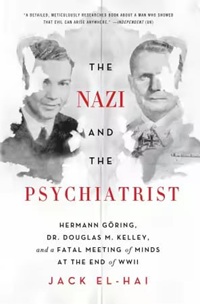
The book’s intellectual heft is amplified by Kelley’s use of the Rorschach test, which he believed held “historical value” in deciphering the Nazi mind (p. 97). Göring’s animated engagement with the inkblots, seeing “a spook with a fat stomach” in Card IX (p. 158), contrasts with his calculated responses, suggesting a performative sanity. El-Hai critiques Kelley’s conclusion that the Nazis exhibited no “distinctive ‘Nazi mind’” (p. 219), a view that aligns with his broader assertion: “They are not unique people… They exist in many places” (p. 171). This perspective is controversial, as it implies that the capacity for atrocities resides within ordinary individuals, a notion El-Hai supports with Kelley’s observation that Nazi traits “ranged from furthering the spread of Nazism to achieving personal power and glory” (p. 167). Such a stance invites scrutiny, as it risks diluting the specificity of Nazi ideology, yet it compels readers to confront uncomfortable truths about human nature.
El-Hai’s portrayal of Kelley is equally compelling, revealing a man whose brilliance is marred by personal turmoil. Kelley’s own psychological descent, culminating in his suicide by cyanide—mirroring Göring’s act—casts a shadow over his findings. “I practiced IQ tests all the time,” his son Doug recalls, hinting at Kelley’s obsessive nature (p. 205). El-Hai suggests that Kelley’s immersion in the Nazi psyche, particularly Göring’s, may have precipitated his unraveling: “The strain of overwork” and “tele-empathy” with his subjects left him vulnerable (p. 208, 205). This parallel between Kelley and Göring—both charismatic, both undone by cyanide—lends the narrative a tragic symmetry, prompting questions about the psychological toll of studying evil.
The book’s strength lies in its granular detail, drawn from Kelley’s personal papers and interviews with his son. Göring’s letter to his daughter Edda, “Dearest daddy, come back to me soon. I am longing for you so much” (p. 81), humanises the Reichsmarschall, complicating the reader’s moral judgement. Similarly, Kelley’s note quoting Psalms, “He caused an east wind to blow in the heaven” (p. 153), reflects his attempt to find meaning in chaos. However, El-Hai’s reliance on Kelley’s perspective occasionally skews the narrative, marginalising other voices, such as Gustave Gilbert’s, who argued for a more pathologised view of the Nazis. Gilbert’s The Psychology of Dictatorship is dismissed as less rigorous, yet El-Hai acknowledges its influence (p. 210). This selective focus can feel tendentious, as it prioritises Kelley’s universalist thesis over competing interpretations.
Controversially, El-Hai’s work challenges the notion of Nazi exceptionalism, aligning with Kelley’s view that “Americans needed to look closer to home” for potential demagogues (p. 172). This assertion, while thought-provoking, risks relativising the Holocaust’s unique horror. El-Hai’s inclusion of Kelley’s warning—“The Nazis rose to power in Germany partly because of their nation’s cultural training” (p. 171)—suggests a cultural specificity that he does not fully unpack, leaving readers to grapple with the tension between universal and particularist explanations. The book’s academic tone, enriched by esoteric terms like “tele-empathy” and “narcissistic grandiosity,” elevates its discourse but may alienate lay readers, a minor flaw in an otherwise incisive text.
The Nazi and the Psychiatrist is a tour de force that marries historical narrative with psychological inquiry. El-Hai’s liberal use of quotes, from Göring’s stoic “So it has come” upon receiving his indictment (p. 101) to Kelley’s chilling epitaph for the Nazis, “the type of mentality with which they are endowed” (p. 148), grounds the work in primary evidence. Its controversial assertion that Nazi evil is not anomalous but latent within humanity demands reflection, even as it courts debate. By intertwining Kelley’s and Göring’s fates, El-Hai crafts a narrative that is both erudite, and profoundly unsettling, urging readers to question the boundaries of sanity and morality.