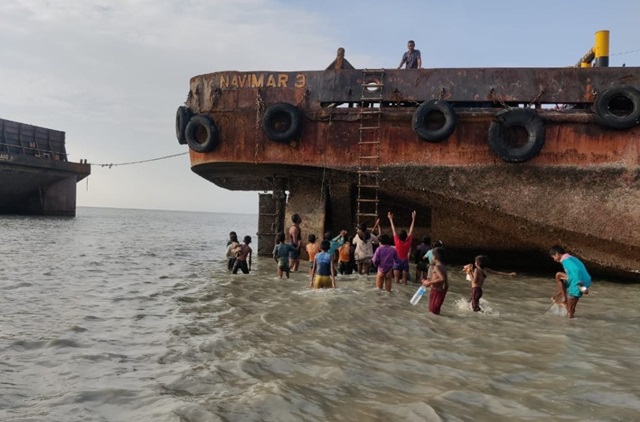
A tugboat, the Navimar 3, has been anchored off Kutubdia Island, situated thirty-three nautical miles south of Chittagong, Bangladesh, since March of last year. Its crew of seven, including an Indian engineer officer, has been stranded aboard, with no means of returning home. The engineer, who has maintained the vessel throughout this prolonged abandonment, has had his passport and professional certification documents withheld by a local agent for Middle East Marine (MEM), a Dubai-based shipping company. He has not received wages for the past 14 months and is unable to disembark due to the lack of a visa. According to The Times, UK, this case is part of a growing crisis of seafarer abandonment in the global maritime industry, which has seen an increase in reported incidents this year, with the International Transport Workers’ Federation (ITF) identifying between 250 and 300 cases in 2024—nearly double the number reported in 2023.
Abandonment cases such as this one are becoming more frequent in the maritime industry. These cases involve crews stranded on various types of vessels, including container ships, tankers, and bulk carriers, across ports and anchorages worldwide. However, there has been a concerning rise in the Middle East, where MEM’s practices have come under particular scrutiny. The Times, UK reports that MEM has been repeatedly accused of abandoning its vessels and leaving crews without pay or support.
The Navimar 3 was arrested in Bangladesh after unloading a cargo of stone boulders. The crew was informed that their next destination would be across the Bay of Bengal to Thoothukudi. However, the vessel was stranded after being seized due to MEM’s unpaid debts. As reported by The Times, UK, the ship has remained anchored in Bangladesh for more than a year. Sandra Bernal, the ITF’s regional flag of convenience coordinator, describes these anchorages as “car parks at sea” and works to address abandonment issues by engaging with port authorities, insurers, and shipping companies.
This is not MEM’s first incident of abandoning a vessel. In May 2024, the ITF described the case of the Navimar 3 as “the worst case of serial seafarer abandonment ever seen.” The crew members were replaced in an effort to resolve the issue, only for the new seafarers to suffer the same fate of unpaid wages and neglect. The Times, UK highlights that the most recent crew members aboard, all from Myanmar, are enduring the same dire circumstances. The Indian engineer officer, who has been onboard since the vessel’s first abandonment, has described his life aboard as one of isolation and extreme hardship. With no shore leave and severe weather conditions, he is forced to manage the engine room on his own. He survives on a meager diet and struggles with a lack of sleep, while his family in India has borrowed money to help pay for his phone bills, which remain his only link to the outside world.
MEM, a company with minimal public exposure, has also been linked to other abandonment cases, including one involving the Oceanlec 263, which was left stranded near a private island in the Maldives. As reported by The Times, UK, the ITF has stepped in to provide emergency provisions and facilitate the repatriation of the abandoned crews. The Navimar 3 is operated by MEM under a bareboat charter agreement, which allows the company to lease the vessel without engaging with the crew or cargo directly. The beneficial owner of the vessel is AD Ports Group, a state-owned enterprise based in Abu Dhabi. Despite multiple communications between AD Ports and the ITF regarding MEM’s practices, no significant progress has been made in resolving the issue.
In cases of abandonment, the flag state of the vessel, which in the case of the Navimar 3 is Palau, is primarily responsible for repatriating the crew. However, as reported by The Times, UK, Palau has been criticized for its unresponsiveness and failure to address abandonment issues. The Palau International Ship Registry, headquartered in Greece, claims that it actively monitors abandonment cases under its registry but has done little to intervene in this instance. This lack of action has sparked growing concerns about the flag of convenience system, where ships are registered under the flags of countries like Palau or Panama, which may never even be visited by the vessel. According to The Times, UK, the flag of convenience system has been increasingly criticized for enabling such abandonment cases and allowing unscrupulous companies to avoid proper oversight and responsibility.